
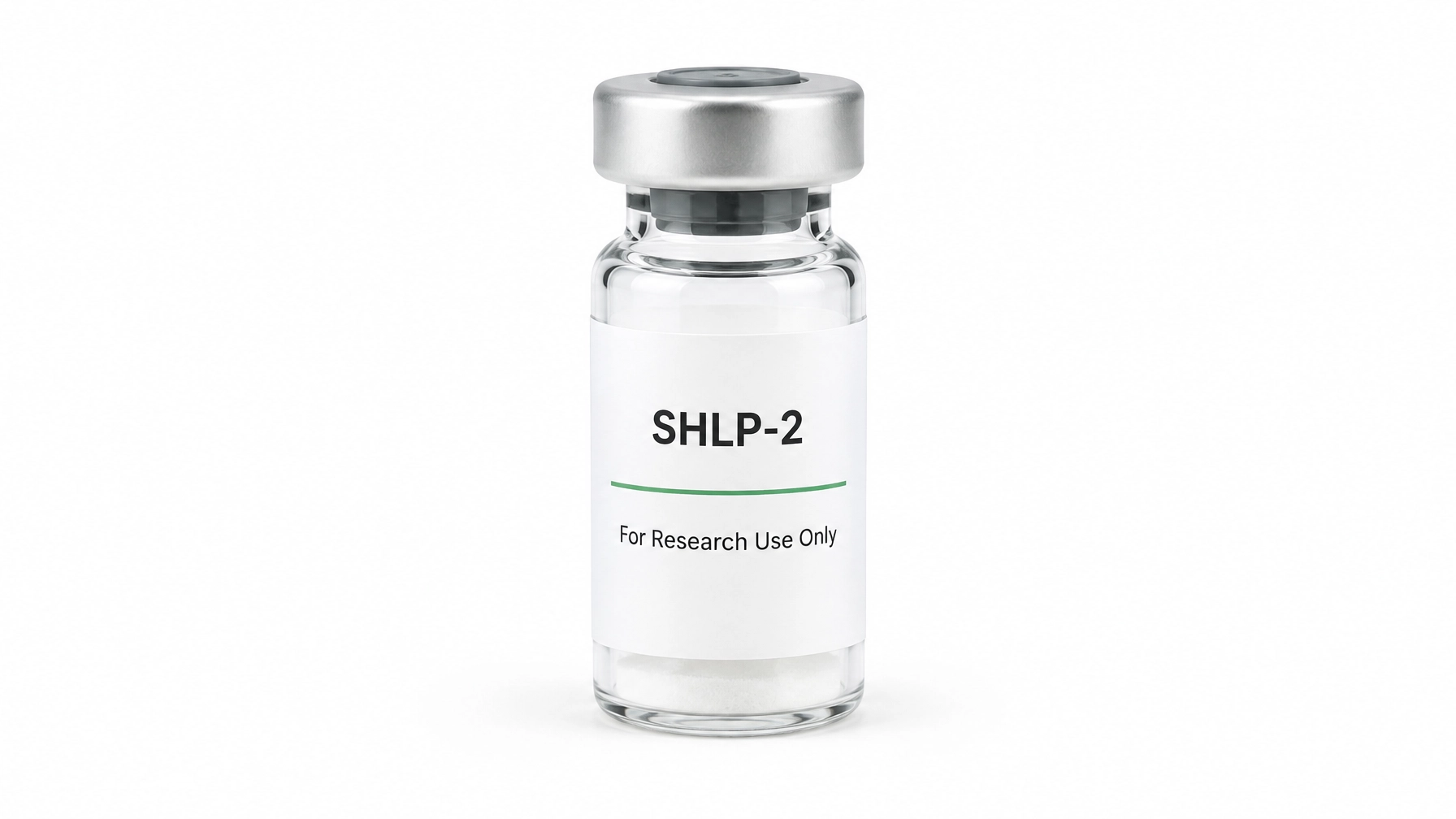
SHLP-2: The Humanin-Like Peptide for Neuroprotection and Metabolic Health Research

Small humanin-like peptide 2, commonly called SHLP-2, is one of the most closely studied peptides in the SHLP family. It has attracted research interest because it connects two major areas of biology: mitochondrial stress protection and metabolic regulation.
Researchers are investigating SHLP-2 in relation to neuronal survival, insulin sensitivity, glucose handling, energy balance, oxidative stress and age-related decline. The findings are promising, but they remain primarily preclinical. That means most evidence comes from cells and animal models rather than controlled human treatment trials.
This article explains what SHLP-2 is, how it relates to humanin, and why it has become an important research tool.
Research-use notice: SHLP-2 is not an approved medicine, diabetes treatment, weight-loss treatment or anti-ageing therapy. This article is educational and must not be used to guide self-treatment or personal peptide administration.
What is SHLP-2?
The problem: mitochondrial biology is more complex than an “energy factory”
Mitochondria are often described as the cell’s power stations. That analogy is useful, but incomplete. A modern power station also sends signals, responds to faults and helps coordinate the wider electricity grid.
Mitochondria do something similar. They produce energy, regulate stress responses and communicate with the rest of the cell. They also contain their own small circular genome, known as mitochondrial DNA, or mtDNA.
Researchers discovered that mtDNA contains short open reading frames. Small genetic sections capable of producing tiny proteins or peptides. These are called mitochondria-derived peptides, or MDPs.
SHLP-2 is one of six small humanin-like peptides, named SHLP-1 through SHLP-6. The family is encoded within the 16S ribosomal RNA region of mitochondrial DNA.

The research opportunity: a small peptide with system-wide signals
SHLP-2 is a short peptide, but its proposed actions reach beyond the mitochondria. Research has examined whether it can influence:
- Cell survival and apoptosis, the programmed removal of damaged cells
- Reactive oxygen species, or ROS, which are chemically reactive molecules produced during metabolism
- Mitochondrial metabolism and oxidative phosphorylation
- Insulin signalling and glucose disposal
- Hypothalamic control of appetite and energy expenditure
- Amyloid-related cellular stress
- Age-associated changes in circulating mitochondrial peptides
Think of SHLP-2 as a possible message sent from the cell’s power station to the rest of the biological “building”. The message may say: reduce unnecessary damage, improve fuel handling and adapt to stress.
The important word is possible. These mechanisms are still being tested.
Why has SHLP-2 received the most attention of the six SHLPs?
The problem: the six SHLPs are often grouped together
Because SHLP-1 through SHLP-6 share a family name, it is easy to assume they have identical effects. They do not.
Each peptide has its own sequence, structure and biological activity. Some have received limited investigation, while SHLP-2 has been examined across several connected research areas.
The solution: follow the strongest evidence base
SHLP-2 has drawn the most attention because researchers have identified several lines of evidence:
- Cell studies have examined mitochondrial protection, oxidative stress and amyloid-related toxicity.
- Retinal research has investigated SHLP-2 in models relevant to age-related macular degeneration.
- Animal studies have reported effects on insulin sensitivity, glucose tolerance, appetite and thermogenesis.
- Human observational studies have measured circulating SHLP-2 in relation to age, obesity and diabetes.
- Mechanistic work has proposed a receptor pathway involving CXCR7 and ERK signalling in mouse models.
A 2023 Nature Communications study was particularly influential because it linked SHLP-2 to hypothalamic neurons involved in energy balance. In male mice, systemic and intracerebroventricular administration was associated with lower food intake, increased thermogenesis and improved insulin sensitivity.
That does not prove the same results occur in humans. It does explain why SHLP-2 currently stands out among the six SHLPs.
Short version: SHLP-2 has the broadest and most connected preclinical research profile in the SHLP family.
SHLP-2 and neuroprotection research
The problem: neurons are highly dependent on reliable energy production
The brain uses substantial energy and depends heavily on healthy mitochondrial function. When mitochondria struggle, neurons may become more vulnerable to oxidative stress, inflammation and programmed cell death.
In this analogy, neurons are like a high-performance communications network. If the power supply becomes unstable, messages may slow down, connections may weaken and individual components may become damaged.
The proposed solution: improve cellular resilience under stress
Research has investigated SHLP-2 in several neuroprotective settings:
- Amyloid-beta toxicity: SHLP-2 has protected neuronal cells from amyloid-beta-induced cell death in laboratory models.
- Oxidative stress: SHLP-2 has been associated with lower ROS and improved cellular survival in stressed cells.
- Retinal mitochondrial function: In retinal pigment epithelium models, SHLP-2 helped preserve mitochondrial activity and oxidative phosphorylation complexes.
- Apoptosis: Some studies suggest that SHLP-2 can reduce markers associated with caspase-dependent cell death.
- Chaperone-like activity: SHLP-2 has been shown to interact with islet amyloid polypeptide in laboratory work and may interfere with amyloid seeding.

These findings may be relevant to neurodegeneration and retinal ageing research. However, they do not mean SHLP-2 prevents Alzheimer’s disease, macular degeneration or cognitive decline in people.
Video placeholder 1
[Video placeholder: SHLP-2 explained, mitochondrial origin, oxidative stress and neuroprotection research]
Suggested visual: animated mitochondrion, mtDNA and a simple “cellular stress response” diagram.
SHLP-2, insulin sensitivity and glucose handling
The problem: insulin resistance disrupts the body’s fuel-management system
Insulin helps move glucose from the bloodstream into tissues that can use or store it. When cells become less responsive to insulin, the body may need more insulin to achieve the same effect.
You can think of insulin as a key and the cell as a locked warehouse. In insulin resistance, the key still exists, but the lock becomes stiff. More signalling is needed to open the door.
The proposed solution: improve signalling in the brain, liver and peripheral tissues
Preclinical research suggests SHLP-2 may influence glucose handling through more than one route.
1. Central regulation
The hypothalamus is a brain region that helps regulate appetite, energy expenditure and glucose balance. In mouse studies, SHLP-2 activated pro-opiomelanocortin, or POMC, neurons in the arcuate nucleus.
POMC neurons act like part of the body’s energy-management control room. Their activity can reduce food intake and increase energy expenditure.
The 2023 study reported that SHLP-2:
- Reduced food intake in high-fat-diet-fed mice
- Increased oxygen consumption and heat generation
- Increased markers of brown-fat thermogenesis
- Improved glucose tolerance
- Improved insulin sensitivity
- Reduced diet-induced weight gain in the experimental model
The study also identified CXCR7, a chemokine receptor, as a possible SHLP-2 receptor in the tested systems. The proposed pathway involved ERK1/2, a signalling pathway that helps transmit instructions inside cells.
2. Peripheral glucose handling
Earlier studies also examined SHLP-2 in relation to:
- Suppression of hepatic glucose production
- Increased peripheral glucose uptake
- Improved insulin-mediated signalling
- Possible effects on pancreatic and metabolic tissues
These findings suggest that SHLP-2 may operate like a coordinated sports team rather than a single player. The brain may influence appetite and energy expenditure while the liver and peripheral tissues respond by adjusting fuel use.

What you need to remember: improved glucose tolerance in mice is not the same as a proven diabetes treatment in humans.
SHLP-2 and ageing
The problem: mitochondrial signalling may change with age
Ageing is associated with changes in mitochondrial performance, oxidative stress, inflammation and metabolic flexibility. Researchers are therefore asking whether mitochondrial-derived peptides change as the body ages.
Observational research has reported relationships between circulating SHLP-2 and biological conditions such as:
- Older age
- Obesity
- Diabetes
- Metabolic dysfunction
- Some age-related disease risk markers
Several studies suggest that SHLP-2 levels decline with age in animal models. Human observational work has also reported lower SHLP-2 levels in people with obesity or diabetes compared with healthy controls.
However, a lower blood level may be a biomarker, not the cause of the condition. It is similar to seeing a warning light on a car dashboard. The light tells you that something may be wrong, but it does not prove replacing the light will repair the engine.
More research is needed to determine:
- Whether low SHLP-2 contributes to age-related decline
- Whether it is mainly a consequence of mitochondrial stress
- How levels vary between tissues and individuals
- Whether exercise, nutrition, sleep or disease treatment influence SHLP-2
- Whether SHLP-2 measurement can become a reliable clinical biomarker

For broader context, read our related articles on mitochondrial-derived peptides, SS-31 and humanin, the telomere and longevity research landscape, and tracking longevity research outcomes.
SHLP-2 and humanin: related, but not identical
Humanin was one of the first mitochondrial-derived peptides to receive serious research attention. It is also encoded in the 16S rRNA region of mtDNA and has been studied in relation to cell survival, neuroprotection, insulin action and ageing.
SHLP-2 shares some of these themes, but it is a distinct peptide.
| Feature | Humanin | SHLP-2 |
|---|---|---|
| Origin | Mitochondrial 16S rRNA region | Mitochondrial 16S rRNA region |
| Family | Mitochondria-derived peptide | One of six small humanin-like peptides |
| Main research themes | Neuroprotection, apoptosis, insulin action and healthspan | Neuroprotection, glucose handling, energy balance and mitochondrial stress |
| Metabolic focus | Insulin action and glucose regulation | Central and peripheral insulin sensitivity in preclinical models |
| Distinctive finding | Broad cytoprotective and signalling research | Hypothalamic POMC activation and proposed CXCR7 interaction |
| Clinical status | Experimental | Experimental |
The name “humanin-like” indicates a relationship in origin and some biological behaviour. It does not mean SHLP-2 is simply humanin in another form.
Where does the SHLP-2 product fit?
wlaustralia’s SHLP-2 material should be approached as a research product, not as a consumer supplement or approved therapy. You can view the current bioregulator research catalogue and research peptide catalogue for current availability and listing information.
Product availability, specifications and documentation should always be checked on the live product listing. For Australian customers, also review the wlaustralia legal information.
Video placeholder 2
[Video placeholder: SHLP-2 and metabolic health research, from hypothalamic signalling to glucose control]
Suggested visual: simple flow chart showing SHLP-2 research → POMC neurons → appetite and thermogenesis → glucose and insulin studies.
Safety, regulation and responsible research
SHLP-2 has not been established as a safe or effective treatment for diabetes, obesity, neurological disease, retinal disease or ageing.
You should:
- Not self-administer SHLP-2
- Not use it to replace prescribed medication
- Not rely on animal studies to make personal treatment decisions
- Ask a qualified clinician about any health concern
- Seek medical review for glucose, neurological, visual or metabolic symptoms
- Use research materials only in an appropriately equipped laboratory
- Follow institutional approval, storage, handling and documentation requirements
In Australia, therapeutic goods and therapeutic claims are regulated by the Therapeutic Goods Administration, or TGA. A research-use product should not be marketed or represented as an approved human medicine, and inclusion in an online catalogue does not automatically mean a product is listed on the Australian Register of Therapeutic Goods, or ARTG.
The bottom line
SHLP-2 is a mitochondrial-derived peptide with one of the strongest preclinical research profiles among the six SHLPs. It has been studied for:
- Neuroprotection and resistance to cellular stress
- Mitochondrial and retinal protection
- Insulin sensitivity and glucose tolerance
- Hypothalamic control of appetite and thermogenesis
- Age-related changes in mitochondrial signalling
The science is exciting because SHLP-2 may help researchers understand how mitochondria communicate with the brain and metabolic tissues.
The evidence is not yet a clinical treatment. For now, SHLP-2 belongs in the laboratory, where careful research can separate genuine biological potential from premature health claims.
Research first. Clinical oversight always.
 Immune Support, ant bacterial, anti viral, auto immune.
 Bioregulators
 Brain
 Skin & Hair Products