
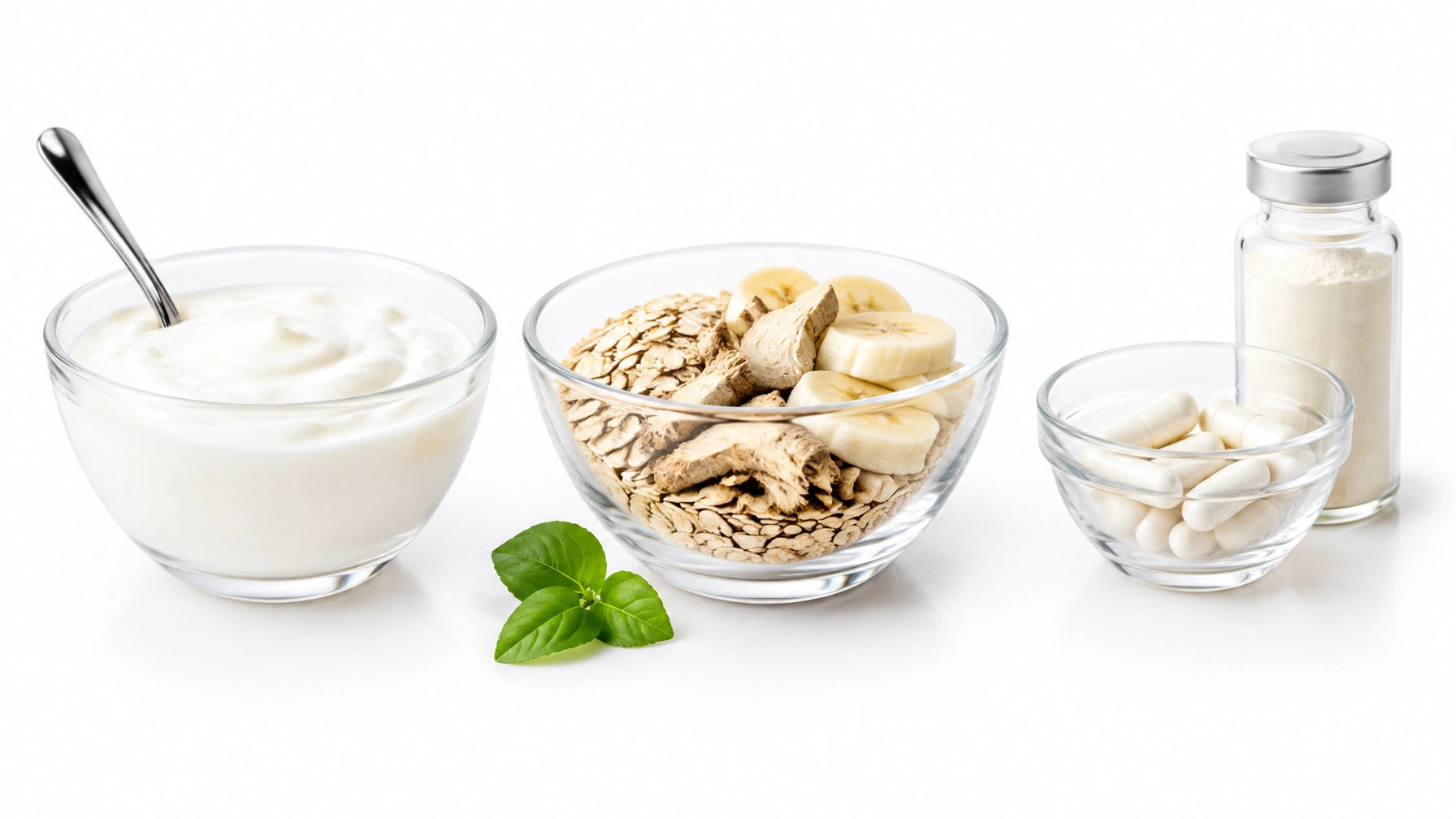
Probiotics vs Postbiotics: Which One Actually Fixes Your Gut?

If you’re comparing gut health supplements, it’s easy to get lost in labels promising better digestion, stronger defences or a “balanced microbiome.” The key is to know what each product actually does, and to remember that no single supplement fixes every gut problem.
Here’s the plain-English version: probiotics add live microbes, prebiotics feed helpful microbes, and postbiotics are preparations made from inactivated microbes or their components. Each may have a role, but the right choice depends on your symptoms, health and the specific product.
First, what are probiotics, prebiotics and postbiotics?
Think of your gut as a garden. Your resident microbes are the plants and wildlife. What you add matters, but so does the soil, the food available and the wider conditions.
| Type | What it is | Simple analogy |
|---|---|---|
| Probiotic | Live microorganisms that provide a health benefit when taken in an adequate amount | Adding helpful gardeners to the garden |
| Prebiotic | A substance selectively used by certain microbes, supporting a health benefit | Supplying food for selected plants |
| Postbiotic | A preparation of inactivated microorganisms and/or their components that provides a health benefit | Using useful materials left by the gardeners |
These definitions come from the International Scientific Association for Probiotics and Prebiotics (ISAPP). One important detail: a product isn’t automatically a postbiotic just because it contains something non-living from microbes. The preparation needs to meet a definition and have evidence of benefit.

Probiotics: useful for some jobs, not every gut
The frustration: You’re bloated or your bowel habits have changed, and a probiotic label promises to “restore balance.”
The reality: Probiotic effects can depend on the specific microorganism, dose, product and reason you’re taking it. A product studied for one outcome may not help with another. A probiotic isn’t a universal repair crew that works the same way in every gut.
Some strains have been studied for particular situations, including certain types of antibiotic-associated diarrhoea. But “probiotic” describes a broad category, not proof that every product prevents illness or acts as one of the immune system boosters advertised online.
If you’re considering one, check the label for the named microorganisms, directions, storage instructions and use-by date. Ask a pharmacist or clinician which product, if any, fits your situation, particularly if you have a weakened immune system or a serious health condition.
Short version: Choose based on a specific need and evidence for that product, not just the word “probiotic.”
Prebiotics: feeding your existing gut community
The frustration: You want to support your gut but don’t necessarily want to add live microbes.
The solution: Prebiotic fibres can provide food for selected gut microorganisms. Foods such as oats, legumes, onions and slightly green bananas can contribute fermentable fibre to your diet. Increase these foods gradually and drink enough fluid.

More fibre isn’t always more comfortable. Some prebiotic fibres, including inulin-type fibres, can make gas or bloating worse for some people, especially if you increase them quickly or already have a sensitive gut. Think of it like adding fuel to a campfire: a steady supply can help, but tipping in too much at once can create a flare-up.
For irregularity, start with steady meals, fluids and a gradual increase in fibre from food. If symptoms persist, speak with a health professional rather than escalating supplement doses yourself.
Short version: Prebiotics may suit people looking to nourish gut microbes, but start low and pay attention to symptoms.
Postbiotics: the newer frontier, with product-specific evidence
The frustration: You’ve heard that live probiotics can be difficult to store or tolerate, and you’re wondering whether postbiotics are a simpler answer.
The solution: Postbiotic preparations don’t contain live microorganisms in the same way probiotics do. That may make some products easier to formulate and store, but it doesn’t mean all postbiotics are more effective, safer for everyone or better for your gut.
The research is developing, and evidence needs to be assessed preparation by preparation. Results for one postbiotic ingredient cannot automatically be applied to every product labelled “postbiotic.” A postbiotic is also not simply a probiotic that has been killed; its identity and evidence matter.

Short version: Postbiotics are promising, but “newer” doesn’t mean “proven best.”
What about the gut–immune connection?
Your gut lining is a bit like a security gate. It helps manage what passes between the gut and the rest of the body, while gut microbes and immune cells communicate with each other. This relationship is often called the gut–immune axis.
That connection is real, but it’s not a shortcut to claiming that a supplement “boosts immunity.” A supplement may affect certain biological processes without being proven to prevent infections or treat immune conditions. Be wary of broad natural health supplements or wellness products claims that promise to fix immunity and digestion at once.
For everyday support, focus first on regular meals, a varied diet, enough fibre for your tolerance, hydration and sleep. A supplement can be an addition, not a replacement for medical care.
A simple decision path
Use this as a starting point, not a diagnosis:
- Bloating? Consider whether a recent increase in fibre, certain foods or a new supplement could be contributing. If symptoms are persistent, severe or worsening, seek clinical advice before adding more products.
- Irregularity? Review fluids, meals and gradual food-based fibre increases. Ask a pharmacist or clinician for help if it continues.
- After antibiotics? Ask your doctor or pharmacist whether a specific probiotic is appropriate. Don’t assume any probiotic will suit every antibiotic or person.
- Concerned about “low immunity”? Repeated, severe or unusual infections deserve medical assessment, not self-treatment with an “immune booster.”
- Interested in postbiotics? Check the exact preparation, the evidence for the intended use and the product’s Australian regulatory status.
How the WL Australia gut-support links fit in
You may also come across the WL Australia research-oriented gut protocol range: Stamakort, Enterogen, Pancreagen and Zhenoluten. These are not probiotics, prebiotics or postbiotics, and they should not be treated as an established gut-health supplement stack. Product descriptions or proposed research uses do not establish that combining them is safe or effective for people.
In particular, the Zhenoluten product page states “Research chemical only, Not for human use.” Do not take it. Do not use these research products to treat digestive, pancreatic or immune conditions. Discuss ongoing gut symptoms and any products you’re considering with a qualified clinician.
Safety and Australian regulation
In Australia, check the product label and intended use. For a product presented as a listed complementary medicine, look for its Australian Register of Therapeutic Goods (ARTG) details, such as an AUST L or AUST L(A) number, where applicable. The Therapeutic Goods Administration’s guidance on listed probiotic medicines explains relevant quality requirements.
An ARTG listing is not a guarantee that a product will fix your symptoms or that every advertised claim applies to you. If you’re pregnant, immunocompromised, managing a health condition or taking medicines, ask your doctor or pharmacist before using supplements. Seek prompt medical care for severe pain, blood in your stool, unexplained weight loss, persistent vomiting or other worrying symptoms.
Take control by starting with the basics, identifying your actual need and choosing cautiously. For more reading, visit the WL Australia blog and ask your clinician which evidence-based options are appropriate for you.
Video placeholder 1: Add an educational video explaining the difference between probiotics, prebiotics and postbiotics.
Video placeholder 2: Add a clinician-led video on choosing gut-health products safely in Australia.
 Immune Support, ant bacterial, anti viral, auto immune.
 Bioregulators
 Brain
 Skin & Hair Products