
SHLP-1: The Mitochondrial-Derived Peptide for Cellular Resilience and Longevity Research

Mitochondria are often called the “powerhouses” of the cell. That description is useful, but incomplete. Your mitochondria are also sensors, recycling centres, and communication hubs. They help determine how a cell responds when energy is low, oxidative stress rises, or internal damage begins to accumulate.
SHLP-1, or Small Humanin-Like Peptide 1, sits within a new area of mitochondrial biology: mitochondrial-derived peptides (MDPs). These are small peptides encoded by short regions of mitochondrial DNA (mtDNA) that may help mitochondria communicate with the rest of the cell.
The important word is may. SHLP-1 is an emerging research compound, not an established treatment. Its biological role remains far less defined than humanin or some other members of the SHLP family.
What are mitochondrial-derived peptides?
The problem: mitochondria need a way to report cellular stress
A cell cannot run effectively if its energy systems operate in isolation. Think of a construction site. The generators produce power, but supervisors still need to know whether the building is stable, materials are running low, or a safety problem has developed.
Mitochondria perform a similar reporting function. They generate adenosine triphosphate (ATP), the main energy currency used by cells, while also sensing changes in:
- Energy availability
- Reactive oxygen species (ROS), which are chemically reactive molecules
- Oxidative stress
- Inflammation
- Mitochondrial membrane integrity
- Programmed cell death, also called apoptosis
MDPs are being studied as possible messengers between mitochondria and the rest of the cell. This type of communication is sometimes called retrograde signalling: the mitochondria send information back to the nucleus and other cellular systems.
The research solution: small peptides as biological messages
Humanin, MOTS-c, and SHLPs 1–6 are examples of MDPs discussed in current scientific literature. They are much smaller than conventional proteins, but their size does not necessarily mean their role is minor. A short peptide can function like a text message: compact, targeted, and capable of changing how a larger system responds.

What is SHLP-1?
SHLP-1 is linked to the 16S ribosomal RNA (rRNA) region of mitochondrial DNA. This is the same general mitochondrial region associated with humanin. SHLP-1 belongs to a group of six small humanin-like peptides, labelled SHLP-1 through SHLP-6.
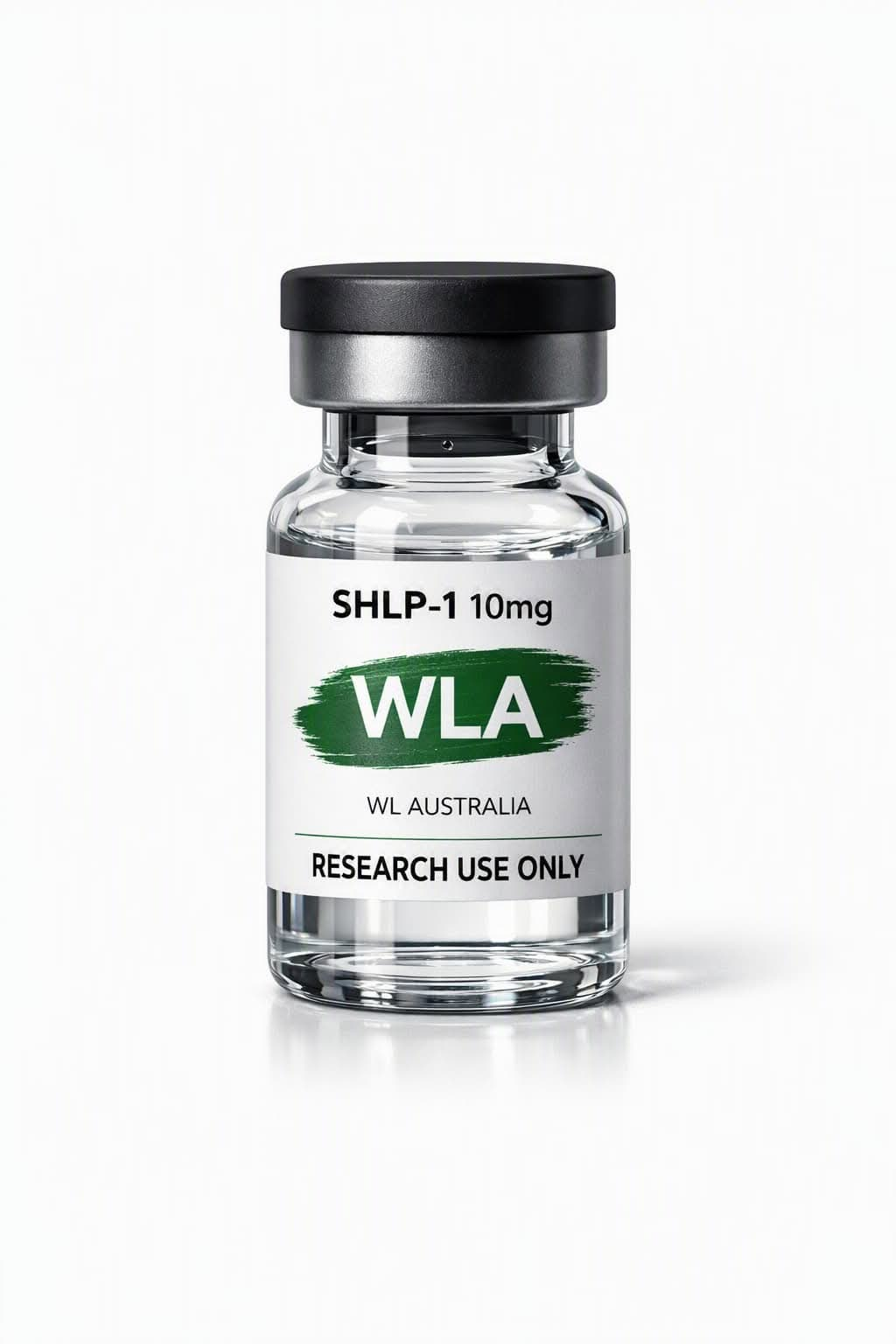
The product available from WLA Australia is SHLP-1 10mg, and the product page clearly identifies it as a research chemical only, not for human use.
Current research descriptions commonly identify SHLP-1 as a short peptide of approximately 24 amino acids. However, researchers should verify identity, purity, formulation, storage conditions, and batch documentation through the relevant certificate of analysis (CoA) rather than relying on a product name alone.
A crucial evidence distinction
The existence and mitochondrial origin of SHLP-1 are established research facts. Its precise biological effects are not.
Much of the stronger evidence in the MDP field concerns humanin, SHLP-2, SHLP-3, and SHLP-6. SHLP-1 is often included in family-level discussions, but it has not received the same level of direct functional characterisation.
That means you should treat claims about SHLP-1 as a research question, not a finished conclusion.
SHLP-1 compared with humanin
The problem: similar origins can create confusion
SHLP-1 and humanin are not the same peptide. They are better understood as different team members from the same department.
Both are associated with the 16S rRNA region of mtDNA, but their sequences, structures, receptor interactions, and biological activity may differ.
Humanin is the better-characterised member. Experimental studies have linked humanin with cellular survival pathways and anti-apoptotic activity in several models. Apoptosis is the cell’s controlled self-destruction process, more like a planned building demolition than an uncontrolled collapse.
Humanin has been studied in connection with signalling pathways involving:
- Extracellular signal-regulated kinase (ERK)
- Protein kinase B, commonly called Akt
- Signal transducer and activator of transcription 3 (STAT3)
- BAX and BID, proteins involved in mitochondrial apoptosis
The research solution: compare, but do not substitute
SHLP-1 should not automatically be assumed to behave like humanin. A zipper is a useful analogy: two zippers may look similar, but the teeth must align precisely for either one to work. Small changes in peptide sequence can influence stability, receptor binding, tissue distribution, and signalling.
| Research feature | SHLP-1 | Humanin | SHLP-2 and SHLP-3 |
|---|---|---|---|
| Mitochondrial origin | Linked to the 16S rRNA region | Encoded in the 16S rRNA region | Encoded in the 16S rRNA region |
| Evidence base | Limited direct functional data | More extensively studied | More functional studies available |
| Apoptosis research | Not clearly defined | Often studied as cytoprotective | Cytoprotective effects reported in models |
| Metabolic research | Emerging and uncertain | Investigated in metabolic models | Insulin-sensitivity research reported |
| Human therapeutic status | Not an approved treatment | Not a general consumer treatment | Preclinical research only |
The practical takeaway is simple: family resemblance is not proof of identical function.
Cellular stress, apoptosis, and SHLP-1 research
The problem: stressed cells can lose control
When cellular stress becomes excessive, mitochondria may release signals that activate apoptosis. This is useful when a cell is severely damaged, but inappropriate or excessive apoptosis can contribute to tissue dysfunction.
Researchers therefore study whether MDPs influence the balance between:
- Stress detection
- Damage control
- Cell survival
- Programmed cell death
The process resembles a car engine warning system. A warning light is helpful because it signals a problem early. But the warning light itself is not the repair. Likewise, a peptide associated with stress signalling should not automatically be described as a treatment for cellular damage.
What is proposed for SHLP-1?
The WLA product page discusses SHLP-1 in relation to cellular stress, apoptosis, and signalling pathways such as STAT3 and ERK. These are reasonable areas for investigation because related MDPs have been studied through similar pathways.
However, current public research does not provide enough direct evidence to confirm that SHLP-1 independently:
- Prevents apoptosis in humans
- Improves insulin sensitivity in people
- Reverses mitochondrial dysfunction
- Extends lifespan
- Treats disease or age-related decline
The responsible position is to describe these as proposed research directions, not established benefits.
Video placeholder: Insert an educational video explaining mitochondrial-derived peptides, retrograde signalling, and how SHLP-1 differs from humanin.
Why SHLP-1 appears in longevity research
The problem: longevity is more than adding years
Longevity research increasingly focuses on healthspan. The period of life spent with good function and resilience. Mitochondria are central to this conversation because they influence energy production, stress response, inflammation, and cellular quality control.
Picture a sports team. The mitochondria are not simply the players scoring points. They are also the conditioning staff, equipment managers, and performance analysts. If the support systems fail, the entire team becomes less adaptable under pressure.
MDPs are interesting because they may connect mitochondrial condition with wider cellular behaviour. Humanin and other MDPs have been investigated in relation to metabolism, inflammation, apoptosis, and age-associated changes. Some studies also report that circulating levels of particular MDPs change with age.
But this broader evidence should not be mistaken for direct evidence that SHLP-1 extends lifespan. At present, SHLP-1 is best viewed as a candidate for further investigation in cellular resilience and ageing biology.
The research solution: use a layered evidence model
When assessing SHLP-1, move through the evidence in order:
- Layer 1: Identity. Is the peptide correctly identified and analytically verified?
- Layer 2: Mechanism. Does it interact with a defined receptor or pathway?
- Layer 3: Cell studies. Does it produce reproducible effects in controlled cell models?
- Layer 4: Animal studies. Do findings translate to a living organism?
- Layer 5: Human studies. Is there reliable evidence of safety and benefit in people?
SHLP-1 currently belongs primarily in the early layers. That does not make it unimportant. It makes careful research essential.
Research, safety, and Australian regulatory context
SHLP-1 is not a supplement, approved medicine, or self-treatment option. The product is labelled for research use only, and you should not inject, ingest, or otherwise administer it to yourself or another person.
In Australia, the Therapeutic Goods Administration (TGA) regulates therapeutic goods according to their intended use. A “research use only” label does not make an unapproved product safe for human administration or automatically remove legal obligations.
Before any human-related peptide research, consider:
- Clinician review for any health decision
- Institutional ethics approval where applicable
- Laboratory quality controls
- Validated analytical testing
- Correct storage and handling
- Contamination and sterility controls
- Current TGA requirements and the Australian Register of Therapeutic Goods (ARTG)
Read the TGA’s guidance on importing, compounding, and supplying unapproved peptide products.
Do not use this article to diagnose, prevent, or treat any condition. Do not replace medical care with peptide experimentation.
The bottom line
SHLP-1 is a compelling mitochondrial-derived peptide for researchers interested in cellular resilience, stress signalling, apoptosis, and longevity biology. Its connection to the 16S rRNA region places it in the same broad mitochondrial conversation as humanin and other SHLPs.
The strongest conclusion is also the most honest: SHLP-1 is biologically interesting, but its specific functions remain under-characterised.
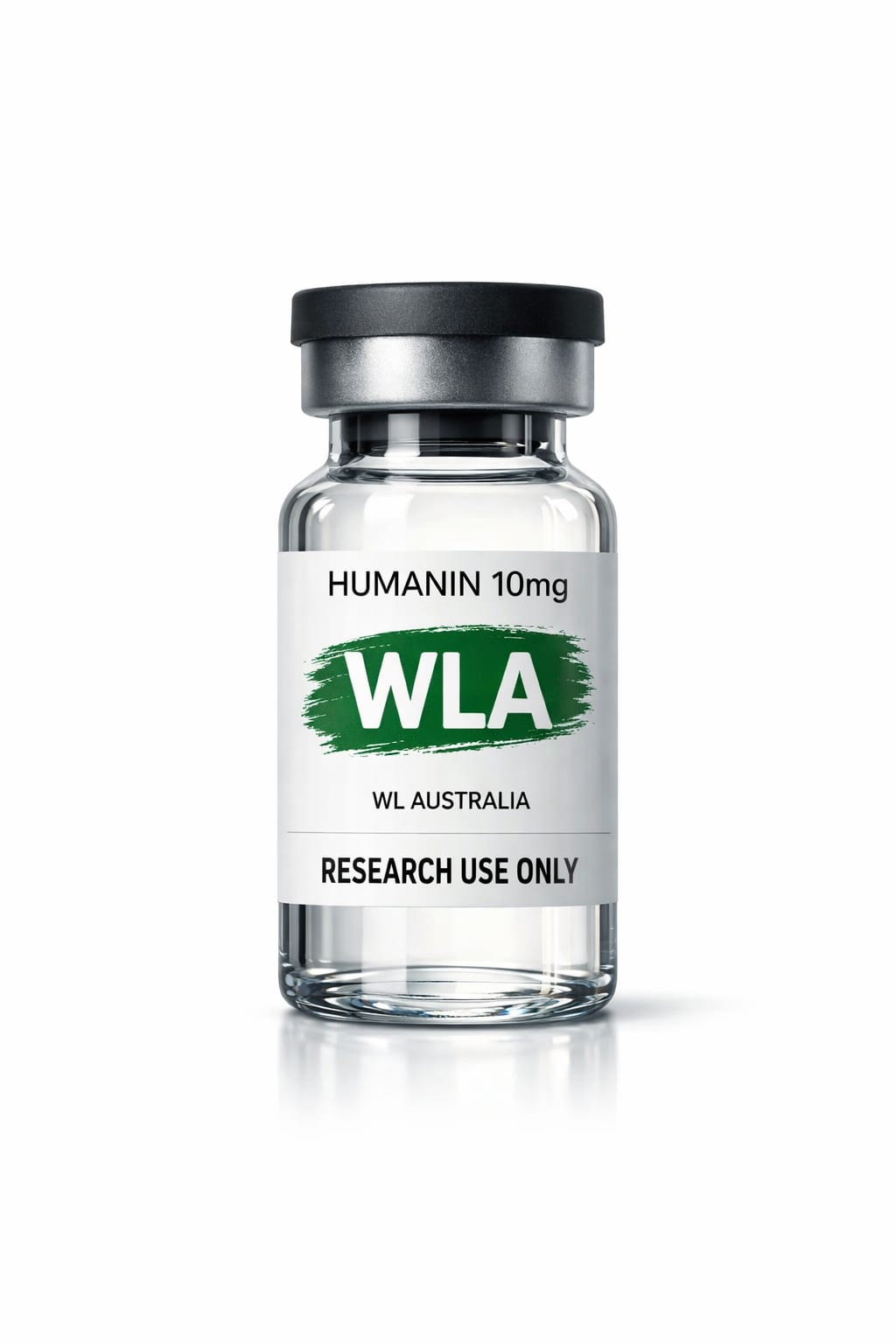
You can explore the SHLP-1 research product page, compare it with Humanin 10mg, and browse the broader mitochondrial peptide collection.
Start with identity. Continue with evidence. Keep safety and compliance in the centre of the work.
Video placeholder: Insert a laboratory-focused video covering SHLP-1 research handling, mitochondrial signalling, and responsible interpretation of preclinical peptide data.
 Immune Support, ant bacterial, anti viral, auto immune.
 Bioregulators
 Brain
 Skin & Hair Products