
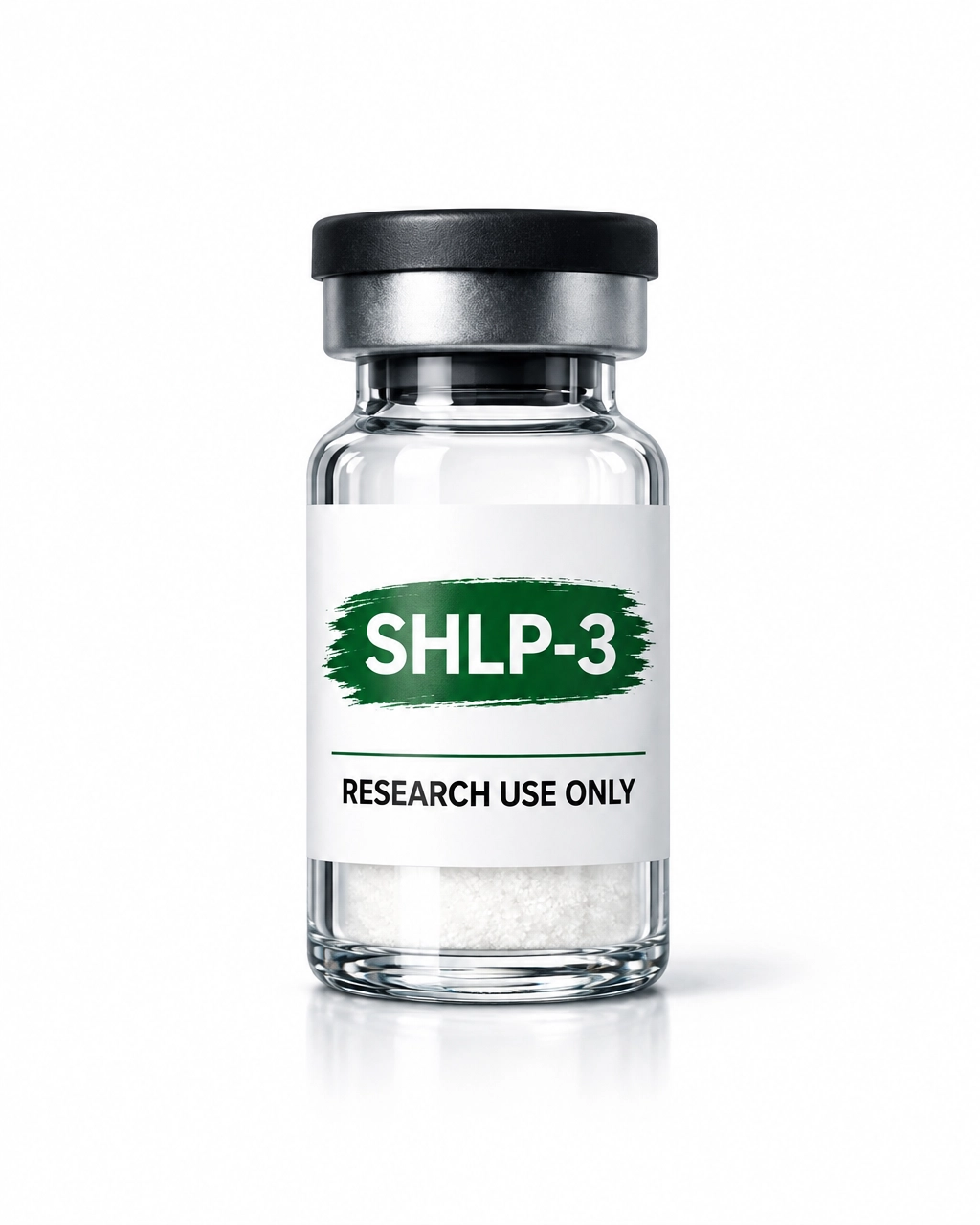
SHLP-3: The Mitochondrial Peptide for Cellular Stress Response and Longevity Research

Mitochondria are often described as the “powerhouses” of your cells. That comparison is useful, but incomplete. Mitochondria also act like sensors, communication hubs and emergency coordinators. They monitor energy demand, respond to cellular stress and help decide whether a damaged cell should recover or undergo controlled cell death.
This is why mitochondrial signalling has become an important area in healthy ageing research.
SHLP-3, short for Small Humanin-Like Peptide 3, is one of several small peptides being studied in this field. Research has explored its proposed role in mitochondrial function, oxidative stress, apoptosis and cytoprotection. However, most evidence remains preclinical, and SHLP-3 should be understood as a research compound, not as an established treatment.
Important: SHLP-3 products are intended for laboratory research only. They are not approved medicines, supplements or treatments for human use. Do not ingest, inject, reconstitute or self-administer research compounds. Discuss any health concern with a qualified Australian healthcare professional.
What is SHLP-3?
The problem: mitochondrial biology is more complex than “energy production”
When people hear about mitochondria, they often think only of adenosine triphosphate, or ATP. ATP is the main chemical energy currency used by cells. Mitochondria produce much of it through a process called oxidative phosphorylation.
But mitochondria do more than supply energy. They also help regulate:
- Reactive oxygen species (ROS), chemically reactive molecules produced during normal metabolism
- Calcium balance
- Fatty-acid processing
- Communication between the mitochondria and the cell nucleus
- Apoptosis, the organised process of programmed cell death
- Responses to nutrient shortage, oxidative pressure and other forms of cellular stress
Think of a mitochondrion as a combined power station, quality-control department and emergency alarm system. If the power station struggles, the alarms change. The nucleus may then adjust gene activity, repair systems or energy use.
The research solution: study the messages mitochondria produce
Mitochondria contain their own DNA, known as mitochondrial DNA (mtDNA). Some sections of mtDNA contain short open reading frames, or sORFs. A short open reading frame is a small stretch of genetic code that can potentially be read by cellular machinery to produce a short peptide.
These peptides are called mitochondrial-derived peptides (MDPs).
The process can be compared to a large instruction manual containing small, previously overlooked messages. For many years, researchers focused on the major genes in the manual. More recent work has examined whether these shorter messages produce functional peptides that influence the wider cell.
SHLP-3 is one of the peptides identified through this research. It is commonly described as a member of the mitochondrial-derived SHLP family, although the precise origin and biology of some SHLPs, including SHLP-3-remain an area of scientific investigation.

How SHLP-3 may participate in the cellular stress response
The problem: stress can push cells towards dysfunction or cell death
Cells regularly experience stress. This may come from:
- Reduced nutrient availability
- Oxidative pressure
- Toxins or chemical challenges
- Disrupted energy production
- Protein-folding problems
- Inflammation or tissue injury
A healthy cell does not respond to every challenge by immediately shutting down. It first attempts to stabilise itself. It may change fuel use, increase protective proteins or remove damaged components.
The difficulty arises when stress becomes too severe or continues for too long. Mitochondria may lose their membrane potential. The electrical gradient they use to support energy production. This can activate the intrinsic, or mitochondrial, pathway of apoptosis.
The research solution: examine whether SHLP-3 supports cellular resilience
Laboratory studies have investigated whether SHLP-3 can influence several markers of cell stress. In cell models exposed to nutrient deprivation or chemical stress, SHLP-3 has been associated with:
- Increased cell viability
- Lower ROS production
- Higher oxygen consumption
- Increased ATP levels
- Reduced markers of mitochondrial damage
- Lower activation of apoptotic pathways
These findings suggest that SHLP-3 may function like a backup generator and stabilising signal during cellular stress. It may help a cell maintain energy production while limiting the chain reaction that can lead to apoptosis.
That does not mean SHLP-3 has been proven to prevent disease or extend human lifespan. It means researchers have identified a pattern worth studying.
The core idea is simple: improve the cell’s ability to respond to stress, and you may better understand how cellular resilience is maintained.
SHLP-3 and apoptosis: why controlled cell death matters
The problem: apoptosis is essential, but excessive activation can damage tissue
Apoptosis is often described as cellular suicide, but it is more like a carefully managed demolition process. A damaged cell dismantles itself in an organised way, helping protect surrounding tissue.
This process involves enzymes called caspases. Caspase-3 is one of the key executioner caspases. When it becomes activated, the cell moves further along the apoptosis pathway.
Mitochondria can influence this process by releasing signals that affect proteins such as cytochrome c, Bax and other regulators of cell survival.
The research solution: examine whether mitochondrial peptides alter the apoptosis pathway
In several laboratory models, SHLP-3 has been studied for its ability to reduce apoptosis-related changes. Reported observations include reduced caspase activation and improved cell survival under specific experimental conditions.
Researchers have also explored whether SHLP-3 influences signalling pathways such as:
- ERK, or extracellular signal-regulated kinase, which can support cell survival and adaptation
- STAT3, or signal transducer and activator of transcription 3, a protein involved in cellular communication and gene regulation
- AKT, a pathway associated with survival and metabolism
- AMPK, or adenosine monophosphate-activated protein kinase, an energy-sensing pathway
These pathways are not simple on/off switches. They are more like a network of traffic lights. Their effects depend on the cell type, stressor, timing and biological context.
For this reason, SHLP-3 research should be interpreted carefully. A result observed in a cultured cell line does not automatically translate into a safe or effective outcome in a person.
SHLP-3, humanin and the wider SHLP family
SHLP-3 belongs to a broader group of peptides known as small humanin-like peptides. The family includes SHLP-1 through SHLP-6.
Humanin is a related mitochondrial-derived peptide that has been more extensively studied. Both humanin and SHLP-3 have been investigated for possible roles in:
- Cellular stress adaptation
- Mitochondrial stability
- Oxidative balance
- Apoptosis regulation
- Age-related biology
However, they are not interchangeable.
Humanin has a better-characterised group of receptor and signalling interactions. By comparison, the receptor biology and full physiological role of SHLP-3 are less clearly established.
The SHLP family is also functionally diverse. Research has suggested that SHLP-2 and SHLP-3 may show cytoprotective activity in certain models, while other family members may behave differently. This is a useful reminder that “mitochondrial peptide” is a broad category, not a guarantee of a particular biological effect.
You can explore related research products in the WL Australia mitochondrial peptide range, including Humanin 10 mg and MOTS-C 10 mg.

Video placeholder 1: Add an educational video here explaining mitochondria, mitochondrial-derived peptides and how short open reading frames can produce signalling peptides.
Why mitochondrial signalling matters in healthy ageing research
The problem: ageing involves many connected biological systems
Healthy ageing is not controlled by one molecule or one organ. It involves the interaction of energy metabolism, DNA maintenance, inflammation, protein quality control and tissue repair.
Mitochondria sit at the centre of this network. They provide energy, but they also communicate with the nucleus and respond to changes throughout the cell.
With age, researchers often observe changes in mitochondrial efficiency, oxidative balance and stress signalling. These observations do not prove that one mitochondrial peptide can reverse ageing. They do explain why MDPs are being investigated as possible pieces of a much larger puzzle.
The research solution: study the communication system, not only the energy output
Mitochondrial research is moving beyond the question, “How much energy does the cell produce?”
Researchers are also asking:
- How does the cell detect mitochondrial stress?
- Which signals travel from mitochondria to the nucleus?
- How do cells decide between repair, adaptation and apoptosis?
- Do mitochondrial-derived peptides change with age?
- Can these peptides become reliable biomarkers or research tools?
- What are the long-term effects of altering these pathways?
SHLP-3 is relevant because it may help researchers study the relationship between mitochondrial function and cellular survival.
The focus is not a quick anti-ageing promise. The focus is understanding the biology.

Video placeholder 2: Add a laboratory explainer video here covering SHLP-3 research findings, apoptosis markers and the difference between cell-culture evidence and human clinical evidence.
What researchers still need to learn
SHLP-3 remains an emerging research subject. Important unanswered questions include:
- What receptors or binding partners does SHLP-3 use?
- Is its production regulated consistently across tissues?
- How does its expression change with age?
- Are its effects different in healthy and diseased cells?
- What delivery methods are scientifically appropriate?
- What are the effects of repeated or long-term exposure?
- Can findings from cell and animal studies be replicated in controlled human trials?
Until these questions are answered, it is not responsible to describe SHLP-3 as a proven longevity, anti-inflammatory, neuroprotective or disease-treatment product.
Safety, legal status and responsible research
SHLP-3 should not be used as a self-treatment. Research material may differ from an approved therapeutic product in its manufacturing standards, sterility, stability, purity, labelling and quality controls.
Before discussing any peptide or longevity strategy, consider:
- Speak with a qualified clinician, particularly if you have a medical condition or take prescription medicines.
- Do not inject, ingest or apply research-only material to the body.
- Do not rely on online dosing schedules as a substitute for medical assessment.
- Check Australian regulatory requirements, including whether a product is listed on the Australian Register of Therapeutic Goods (ARTG).
- Review the supplier’s legal information and intended-use statements. See the WL Australia legal information page.
- Treat preclinical findings as early evidence, not as a clinical recommendation.
You can also contact WL Australia through the official contact page for product availability and research-use information.
The key takeaway
SHLP-3 is a small humanin-like peptide being studied as part of the expanding field of mitochondrial-derived peptide research. Its proposed role includes supporting cellular stress responses, maintaining mitochondrial activity and reducing apoptosis-related changes in selected laboratory models.
The most accurate way to view SHLP-3 is as a research tool for exploring mitochondrial communication and cellular resilience.
Mitochondria are not simply batteries. They are more like a coordinated operations centre: producing energy, monitoring damage and sending signals that influence the rest of the cell. SHLP-3 may be one of those signals, but its full role is still being mapped.
Research first. Evidence over hype. Safety before experimentation.
Further reading
- Role of Signaling Molecules in Mitochondrial Stress Response: Frontiers in Genetics
- Naturally occurring mitochondrial-derived peptides are age-dependent regulators of apoptosis, insulin sensitivity and inflammatory markers, Aging
- Browse WL Australia mitochondrial peptides
- Browse WL Australia longevity research products

 Immune Support, ant bacterial, anti viral, auto immune.
 Bioregulators
 Brain
 Skin & Hair Products