
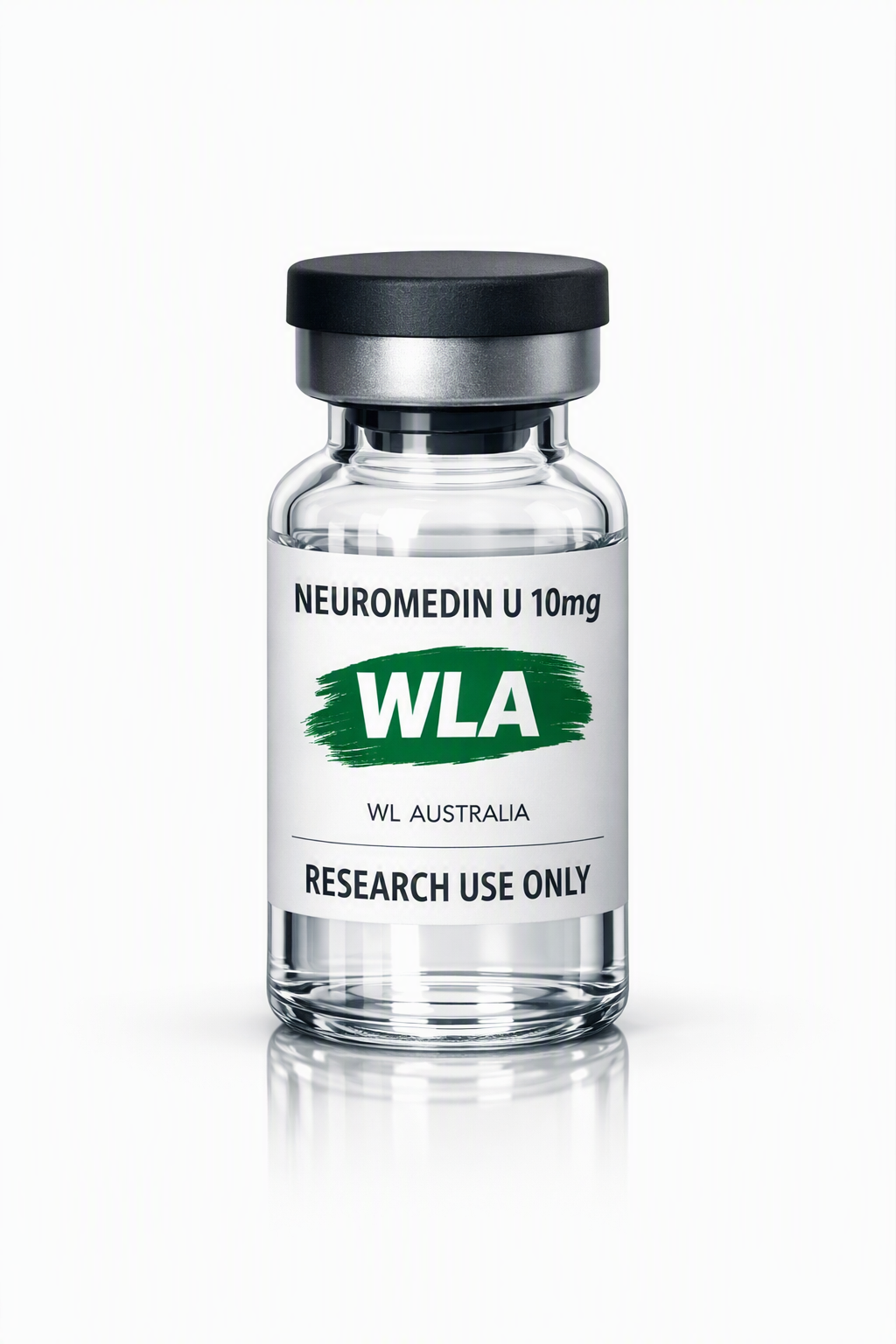
Neuromedin U: The Appetite-Suppressing Peptide for Metabolic and Gut Research

Neuromedin U (NMU) is a naturally occurring brain–gut neuropeptide that helps coordinate appetite, energy balance, gut movement and the stress response.
It is less familiar than leptin or ghrelin, but that is part of what makes it interesting. Leptin is often described as the body’s long-term energy “fuel gauge”, while ghrelin acts more like a meal-time “hunger alarm”. NMU appears to sit at a busy control junction, connecting the brain, digestive tract, metabolism and stress systems.
The important qualification is simple: most NMU evidence remains preclinical, meaning it comes from laboratory, cellular and animal research rather than established human treatment trials.
What is Neuromedin U?
The problem: the name sounds obscure, but the biology is highly practical
NMU was first isolated in 1985 from porcine spinal cord by researchers studying substances that caused powerful contractions in rat uterine tissue.
That unusual activity gave the peptide its name:
- “Neuromedin” refers to its classification among neuropeptides.
- “U” refers to its strong uterus-contracting, or uterotonic, activity.
Think of the original discovery as finding a new electrical signal while testing a motor. Researchers noticed the signal because it made the motor move. Later, they discovered that the same signal was involved in several other systems.
NMU exists mainly in two forms:
- NMU-8: an eight-amino-acid fragment.
- NMU-25: a longer 25-amino-acid form in humans.
The shorter NMU-8 sequence represents the biologically important C-terminal region of the longer peptide. In simple terms, NMU-8 contains much of the “business end” needed to activate its receptors.

Short summary: NMU was named for uterine contraction, but its research profile now extends across appetite, metabolism, gut function, stress and pain biology.
NMUR1 and NMUR2: two receptors, two main control rooms
The problem: one peptide can produce different effects in different tissues
NMU works through two main G-protein-coupled receptors, or GPCRs. GPCRs are cell-surface communication switches that receive a chemical message and pass instructions into the cell.
The two main NMU receptors are:
| Receptor | Main location | Research role |
|---|---|---|
| NMUR1 | Peripheral tissues, especially the gastrointestinal tract, smooth muscle and immune cells | Gut motility, smooth muscle contraction, intestinal signalling and immune regulation |
| NMUR2 | Central nervous system, particularly hypothalamic and stress-related brain regions | Appetite, energy expenditure, stress responses and pain-related signalling |
A useful analogy is a company with two offices:
- NMUR1 is the field office. It is positioned in the gut and other peripheral tissues, where it helps manage movement and local functions.
- NMUR2 is the headquarters. It is concentrated in the brain, where it helps coordinate appetite, energy output and stress circuits.
This division is not absolute. Biological systems overlap, and NMU can influence both central and peripheral pathways. However, the distinction helps explain why researchers study NMUR1 and NMUR2 separately.
The solution: when assessing NMU research, always ask two questions: where is the receptor located, and what biological job is it performing there?
Appetite suppression and energy homeostasis
The problem: controlling energy balance involves more than reducing hunger
In animal studies, NMU is one of the more potent anorexigenic peptides studied. “Anorexigenic” means that it reduces food intake.
Central administration of NMU in rodents has been associated with:
- Reduced food consumption.
- Lower body weight.
- Increased energy expenditure.
- Changes in physical activity.
- Activation of hypothalamic pathways involved in satiety and metabolism.
The hypothalamus acts like the body’s operations centre. It receives information about stored energy, recent meals, hormones and stress. NMU appears to influence this centre through NMUR2, particularly in areas such as the paraventricular nucleus, or PVN, a hypothalamic region involved in appetite and the stress response.
NMU is therefore interesting because it may influence both sides of the energy equation:
- Energy in: less food intake.
- Energy out: greater energy expenditure and thermogenic activity.
This differs from a simple appetite suppressant. It is more like adjusting both the fuel arriving at a power station and the amount of energy the station uses.
Animal models lacking functional NMU signalling have shown altered feeding and increased susceptibility to obesity-like phenotypes. These findings support NMU as a physiological regulator rather than merely an experimental appetite blocker.
However, do not translate rodent results directly into a human weight-management claim. Dose, route, receptor distribution and metabolism can differ considerably between species.
Pulse point: promising appetite biology is not the same as an approved weight-loss therapy.
Energy expenditure, temperature and glucose research
The problem: body weight is influenced by metabolism, not only meal size
Researchers are also studying whether NMU increases energy expenditure through sympathetic nervous system activity and thermogenesis.
Thermogenesis means heat production. Your body already uses this process to maintain temperature, particularly through tissues such as brown adipose tissue. You can picture it as an engine that burns some fuel to produce heat rather than storing all of it.
Preclinical NMU research has explored links to:
- Increased core body temperature.
- Greater metabolic activity.
- Sympathetic nervous system signalling.
- Changes in glucose handling.
- Interaction with insulin and other metabolic hormones.
These effects may help explain why NMU attracts interest despite being less famous than leptin or ghrelin. It appears to operate as part of a broader energy-homeostasis network, not as a single-purpose hunger switch.
The challenge is that the same network also affects blood pressure, stress hormones, immune signalling and smooth muscle. A compound that changes metabolism may also change other systems.

The solution: metabolic research should measure the whole system, including appetite, temperature, cardiovascular effects, glucose markers and stress biology.
NMU and the gastrointestinal tract
The problem: appetite and digestion are connected, but not identical
NMU is strongly expressed throughout the gastrointestinal tract, including the small intestine. Its peripheral receptor, NMUR1, is associated with smooth muscle and gut function.
Research has linked NMU to:
- Gastrointestinal smooth muscle contraction.
- Intestinal motility.
- Ion transport across the intestinal lining.
- Gastric emptying.
- Communication between the gut and brain.
The gut is not simply a passive tube. It behaves more like a conveyor belt with sensors, motors and quality-control checkpoints. NMU may help regulate how quickly that conveyor belt moves.
Some experimental work also suggests that NMU can influence gastric acid secretion, particularly following central administration. However, the evidence for direct acid regulation is less consistently established than the evidence for smooth muscle contraction, motility and gastric emptying.
This distinction matters. A research summary should not present NMU as a proven treatment for reflux, gastritis, ulcers or digestive disorders.
For broader gut research, see:
- Neuromedin U 10mg product page
- Enterogen and intestinal barrier research
- Stamakort and gastric mucosal research
Video placeholder 1: Insert educational video explaining the brain–gut axis, NMUR1 and NMUR2, gastric emptying and intestinal motility.
NMU, stress and the HPA axis
The problem: appetite regulation is closely tied to stress physiology
NMU also interacts with the hypothalamic–pituitary–adrenal axis, commonly called the HPA axis. This is the body’s central stress-response pathway.
The sequence works like a relay race:
- The hypothalamus releases corticotropin-releasing hormone, or CRH.
- CRH signals the pituitary gland to release adrenocorticotropic hormone, or ACTH.
- ACTH signals the adrenal glands to release stress hormones such as cortisol in humans.
Experimental NMU administration can activate CRH-containing neurons and stimulate this HPA sequence in animal models.
This helps explain the connection between appetite and stress. During acute stress, the body may temporarily reduce eating, increase alertness and mobilise energy. NMU may act as one of the biological links between these responses.
The same pathway is also relevant to body temperature, sympathetic activity and energy expenditure. In other words, NMU may help the body switch from “store and digest” mode to “respond and mobilise” mode.
But prolonged activation is not automatically beneficial. Persistent HPA-axis stimulation can affect sleep, mood, blood pressure, glucose regulation and immune function.
The solution: stress-related NMU research should be evaluated with the same caution as metabolic research. More signalling is not always better signalling.
Emerging links to pain and immune biology
The problem: NMU is not exclusively a metabolism peptide
NMU and NMUR2 are also being studied in relation to nociception, the nervous system’s processing of potentially painful stimuli.
Research interest includes:
- Pain-related signalling in the central nervous system.
- Interactions between NMU and stress circuits.
- Immune-cell regulation through peripheral receptors.
- Type 2 immune responses and inflammatory signalling.
These areas are still developing. They demonstrate why NMU cannot be neatly labelled as only an appetite peptide. It is better understood as a multi-system signalling molecule.
That broad activity is scientifically interesting, but it also creates a safety question: activating one pathway may influence several others.
Why NMU is interesting beside leptin and ghrelin
| Peptide | Simple role | Research distinction |
|---|---|---|
| Leptin | Long-term signal of stored energy | Communicates with the brain about fat reserves |
| Ghrelin | Meal-related hunger signal | Often rises before eating and stimulates appetite pathways |
| NMU | Appetite, energy expenditure, gut and stress signalling | May reduce intake while also influencing thermogenesis, motility and HPA activity |
NMU is interesting because it may function as a coordinator, not just a hunger or satiety messenger. It links the brain’s energy-control centre with the gut’s mechanical and chemical systems.
That is the opportunity. The limitation is that coordinated biology can also create coordinated side effects.
Safety, evidence and Australian context
The Neuromedin U 10mg product page identifies the product as a research chemical only and not for human use. It is not presented as an approved medicine, weight-loss treatment or supplement.
You should:
- Treat the evidence as primarily preclinical.
- Avoid self-treatment or self-injection.
- Do not use NMU to manage obesity, reflux, pain, diabetes or stress without appropriate medical care.
- Discuss any research chemical exposure with a qualified clinician.
- Check current Australian requirements through the Therapeutic Goods Administration and relevant professional advice.
- Seek medical review for unexplained weight change, persistent abdominal symptoms, severe pain, palpitations or significant changes in appetite.
Do not use a product description as a substitute for diagnosis. A clinician can assess whether symptoms relate to nutrition, medication, endocrine disease, gastrointestinal disease or another cause.
Video placeholder 2: Insert clinician-led video covering preclinical evidence, research-only status, HPA-axis effects and why NMU should not be self-administered.
Final thoughts
Neuromedin U is a powerful example of how the body manages several systems through one signalling network.
Its unusual name comes from uterine contraction, but modern research has expanded the picture. NMU-8 and NMU-25 act through NMUR1 and NMUR2, with research links to:
- Appetite suppression.
- Energy homeostasis.
- Thermogenesis and body temperature.
- Gastric emptying and gut motility.
- Gastric acid regulation.
- Stress and HPA-axis activation.
- Pain and immune signalling.
The central message is balance. Appetite, metabolism, gut function and recovery do not operate in isolation.
NMU remains an intriguing research target, but its strongest findings are still preclinical. Study the mechanism, respect the uncertainty and involve qualified medical oversight before making decisions about your health.
 Immune Support, ant bacterial, anti viral, auto immune.
 Bioregulators
 Brain
 Skin & Hair Products