
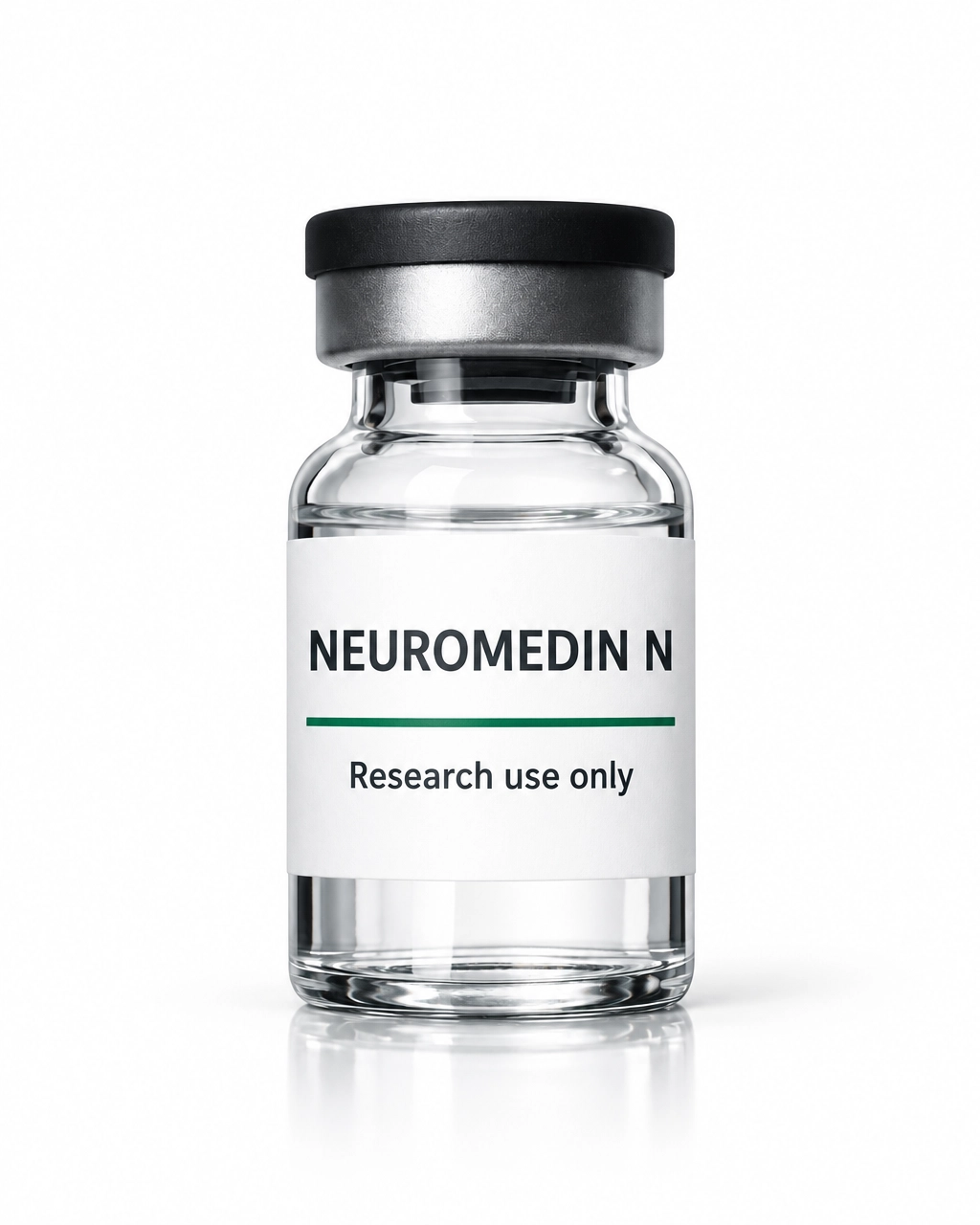
Neuromedin N: The Neurotensin-Related Peptide for Gut and Dopamine Research

Neuromedin N is a small peptide with a surprisingly connected biology. It is not an unrelated molecule that happens to resemble neurotensin. Instead, both peptides are produced from the same larger precursor protein, which means researchers can study them as a biological pair.
Neuromedin N is a hexapeptide, a peptide made from six amino acids, with the sequence Lys-Ile-Pro-Tyr-Ile-Leu, often abbreviated KIPYIL. It belongs to the neuromedin family and has been investigated for its links to neurotensin receptors, dopamine signalling, gut motility and endocrine regulation.
The important point is balance: Neuromedin N is biologically interesting, but it is less studied than neurotensin. Much of the evidence comes from laboratory and animal research, while its precise roles in humans remain incompletely defined.
Video placeholder: Neuromedin N explained: shared precursor biology, receptor activity and current research questions.
What is Neuromedin N?
The problem: treating related peptides as if they were interchangeable
Because Neuromedin N and neurotensin come from the same precursor, it is easy to assume they do exactly the same job. That would be too simple.
The solution: start with the shared biological blueprint
Think of the NTS gene as a construction plan. It contains instructions for a larger precursor protein called pro-neurotensin/neuromedin N. Cellular enzymes then cut this precursor at specific processing sites, much like a production line separating one long sheet of material into individual components.
Two of those components are:
- Neurotensin (NT): a 13-amino-acid peptide
- Neuromedin N (NN): a six-amino-acid peptide
Their shared origin explains why they have overlapping biological activity. Their different structures and tissue processing patterns help explain why they may also produce distinct effects.
Neuromedin N shares important sequence features with the active end of neurotensin. This gives it the ability to interact with the neurotensin receptor family, although researchers are still working to define exactly which receptors and signalling pathways dominate in each tissue.
Neuromedin N and neurotensin receptors
The main neurotensin-related receptors are:
| Receptor | What it is | Why researchers care |
|---|---|---|
| NTS1 | A high-affinity G-protein-coupled receptor | Strongly associated with many central neurotensin effects, including dopamine-related signalling |
| NTS2 | A second neurotensin receptor with different distribution and signalling behaviour | Often considered important for Neuromedin N activity, although its exact role remains under investigation |
| NTS3/sortilin | A single-pass receptor involved in peptide handling and signalling | May influence peptide trafficking and broader neurotensin-system biology |
A G-protein-coupled receptor (GPCR) is a cell-surface communication switch. When a peptide binds to it, the receptor passes a signal into the cell, which can change neuronal firing, hormone release or muscle activity.
Neuromedin N can interact with neurotensin receptors, but scientists should not automatically describe it as a perfect substitute for neurotensin. Receptor preference, tissue concentration and downstream signalling may all differ.

Short version: Neuromedin N uses part of the same communication network as neurotensin, but the message may not be identical.
Where is Neuromedin N found?
The problem: one peptide can behave differently in the brain and gut
The same precursor can be processed in different tissues. This is one reason peptide biology can feel confusing: the body does not always manufacture the same final products in the same proportions.
The solution: study the tissue before interpreting the effect
In the central nervous system, research suggests the precursor can produce neurotensin and free Neuromedin N in approximately comparable amounts. They may be stored together and released from nerve endings, allowing researchers to study their combined and individual effects.
In the gastrointestinal tract, processing appears to be different. Instead of producing large amounts of free Neuromedin N, gut tissue may generate neurotensin alongside a larger peptide fragment that ends with the Neuromedin N sequence.
This distinction matters. A vial of synthetic Neuromedin N used in an experiment does not necessarily reproduce the exact mixture released naturally from intestinal cells.
The precursor system is especially associated with enteroendocrine N cells in the jejunum and ileum. These specialised cells act like biological sensors. They detect nutrients and other signals in the digestive tract, then release messenger molecules that influence digestion, metabolism and communication with the nervous system.
Neuromedin N and dopamine research
Dopamine is a neurotransmitter involved in movement, motivation, reward, learning and endocrine control. You can think of dopamine circuits as a network of adjustable control panels rather than a single “pleasure chemical” switch.
The problem: neurotensin findings are often transferred directly to Neuromedin N
Neurotensin has a much larger research literature linking it to dopamine-rich regions. Neuromedin N is sometimes discussed as though it has the same broad effects. The evidence does not yet justify that level of certainty.
The solution: separate the peptide, brain region and receptor
Research has examined Neuromedin N in the ventral tegmental area (VTA), a midbrain region containing dopamine-producing neurons. In experimental models, Neuromedin N has been reported to mimic some neurotensin-like effects in the VTA.
However, those effects were not necessarily reproduced in the nucleus accumbens, another dopamine-rich region involved in motivation and reward. This regional difference is important. It suggests that Neuromedin N may not simply turn dopamine signalling up or down throughout the brain.
Researchers may therefore compare:
- Neuromedin N versus neurotensin
- VTA responses versus nucleus accumbens responses
- NTS1 activation versus NTS2 activation
- Changes in neuronal firing versus changes in dopamine release
- Direct brain effects versus indirect gut–brain signalling

The current evidence supports Neuromedin N as a potential modulator of dopamine-related circuits. It does not establish a proven cognitive, mood or performance benefit in humans.
Gut motility and endocrine regulation
The problem: irregular digestive movement can be difficult to interpret
The digestive tract uses coordinated waves of electrical and muscular activity to move contents forward. One important pattern is the migrating motor complex (MMC), a repeating “housekeeping” wave that occurs between meals.
The solution: examine Neuromedin N as part of the gut’s signalling network
Experimental studies have reported that Neuromedin N can:
- Inhibit or disrupt migrating motor complex activity
- Reduce small-intestinal motility
- Delay gastric emptying
- Influence intestinal sympathetic nerve activity
- Stimulate gastric acid secretion in experimental settings
- Affect insulin secretion and nutrient handling
- Influence fatty-acid absorption in the jejunum
A useful analogy is a conveyor belt. If the belt moves too quickly, there may be less time for digestion and absorption. If it slows too much, contents may accumulate and create a different problem. Neuromedin N appears to participate in the biological controls that adjust this movement, but its normal human role is not yet fully mapped.
These findings also show why endocrine regulation and gut motility should be studied together. Enteroendocrine peptides do not merely control muscle movement. They can coordinate secretion, absorption and communication with the brain.
Much of this evidence comes from animal or ex vivo research. It should not be presented as proof that Neuromedin N can treat constipation, reflux, metabolic disease or any other digestive condition.
How researchers separate Neuromedin N from neurotensin
When two peptides come from the same precursor, researchers need a careful experimental design. Common strategies include:
-
Testing each peptide separately
Neurotensin and Neuromedin N are applied independently rather than as a combined preparation. -
Using receptor-selective tools
Researchers may use receptor antagonists, agonists or genetic models to determine whether an effect depends mainly on NTS1, NTS2 or another pathway. -
Comparing different tissues
Brain slices, intestinal preparations and cultured endocrine cells may respond differently. -
Measuring processing patterns
Scientists can examine which prohormone convertases are present and which peptide fragments are actually produced. -
Assessing multiple outcomes
Neuronal firing, dopamine release, muscle contraction, gastric secretion and hormone release are different endpoints. A result in one system should not be generalised automatically to another.
This approach is like testing two drivers using the same engine but on different tracks. The shared machinery matters, but the track, controls and measurement determine what you actually learn.
Neuromedin N compared with neurotensin
| Feature | Neuromedin N | Neurotensin |
|---|---|---|
| Size | Six amino acids | Thirteen amino acids |
| Origin | Same NTS precursor | Same NTS precursor |
| Receptor relationship | Can interact with neurotensin receptors; receptor preference remains under study | Well-characterised activity at NTS1 and NTS2 |
| Dopamine research | More limited and region-specific | Larger body of central dopamine research |
| Gut research | Linked experimentally with motility and secretion | More extensively studied in gut and endocrine physiology |
| Evidence base | Thinner, with many preclinical findings | Broader, but still not a basis for self-treatment |
For a broader overview of the companion peptide, read the related Neurotensin research page.
Video placeholder: Neuromedin N versus neurotensin: how researchers distinguish two peptides from one precursor.
Research status and safety
Neuromedin N remains an experimental research peptide. It is not an approved treatment for dopamine disorders, digestive disease, hormone problems, weight management or cognitive performance.
For Australian readers, product status, import requirements and therapeutic claims are regulated under Australian law. A research listing should not be interpreted as evidence of therapeutic approval by the Therapeutic Goods Administration (TGA).
If you are reviewing the compound for laboratory work, consult the relevant institutional safety procedures, documentation and qualified personnel. If you are considering any peptide for personal use:
- Do not self-administer research products.
- Do not use research descriptions as dosing instructions.
- Discuss health concerns with a registered clinician.
- Review possible interactions and medical contraindications professionally.
- Seek medical advice for persistent digestive, hormonal, neurological or mood symptoms.
You can browse the verified WLAustralia research peptide shop. A dedicated Neuromedin N product URL was not present in the current site index, so check the live catalogue rather than relying on an unverified link.
Final perspective
Neuromedin N is best understood as a companion peptide to neurotensin, produced from the same precursor but not necessarily carrying the same biological message.
Its strongest research themes include:
- Shared biosynthesis with neurotensin
- Interaction with neurotensin receptor pathways
- Region-specific dopamine modulation
- Regulation of intestinal motility
- Possible roles in secretion and endocrine signalling
The opportunity is real, but so is the uncertainty. Better research depends on separation, comparison and careful controls. By studying Neuromedin N alongside neurotensin, not confusing one for the other, researchers can gradually clarify how this small peptide contributes to the brain–gut–endocrine network.
 Immune Support, ant bacterial, anti viral, auto immune.
 Bioregulators
 Brain
 Skin & Hair Products