
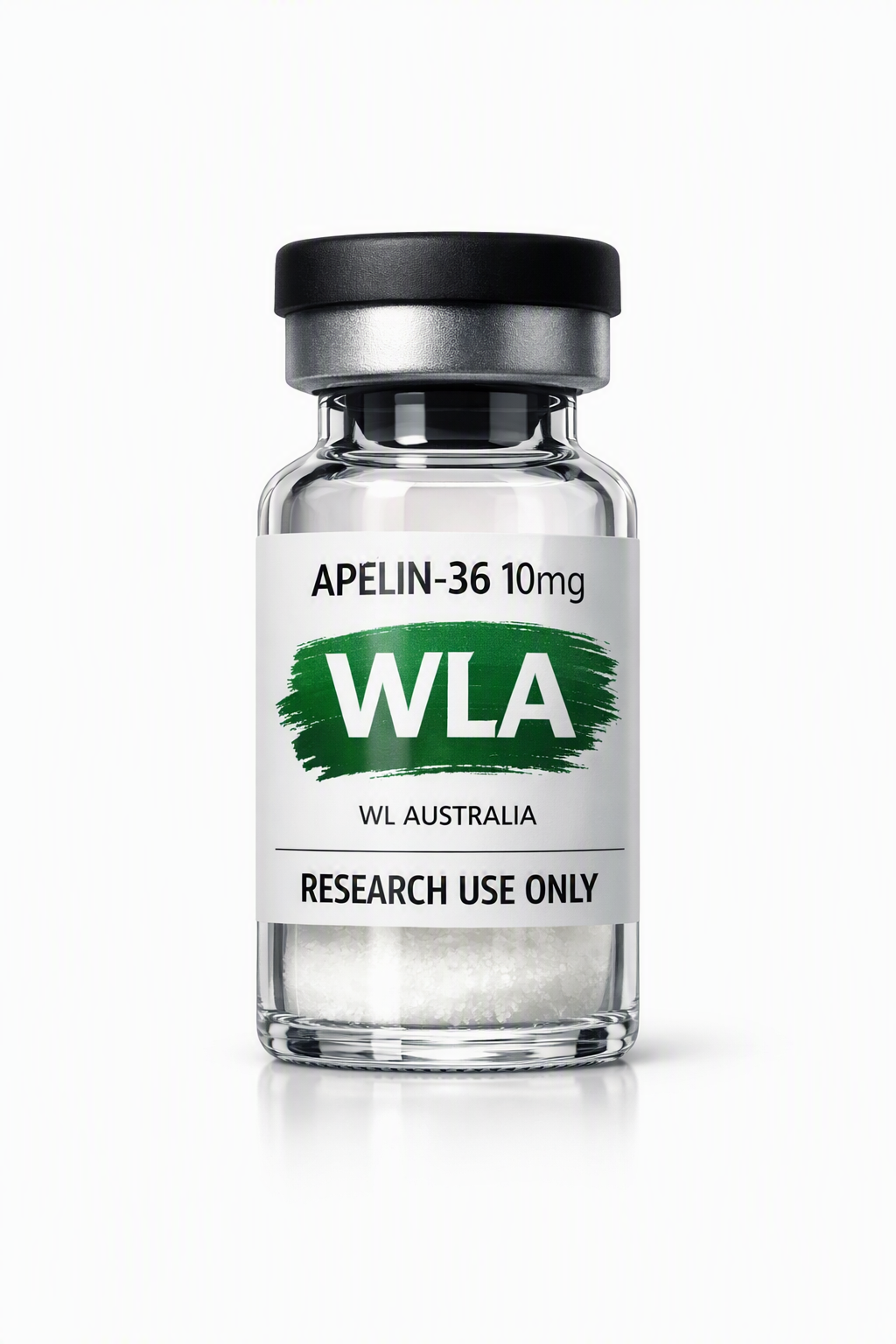
Apelin-36: The Full-Length APJ Ligand for Cardiovascular and Fluid Balance Research

Apelin-36 is the longest and most abundant circulating form of the apelin peptide family. It is the full-length, 36-amino-acid parent peptide from which shorter forms such as apelin-17 and apelin-13 are produced.
That difference matters.
Think of the apelin family as a single blueprint cut into several working components. Apelin-36 is the complete blueprint, while apelin-17 and apelin-13 are shorter sections that may interact with the APJ receptor more quickly and potently.
This makes Apelin-36 valuable in research focused on vascular tone, cardiac performance, fluid balance, glucose handling and adipose tissue biology. It is not a general wellness supplement or an approved self-treatment.
Video placeholder, Apelin-36 explained: the full-length apelin peptide and APJ receptor
What makes Apelin-36 different?
The apelin system begins with a precursor molecule called pre-proapelin. Enzymes process this precursor into several active fragments, including:
- Apelin-36: the full-length, 36-amino-acid parent form
- Apelin-17: a shorter C-terminal fragment
- Apelin-13: a shorter, highly active C-terminal fragment
- Pyr¹-apelin-13: a modified form often studied for strong acute cardiovascular activity
All of these peptides can bind the APJ receptor, also known as APLNR. APJ is a G-protein-coupled receptor, or GPCR. A type of cellular switch that converts an external signal into an internal response.
The practical research distinction is simple:
- Apelin-36 is generally more abundant in circulation.
- Apelin-13 is generally more potent on a molar basis.
- Apelin-36 may produce a longer-lasting functional response.
- The longer peptide may create a different APJ receptor signalling pattern from the shorter forms.
In other words, Apelin-36 is not simply “Apelin-13 with extra amino acids.” The additional sequence can influence receptor engagement, tissue distribution, enzymatic breakdown and the duration of the biological signal.
Apelin-36 vs Apelin-17 vs Apelin-13
| Feature | Apelin-36 | Apelin-17 | Apelin-13 |
|---|---|---|---|
| Length | 36 amino acids | 17 amino acids | 13 amino acids |
| Relationship | Full-length parent form | Shorter C-terminal fragment | Shorter C-terminal fragment |
| Circulating abundance | Generally higher than shorter forms in circulation | Intermediate or less commonly emphasised | Often lower than Apelin-36, depending on tissue and assay |
| Relative APJ potency | Active, but usually lower than Apelin-13 on a molar basis | Active at APJ | Generally among the most potent naturally occurring forms |
| Functional duration | Research suggests a longer-lasting effect profile | Intermediate | Often faster onset and offset |
| Main research focus | Cardiovascular tone, fluid balance, cardiac function and parent-peptide biology | Comparative APJ pharmacology | Acute vasodilation, metabolism and cardioprotection |
| Best research question | How does the complete endogenous ligand behave? | How does peptide length affect signalling? | What happens when APJ is activated rapidly and strongly? |
Results can vary with species, tissue, assay design and peptide preparation. Research should compare like with like.
Cardiovascular tone: the pressure-control problem
Your blood vessels are not rigid pipes. They are more like adjustable garden hoses, constantly widening or narrowing to manage pressure and blood flow.
When vascular tone becomes poorly regulated, researchers investigate whether the apelin/APJ system can influence:
- Vasodilation, or relaxation of blood vessels
- Endothelial function, meaning how well the vessel lining responds
- Peripheral vascular resistance
- Blood pressure regulation
- Coronary blood flow
Apelin signalling is linked to nitric oxide pathways. Nitric oxide acts like a local “open the valve” message, encouraging vascular smooth muscle to relax.
Human research has shown apelin-related peptides can produce nitric oxide-dependent arterial vasodilation. Apelin-13 may act rapidly, while Apelin-36 has been associated with a more sustained vascular response after infusion has stopped.
That longer functional tail is one reason Apelin-36 remains important in cardiovascular research. Researchers are not only asking, “How strongly does the peptide activate APJ?” They are also asking, “How long does the signal remain active?”
For broader cardiovascular context, see Cardiovascular Vitality: Cardiogen and Heart Health Research and the Apelin-36 10mg product page.
Fluid homeostasis: the body’s water-management system
Fluid balance is managed through a coordinated system involving the brain, kidneys, blood vessels and hormones. Picture it as a building’s water-management network: sensors detect pressure and concentration, valves adjust flow, and the kidneys decide how much water to retain or release.
A key hormone in this system is vasopressin, also called antidiuretic hormone or ADH. ADH helps the kidneys conserve water and can influence vascular tone.
Apelin research examines how the apelin/APJ system interacts with ADH and vasopressin signalling. In experimental models, apelin can influence:
- Thirst and drinking behaviour
- Vasopressin release
- Central blood-pressure regulation
- Kidney water handling
- The balance between water retention and water excretion
This interaction is important because apelin and vasopressin may act as counterbalancing signals in some physiological settings. Vasopressin tends to promote water retention, while apelin may participate in the body’s response to fluid loading and cardiovascular pressure.
The result is not a simple “water-loss” or “water-retention” switch. It is a feedback network, and the direction of the response depends on the tissue, timing and physiological state being studied.
Cardiac contractility and ischemia research
The heart is both a pump and an electrical-mechanical system. Contractility describes how strongly heart muscle fibres contract with each beat.
Research on Apelin-36 investigates its positive inotropic effect, meaning its potential to increase the force of cardiac contraction, through APJ signalling. In laboratory and human cardiovascular studies, apelin peptides have been examined for effects on:
- Left ventricular contractility
- Cardiac output
- Coronary blood flow
- Filling pressures
- Ischemia-reperfusion injury
Ischemia occurs when tissue receives too little blood and oxygen. Reperfusion restores blood flow but can also create oxidative stress, like restarting an overheated engine and producing a burst of damaging friction.
Apelin-36 is studied in this setting because APJ activation may engage cell-survival pathways such as PI3K/Akt, a signalling route involved in cellular resilience and repair. Preclinical studies have explored whether Apelin-36 can reduce cardiomyocyte injury and support heart tissue during oxygen deprivation.
These findings are promising research signals, not proof of a human treatment. Heart disease, chest pain or suspected ischemia require urgent medical care, not peptide experimentation.
Video placeholder: Apelin-36, cardiac contractility and ischemia research
Glucose uptake, insulin sensitivity and adipose tissue biology
Metabolism is often explained as a fuel system, but it is more accurate to think of it as a logistics network. Glucose is the cargo, insulin is one of the access keys, and tissues such as muscle and fat decide how efficiently that cargo is accepted.
Apelin-36 has been studied in relation to:
- Glucose uptake
- Insulin sensitivity
- Glucose-stimulated insulin secretion
- Energy homeostasis
- Body-weight regulation
- Adipose tissue signalling
APJ is expressed in metabolic tissues, including pancreatic islets and adipose tissue. Experimental studies have examined whether Apelin-36 changes how cells respond to insulin or how glucose is distributed after a meal.
Adipose tissue is not just passive storage. It behaves more like an endocrine organ, releasing signals that influence inflammation, appetite, insulin sensitivity and energy use. Researchers therefore investigate the apelin system in both white adipose tissue, which primarily stores energy, and brown adipose tissue, which is involved in heat production and energy expenditure.
This is where Apelin-36 differs from the usual “fat-burning” language. The research question is broader: How does APJ signalling help coordinate cardiovascular and metabolic function at the same time?
For related metabolic reading, explore Metabolic Efficiency: Upregulating GLUT4 for Insulin Sensitivity and The Metabolic Engine: Investigating DADA for Energy and Liver Health.
Why the longer half-life matters
Short peptides are often cleared quickly from the body. This can create a sharp signal that rises and falls like a brief text notification.
Apelin-36 appears to have a longer functional duration than Apelin-13 in some vascular studies. Researchers have observed that its vasodilatory effects may persist after infusion has stopped, suggesting slower signal offset or different receptor-level handling.
However, this does not mean native Apelin-36 is a long-acting medicine. Unmodified peptides can still have short plasma half-lives, which is why researchers continue to investigate stabilised, PEGylated and lipid-modified APJ agonists.
The key distinction is:
Longer-lasting functional activity does not automatically equal a long plasma half-life.
Responsible research and Australian safety considerations
The WL Australia Apelin-36 listing is labelled research chemical only, not for human use.
Before working with any peptide research material:
- Do not self-administer or use it as a treatment.
- Do not use Apelin-36 to manage blood pressure, diabetes, heart disease or fluid retention.
- Obtain review from a qualified clinician when research intersects with a health condition.
- Consider the risks of altered blood pressure, cardiac contractility, glucose regulation and fluid balance.
- Keep accurate records of identity, batch information, storage and laboratory conditions.
- Follow Australian regulatory requirements and institutional research standards.
People with cardiovascular, kidney, endocrine or metabolic conditions should be especially cautious. APJ signalling affects several connected systems, so changing one pathway may influence others.
Final takeaways
Apelin-36 is best understood as the full-length reference ligand for APJ research.
Remember the core principles:
- Length matters: Apelin-36 is the parent form; Apelin-13 and Apelin-17 are shorter fragments.
- Abundance matters: Apelin-36 is generally more prominent in circulation.
- Potency matters: Apelin-13 is often more potent, while Apelin-36 may create a more sustained functional signal.
- Context matters: cardiovascular, fluid, metabolic and adipose effects are interconnected.
- Safety matters: research findings do not establish a self-treatment protocol.
Apelin-36 helps researchers study the body’s internal coordination system: the way blood vessels, heart muscle, kidneys and metabolism work as one team. That is the real opportunity: not quick claims, but better research, clearer comparisons and more responsible biological understanding.
 Immune Support, ant bacterial, anti viral, auto immune.
 Bioregulators
 Brain
 Skin & Hair Products