
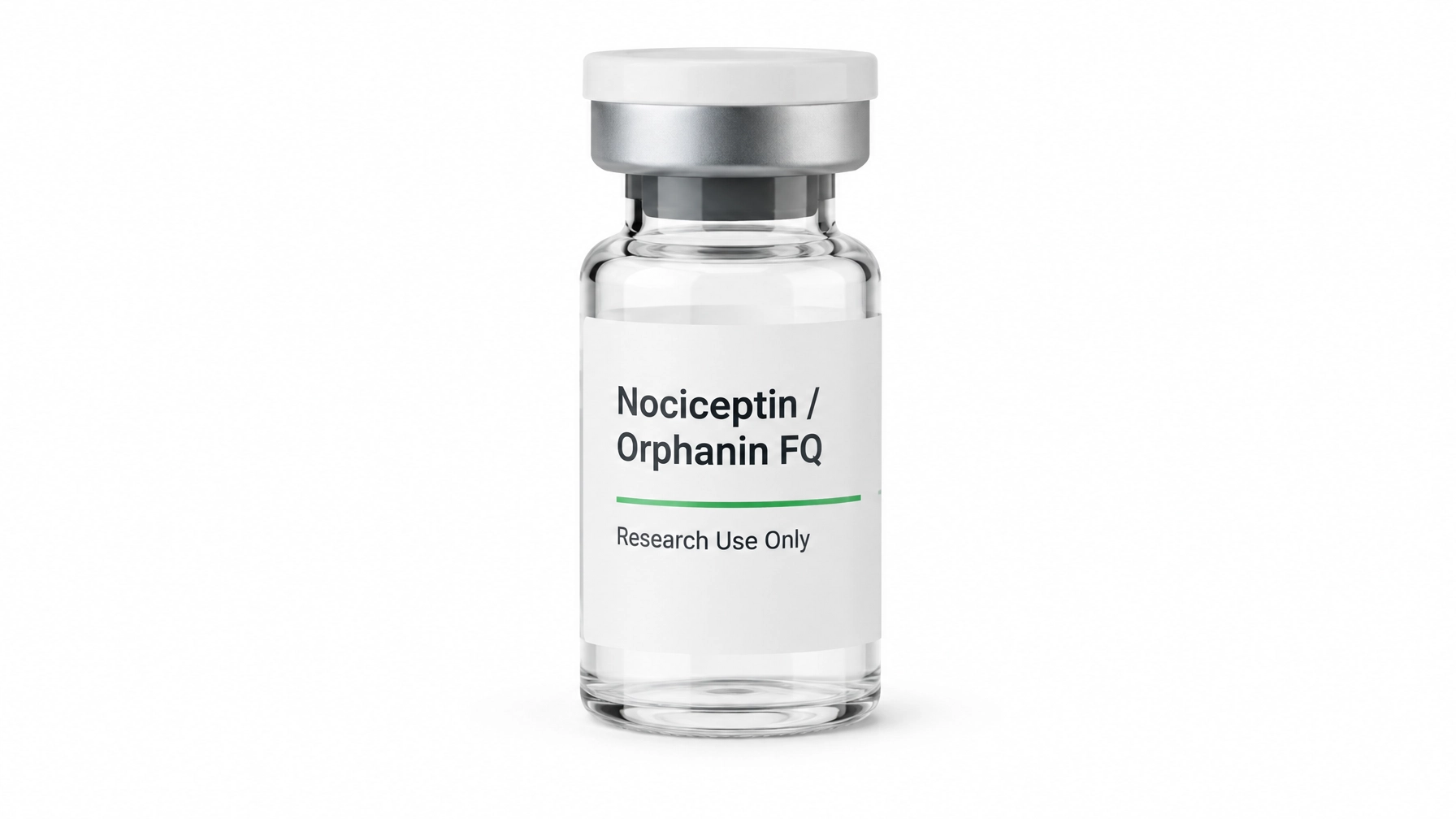
Nociceptin (Orphanin FQ): The Orphan Receptor Peptide Behind NOP Research

Nociceptin, also called orphanin FQ, is a naturally occurring 17-amino-acid neuropeptide. It is the primary endogenous ligand, the body’s own signalling molecule, for the NOP receptor, formerly called ORL1.
At first glance, NOP looks like an opioid receptor. It belongs to the same broad receptor family and uses similar cellular signalling machinery. Yet classic opioids such as morphine do not activate it in the usual way.
That unusual combination makes nociceptin an important research tool. It sits at the intersection of pain, stress, anxiety, reward, addiction and appetite, while repeatedly reminding researchers that biology rarely behaves like a simple on/off switch.
Research note: Nociceptin is discussed here for scientific education only. It is not an approved treatment, supplement or recommendation for self-use.
Quick overview
| Feature | Nociceptin / Orphanin FQ |
|---|---|
| Type | Endogenous neuropeptide |
| Length | 17 amino acids |
| Main receptor | NOP, formerly ORL1 |
| Receptor family | Opioid-receptor-related G-protein-coupled receptor |
| Research areas | Pain, stress, anxiety, reward, addiction and appetite |
| Clinical status | Research compound; not a self-treatment |
| Key scientific lesson | Effects depend on location, dose and biological context |
The problem: a receptor with no known messenger
In the early 1990s, researchers identified and cloned a receptor that looked related to the classical opioid receptors. It had the familiar seven-pass structure of a G-protein-coupled receptor, or GPCR. A type of cellular antenna that receives chemical messages from outside or around a cell.
There was one major problem: nobody knew what naturally activated it.
Scientists called it an orphan receptor. Think of finding a lock in a house without knowing which key belongs to it. The receptor was real, its structure was clear, and it was present in the nervous system, but its biological partner remained missing.
The receptor was initially named opioid receptor-like 1, or ORL1. Today, it is generally called the NOP receptor, short for nociceptin/orphanin FQ peptide receptor.
The solution: reverse pharmacology
Instead of starting with a known natural molecule and searching for its receptor, two research teams took the reverse route:
- Clone and study the receptor.
- Extract molecules from brain tissue.
- Test those molecules against the orphan receptor.
- Identify the natural ligand.
In 1995, two groups independently reported the discovery of the same 17-amino-acid peptide. One team called it nociceptin, while the other named it orphanin FQ. The names reflected different observations: nociceptin was linked to early pain research, while orphanin FQ highlighted the peptide’s relationship with the previously orphaned receptor.
This discovery became a landmark in pharmacology because it helped establish reverse pharmacology as a powerful method for finding previously unknown signalling systems.
Short version: the receptor came first; the peptide was found later.
[Video placeholder: The orphan receptor story, from ORL1 to nociceptin/NOP]
Why NOP is related to opioid receptors, but different
The NOP receptor is a distant cousin of the mu-opioid receptor, delta-opioid receptor and kappa-opioid receptor. These classical opioid receptors are activated by compounds such as endorphins, enkephalins, dynorphins and opioid medicines.
NOP shares several structural features with them:
- It is a GPCR.
- It commonly signals through Gi/Go proteins, which reduce certain cellular signalling pathways.
- It can reduce calcium entry into nerve terminals.
- It can increase potassium conductance, making neurons less likely to fire.
- It can reduce the release of neurotransmitters.
The important difference is the “key shape”. Classic opioids generally do not fit the NOP receptor effectively, and nociceptin does not behave like a conventional ligand at the mu, delta or kappa receptors.
A useful analogy is a family of similar locks. The locks may have the same general design, but each one still requires its own key. Similar appearance does not mean interchangeable function.
| Feature | Classical opioid receptors | NOP receptor |
|---|---|---|
| Typical endogenous ligands | Endorphins, enkephalins and dynorphins | Nociceptin/orphanin FQ |
| Activated by classic opioids? | Often yes | Not in the conventional sense |
| Main research themes | Analgesia, reward and dependence | Pain modulation, stress, reward and appetite |
| Relationship | Core opioid receptor family | Opioid-receptor-related but pharmacologically distinct |
For further reading on brain signalling and peptide research, see WL Australia’s article on neural plasticity and brain pathways.
The pain paradox: one peptide, opposing effects
The pain story is where nociceptin becomes especially instructive.
The frustration is simple: researchers want to classify a molecule as either pain-relieving or pain-promoting. Nociceptin resists that label.
In some experimental settings, nociceptin can increase pain sensitivity. This is called pronociceptive activity, meaning it may promote or amplify nociception, the nervous system’s processing of potentially harmful stimuli. Early studies, particularly involving the brain, reported hyperalgesia, or increased sensitivity to painful stimuli.
In other settings, nociceptin can reduce pain. This is called antinociceptive activity. Spinal and peripheral actions may inhibit the release of excitatory transmitters involved in pain signalling, including glutamate and substance P.
The result can look contradictory:
- In one brain region: nociceptin may increase pain sensitivity.
- In the spinal cord: it may dampen incoming pain signals.
- At different doses: the effect may change.
- During different pain states: inflammation or nerve injury may alter the response.
- With different administration routes: local and central effects may not match.
Think of the nervous system as a sports team rather than a single player. The same midfielder may slow the game in one position but accelerate it in another. The outcome depends on where the player is standing, what instructions they receive and what the rest of the team is doing.
Why this matters for drug discovery
This context-dependence is one reason NOP has attracted attention in pain research. Scientists have investigated both NOP agonists, compounds that activate NOP, and NOP antagonists: compounds that block it.
The objective is not simply to “turn nociceptin up” or “turn it down”. The goal is to understand which receptor actions might be useful in particular pain circuits while avoiding unwanted effects elsewhere.
The lesson: location, dose and disease state can matter as much as the molecule itself.
Stress and anxiety: regulating the alarm system
The brain’s stress response can be compared with a home security system. It is essential when danger is present, but damaging if the alarm remains active long after the threat has passed.
NOP and nociceptin are found in regions involved in stress regulation, including the hypothalamus and limbic structures. These areas help coordinate the hypothalamic-pituitary-adrenal axis, commonly called the HPA axis. This is the hormonal alarm pathway that helps the body respond to stress.
Research has connected the N/OFQ–NOP system with:
- Stress-related behaviour
- Anxiety-like responses in experimental models
- Corticotropin-releasing factor signalling
- Noradrenaline, serotonin and dopamine systems
- Stress coping and emotional regulation
Some studies report anxiety-reducing effects under particular experimental conditions. Other findings are more complex, reflecting differences in brain region, timing and model.
That complexity is important. NOP is not a simple “calm switch”. It appears to act more like a volume control within several connected stress circuits.
If you are researching broader brain and wellbeing compounds, WL Australia’s Brain & Mental Health research category provides related product context. It should not be interpreted as medical advice.
Reward, addiction and dopamine pathways
Reward circuits help the brain decide which behaviours are worth repeating. Dopamine acts like a motivational accounting system, helping assign importance to food, social interaction and drugs of abuse.
NOP is present in parts of the mesolimbic pathway, including the ventral tegmental area and nucleus accumbens. These areas are central to reward and reinforcement.
In preclinical research, nociceptin signalling can:
- Reduce the activity of some dopamine neurons
- Alter dopamine release
- Modulate opioid-driven reward
- Influence drug-seeking behaviour
- Interact with stress-related relapse pathways
- Affect withdrawal and negative emotional states
This has made NOP a major target in addiction research. Scientists have examined whether carefully designed NOP agonists or antagonists could reduce drug reinforcement, stress-induced relapse or the emotional burden associated with withdrawal.
However, animal findings do not automatically translate into safe or effective human treatments. Addiction is a medical condition involving learning, stress, environment, genetics and brain adaptation. NOP research may help explain these systems, but it is not a basis for self-treatment.
[Video placeholder: NOP, dopamine and the stress–reward connection]
Appetite and feeding behaviour
NOP signalling also intersects with appetite and feeding. Research suggests that nociceptin can influence food intake through hypothalamic and reward-related pathways.
The system may connect three processes:
- Energy regulation: the body’s need for fuel.
- Reward: how motivating food feels.
- Stress, how emotional state changes eating behaviour.
This is similar to a car with three control systems: the fuel gauge, the accelerator and the driver’s mood. Appetite is not controlled by one dial alone.
Because nociceptin may influence all three systems, NOP-targeted compounds have been investigated in metabolic and eating research. This area remains less clinically developed than many conventional appetite pathways.
Why researchers continue to study NOP
NOP is attractive as a drug-discovery target because one receptor system connects several major biological problems:
- Pain: Can NOP pathways provide more precise pain modulation?
- Addiction: Can they reduce reward or stress-driven relapse?
- Mood: Can they regulate overactive stress circuits?
- Appetite: Can they clarify the link between feeding and reward?
- Opioid safety: Can NOP biology contribute to opioid-sparing strategies?
The challenge is equally clear: the system is highly context-dependent. A compound that produces a useful effect in one circuit could produce an unwanted effect in another.
That is why serious NOP research focuses on receptor selectivity, brain-region targeting, dose-response relationships, pharmacokinetics and safety, not just attractive headlines.
Nociceptin research at WL Australia
You can review current WL Australia research products and availability through the shop. A dedicated, publicly indexed Nociceptin product URL was not available when this article was prepared, so confirm current listing and stock details directly rather than relying on an assumed product link.
You can also explore the pain research category and related neuropeptide products such as Neuropeptide Y for broader research context. These products are not interchangeable with nociceptin and should not be treated as equivalent.
Safety, legality and responsible research
Nociceptin is a bioactive neuropeptide with effects across the central nervous system. It is not approved for personal use, and research findings do not establish a safe human protocol.
WL Australia states that its products are intended strictly for qualified laboratory and research use. Products must not be used:
- In humans
- In animals
- For self-treatment
- As a substitute for medical care
- Outside applicable Australian laws and institutional requirements
Before any work involving bioactive peptides, qualified researchers should complete appropriate institutional review, risk assessment, storage controls, handling procedures and waste disposal. Anyone experiencing persistent pain, anxiety, appetite changes or substance-use concerns should speak with a qualified Australian health professional.
Read the WL Australia legal disclaimer and check current guidance from the Therapeutic Goods Administration before purchasing or handling research materials.
Bottom line: nociceptin is valuable not because it offers a simple answer, but because it exposes the real complexity of the nervous system. One peptide can influence pain, stress, reward and appetite, and its effect may change with the circuit, dose and biological state. That is precisely why the NOP receptor remains a compelling subject for careful, evidence-led research.
 Immune Support, ant bacterial, anti viral, auto immune.
 Bioregulators
 Brain
 Skin & Hair Products