
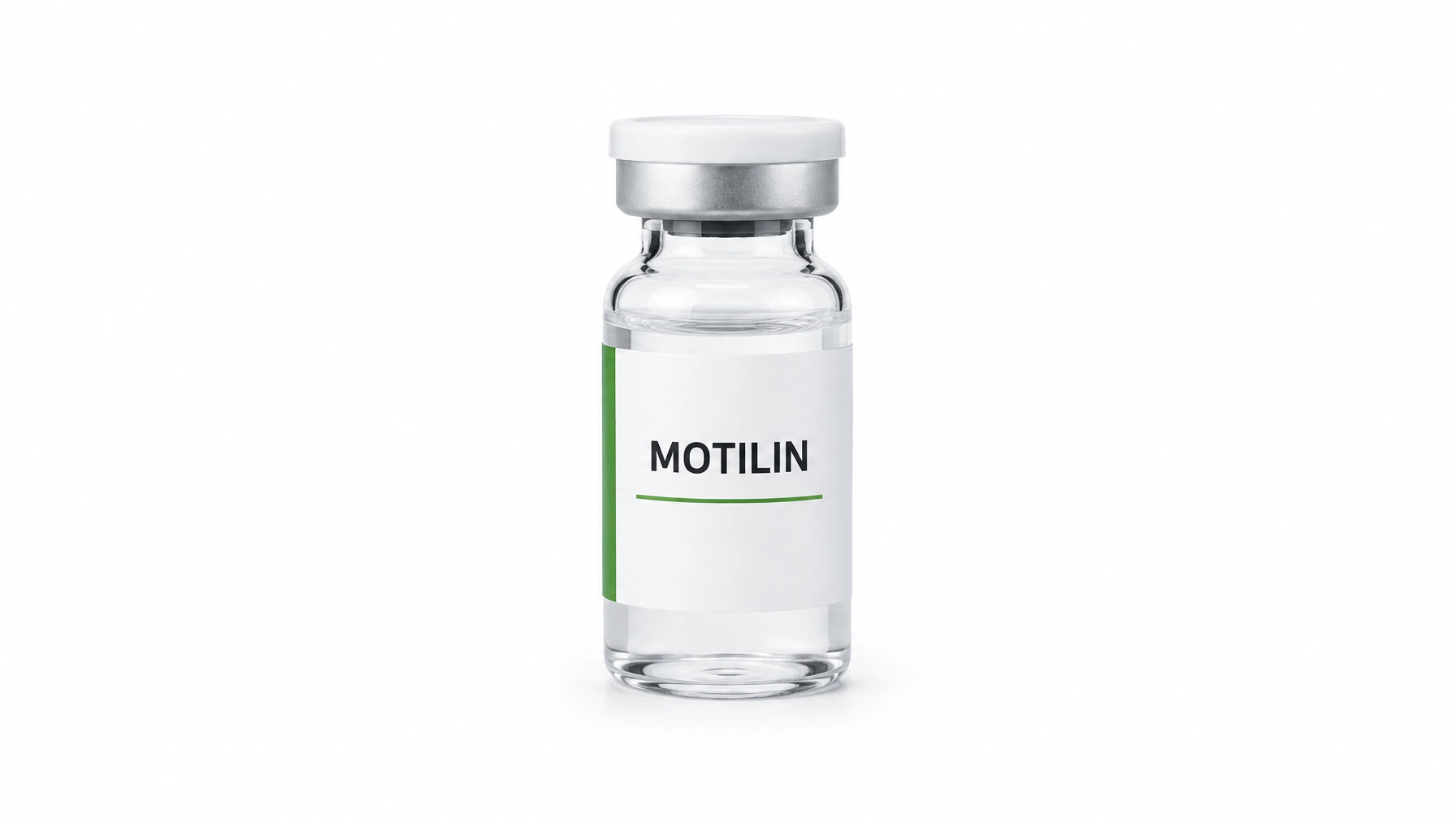
Motilin: The Gut Hormone Driving Digestive Motility Research

Your digestive system is not simply a passive tube. It is an organised transport network, using carefully timed contractions to mix food, absorb nutrients and move waste forward.
One of the hormones involved in this timing system is motilin. A naturally occurring, 22-amino-acid peptide hormone produced mainly in the upper small intestine. Researchers study motilin because it appears to help coordinate the gut’s fasting “clean-up cycle”, influence gastric emptying and communicate with appetite and nervous-system pathways.
This article explains what motilin is, how it works and why it remains an important research subject.
Research-use notice: This article is educational only. Motilin research products are not approved for self-treatment. Do not inject, ingest, reconstitute or otherwise use research chemicals in humans. Speak with a qualified Australian health professional about digestive symptoms or treatment options.
What is motilin?
The problem: digestion needs timing, not constant movement
Your stomach and small intestine must perform different tasks at different times. After a meal, the gut needs to mix food with digestive juices and gradually move the contents forward. Between meals, it needs a different pattern: stronger, sweeping contractions that clear residual material.
Motilin helps coordinate this fasting pattern.
Motilin is a peptide hormone, meaning it is a short chain of amino acids used as a biological messenger. It is produced mainly by specialised endocrine cells in the lining of the duodenum and jejunum. The first and middle sections of the small intestine.
Think of these cells as dispatchers positioned along a transport route. When the gut is in a fasting state, they release pulses of motilin that help signal the next stage of intestinal movement.
The short version: motilin is one of the gut’s timing signals.

From duodenal extracts to modern receptor research
The problem: scientists needed to identify the signal behind gut contractions
Motilin was first identified through studies of intestinal extracts in the early 1970s. Researchers, including J.C. Brown and colleagues, investigated why changes in the duodenum could produce powerful contractions in the stomach.
They isolated a substance from porcine duodenal mucosa that stimulated gastrointestinal motor activity. Because of this effect, it was named motilin. Its complete amino-acid sequence was reported in 1973.
This discovery moved gut-motility research from observation to mechanism. Scientists could now investigate:
- Where motilin is produced
- How it is released during fasting
- Which receptor it activates
- How it affects the stomach and small intestine
- Whether its pathway could be used to understand motility disorders
The sequence was an important building block. It was like identifying the exact key before searching for the lock.
The short version: motilin began as a gut-movement signal isolated from the duodenum and became a foundation for receptor and drug research.
The migrating motor complex: your gut’s housekeeping wave
The problem: food particles and secretions remain after digestion
Between meals, the stomach and small intestine still contain mucus, secretions, bacteria and small food remnants. The gut needs a way to move these materials onward before the next meal arrives.
This is where the migrating motor complex (MMC) becomes important. The MMC is a repeating pattern of contractions that travels through the upper gastrointestinal tract during fasting.
Researchers often describe it as the gut’s housekeeping cycle.
The MMC has several phases, with phase III producing the strongest and most regular contractions. These waves can be compared with a street sweeper moving down a road: they do not digest the material, but they help clear and organise what remains.
Motilin levels often rise in pulses around the time of phase III activity. In humans, motilin appears to be particularly important in coordinating phase III contractions in the stomach and proximal small intestine.
This matters because impaired motility can create a traffic-jam effect. Food may remain in the stomach for too long, movement through the small intestine may become irregular, or symptoms such as fullness, nausea and abdominal discomfort may develop.
The short version: motilin is closely linked with the fasting MMC, especially its powerful phase III sweep.
How motilin signals through GPR38
The problem: a hormone cannot act without a receiving system
Hormones work by binding to receptors. A receptor is like a docking station: it recognises a specific signal and translates it into an action inside the cell.
Motilin binds to the motilin receptor, also known as GPR38 or MTLR. GPR38 is a G protein-coupled receptor (GPCR), a large family of cell-surface receptors that convert outside signals into internal cellular responses.
In the gastrointestinal tract, motilin receptors are found on pathways involving:
- Enteric neurons, which form the local nervous system of the gut
- Smooth muscle cells, which generate contractions
- Regions of the stomach and upper small intestine involved in motor control
When motilin activates its receptor, signalling pathways involving calcium and inositol trisphosphate (IP3) can promote smooth-muscle contraction. In plain English, the hormone helps convert a chemical message into mechanical movement.
That is why researchers study motilin receptor activity when examining gastric emptying and upper-gut motility.

Motilin, gastric emptying and functional bowel conditions
The problem: slow or poorly coordinated movement can be difficult to explain
Gastric emptying refers to how quickly the stomach transfers its contents into the small intestine. If this process is delayed, people may experience early fullness, nausea, bloating or discomfort.
Motilin is studied in relation to:
- Gastroparesis, a condition involving delayed stomach emptying
- Functional dyspepsia, which can involve upper-abdominal discomfort and altered digestive function
- Postoperative ileus, where bowel movement slows after surgery
- Other disorders involving irregular gastrointestinal motility
Motilin is not a universal explanation for these conditions. Digestive movement is controlled by a team of systems, including the enteric nervous system, autonomic nerves, smooth muscle, serotonin, ghrelin and other gut hormones.
Think of it as a sports team. Motilin may be an important midfielder, but it does not control the entire match.
Research into motilin can still help scientists understand why some people experience delayed or poorly coordinated movement, and whether selective motilin-receptor medicines could offer useful options in the future.
The short version: motilin is a research target, not a proven answer for every digestive complaint.
Erythromycin: the antibiotic that revealed a motilin connection
The problem: researchers needed a way to activate the motilin receptor
An important development in motilin research came from an unexpected source: erythromycin.
Erythromycin is a macrolide antibiotic. Researchers discovered that, in addition to its antibacterial action, it can activate the motilin receptor. This means erythromycin can produce motilin-like contractions and stimulate gastric emptying in some clinical settings.
The connection helped confirm that the motilin receptor was functionally important. Erythromycin acted like a substitute key for the same lock.
| Feature | Native motilin | Erythromycin |
|---|---|---|
| Biological type | 22-amino-acid peptide hormone | Macrolide antibiotic |
| Main research action | Activates the motilin receptor | Can activate the same receptor |
| Gut effect | Promotes MMC-like contractions | May stimulate gastric emptying |
| Main limitation | Research and physiological complexity | Antibiotic resistance, interactions and cardiac risks |
| Long-term use | Not established for self-treatment | Often limited by tachyphylaxis and safety concerns |
Erythromycin has been investigated as a short-term prokinetic, meaning a substance that increases gastrointestinal movement. However, it is not simply a digestive supplement. It is a prescription medicine with important risks, including drug interactions, possible QT-interval prolongation and the wider problem of antibiotic resistance.
Repeated exposure may also cause tachyphylaxis, where the response becomes weaker over time. This has encouraged research into “motilides”. Non-antibiotic compounds designed to imitate motilin-receptor activity without antibacterial effects.
The short version: erythromycin helped prove the motilin receptor could be targeted, but it is not a risk-free motility solution.
The gut-brain angle
The problem: digestion and appetite do not operate independently
Your gut and brain communicate through several overlapping channels, including hormones, the vagus nerve, the enteric nervous system and circulating chemical signals.
Motilin is released during fasting and has been associated with hunger-related gastrointestinal contractions. When the stomach contracts during the MMC, you may notice rumbling or a sensation of hunger. This does not mean every hunger signal is caused by motilin. Instead, motilin forms part of a wider gut-brain network.
This network also includes ghrelin, a hormone strongly associated with appetite and growth-hormone signalling. Motilin and ghrelin share some functional similarities, but they are not interchangeable.
You can explore related research through WL Australia’s Ghrelin product page and Neuropeptide Y product page. Neuropeptide Y is involved in appetite and nervous-system signalling, offering a useful comparison with motilin’s gut-motility role.
The short version: the gut-brain axis is a communication network, not a single hormone pathway.
Motilin as a research product
The problem: research interest can be confused with established treatment
Motilin is scientifically interesting because it connects:
- Small-intestinal endocrine cells
- The fasting MMC
- Gastric emptying
- Smooth-muscle contraction
- GPR38 receptor signalling
- Appetite and gut-brain communication
- The development of prokinetic medicines
However, a research peptide is not the same as an approved medicine or dietary supplement.
You can browse WL Australia’s current research peptide catalogue for product availability. A dedicated Motilin product URL was not available in the public catalogue reviewed for this article, so check the current listing directly rather than relying on an unverified third-party page.
For broader gastrointestinal peptide reading, see the Neurotensin product page and the research article on Dalargin and gastroprotection.
Video placeholder 1: Explainer video, How motilin and the migrating motor complex move through the fasting gut.
Video placeholder 2: Research video, Motilin receptor GPR38, erythromycin and the search for selective prokinetic compounds.
Safety, regulation and responsible next steps
The problem: digestive symptoms may have many causes
Bloating, nausea, reflux, constipation, diarrhoea and early fullness can result from dietary factors, medication effects, infection, inflammation, motility disorders or other medical conditions.
Do not use motilin or any research peptide to self-treat these symptoms. Research products may not have been assessed for human safety, quality, sterility, dose accuracy or effectiveness.
Before considering any peptide-related research discussion:
- Speak with a qualified clinician, especially if symptoms are persistent or worsening.
- Seek urgent medical attention for severe abdominal pain, repeated vomiting, blood in stool, black stools, unexplained weight loss or difficulty swallowing.
- Do not replace a diagnostic assessment with an online protocol.
- Check Australian regulatory requirements through the Therapeutic Goods Administration.
- Remember that “research use only” labelling does not make a product suitable for human use.
Motilin research may help scientists understand digestive motility more clearly. For you, the practical goal is simpler: identify the cause of symptoms, use evidence-based care and treat the gut as an integrated system.
Motilin is a signal. The real objective is safe, informed optimisation.
 Immune Support, ant bacterial, anti viral, auto immune.
 Bioregulators
 Brain
 Skin & Hair Products