
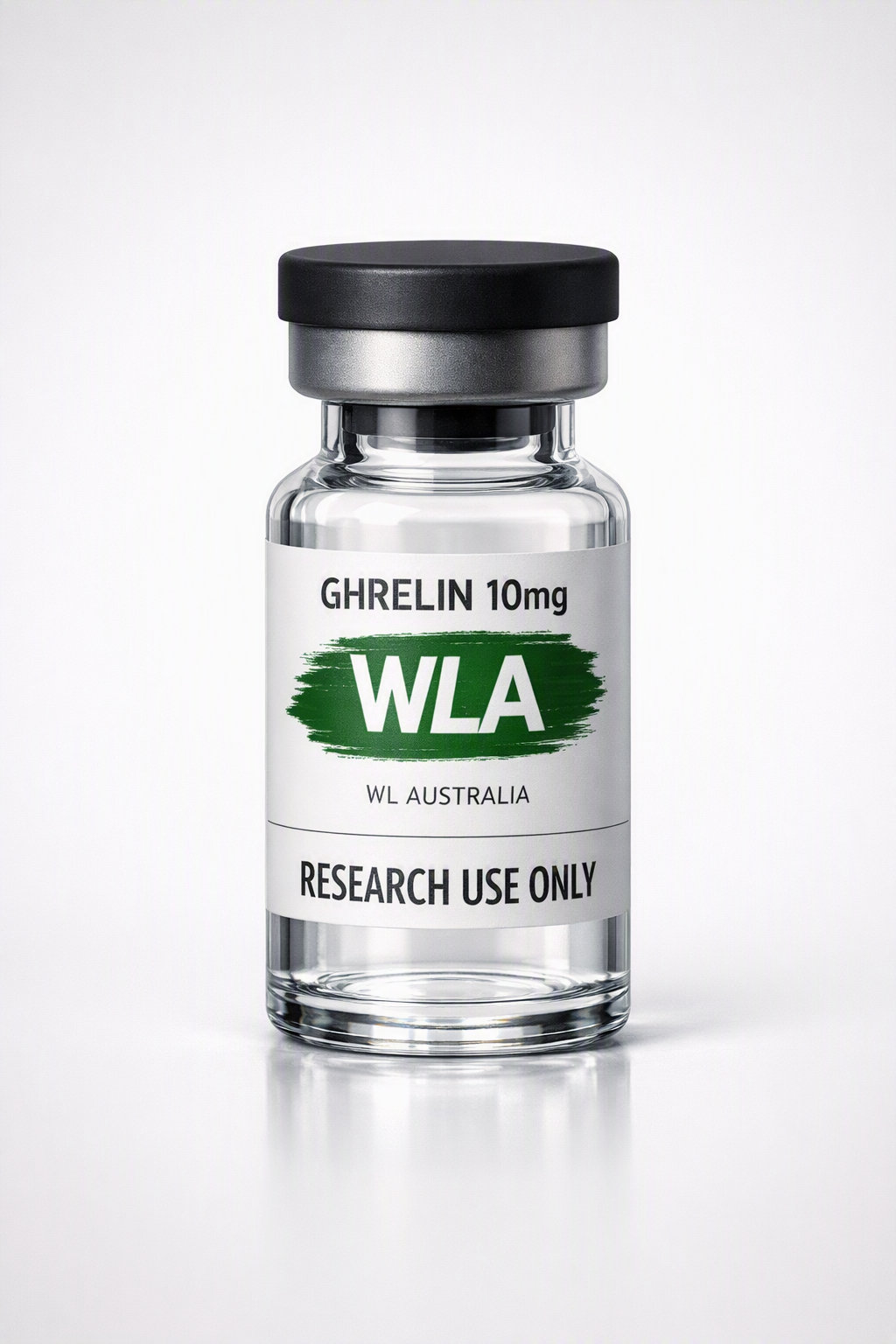
Ghrelin and the GHS-R1a Receptor: Acylated vs Unacylated Ghrelin in Growth Hormone Research

Ghrelin is often called the “hunger hormone”, but that description only covers one part of its biology. In growth hormone research, ghrelin is especially important because it was identified as the body’s natural ligand for the growth hormone secretagogue receptor type 1a (GHS-R1a).
This receptor acts like a biological switch. When activated by the correct form of ghrelin, it can stimulate growth hormone release from the pituitary and influence signalling between the stomach, brain and endocrine system.
The key detail is easy to miss: not all ghrelin is equally active.
The fatty-acid modification attached to ghrelin determines whether it can effectively engage GHS-R1a. This article explains the difference between acylated ghrelin and unacylated ghrelin, the role of GHS-R1a, and why this distinction matters in laboratory research.
Research-only notice: WL Australia Ghrelin 10mg is supplied as a research chemical only and is not for human use. This article is educational and does not provide a treatment protocol, dosage instructions or medical advice. Do not self-administer research peptides. Any investigation involving human health, hormone testing or endocrine function must be reviewed by an appropriately qualified clinician and conducted under applicable Australian regulations.
Why ghrelin research begins with the growth hormone secretagogue receptor
The research problem: Growth hormone release is controlled by several overlapping signals. Looking only at the pituitary is like trying to understand a sports team by watching the scoreboard without observing the players.
The solution is to examine the entire signalling pathway.
Ghrelin was discovered as the endogenous, or naturally occurring, ligand for GHS-R1a. A ligand is a molecule that binds to a receptor and changes its activity. In this case, ghrelin acts on a receptor found in key areas of the hypothalamus and anterior pituitary.
The receptor belongs to the G protein-coupled receptor (GPCR) family. GPCRs are like communication panels on the surface of cells. When the right molecular signal reaches the panel, it activates internal pathways.
For GHS-R1a, those pathways are associated with:
- Growth hormone release from pituitary somatotrophs, the specialised cells that produce growth hormone
- Hypothalamic control of growth hormone-releasing hormone, or GHRH
- Modulation of somatostatin, a hormone that can restrain growth hormone release
- Appetite and energy-balance signalling
- Broader cardiovascular, neurological and tissue-maintenance research
Ghrelin therefore does not function as a simple “on” button. It is more like a control signal entering a network of linked systems.
Short version: Ghrelin research is fundamentally receptor research.
Acylated versus unacylated ghrelin: one modification, a major difference

The research problem: Ghrelin molecules can circulate in different chemical forms. If researchers treat them as interchangeable, they may confuse two very different biological signals.
The solution is to identify the acylation state before interpreting results.
The most studied active form is acylated ghrelin (AG). It contains an eight-carbon fatty-acid group, commonly called an octanoyl group, attached to the third amino acid in the peptide chain, serine-3.
This attachment is produced by ghrelin O-acyltransferase (GOAT), an enzyme that adds the fatty-acid group to ghrelin.
Unacylated ghrelin, also called des-acyl ghrelin (UAG), lacks this fatty-acid group. It is the more abundant circulating form, while acylated ghrelin usually represents a smaller fraction of total circulating ghrelin.
Think of the acyl group as a specialised key grip. The peptide provides the general shape, but the fatty-acid modification helps the molecule fit and activate the GHS-R1a receptor effectively.
Without that modification, ghrelin’s interaction with GHS-R1a becomes extremely weak under normal physiological conditions.
Acylated vs unacylated ghrelin
| Feature | Acylated ghrelin (AG) | Unacylated/des-acyl ghrelin (UAG) |
|---|---|---|
| Chemical structure | Fatty-acid group attached to serine-3 | No fatty-acid group at serine-3 |
| Enzyme involved | GOAT adds the acyl group | Remains non-acylated or may result from deacylation |
| Circulating proportion | Usually the minor circulating form | Usually the major circulating form |
| GHS-R1a binding | High, generally in the nanomolar range | Very low, with reported activity mainly at much higher concentrations |
| Growth hormone activity | Potent growth hormone secretagogue | Little or no meaningful GHS-R1a-mediated GH release at physiological levels |
| Main research interpretation | Canonical active ghrelin signal | Distinct form with possible GHS-R1a-independent actions |
| Appetite signalling | Strongly associated with orexigenic, or appetite-stimulating, activity | Does not replicate all acylated ghrelin effects |
| Key caution | Activity depends on concentration, context and receptor biology | Should not be assumed to be an inactive “waste” form |
The important conclusion is not that unacylated ghrelin has no biological relevance. Instead, it appears to operate differently. Research has examined its possible roles in glucose regulation, cellular protection, neurobiology and tissue metabolism, including mechanisms that may not depend on GHS-R1a.
Some experimental findings also suggest that local conversion or alternative binding partners may influence UAG activity. These areas remain under investigation.
Short version: Acylation changes the message.
How GHS-R1a supports growth hormone release
The research problem: It is easy to describe ghrelin as directly “raising growth hormone” without explaining where and how the signal acts.
The solution is to separate the pituitary and hypothalamic components.
At the pituitary, acylated ghrelin can bind GHS-R1a on somatotrophs. This is the direct route: the receptor is activated on the growth-hormone-producing cell, encouraging release of stored growth hormone.
At the hypothalamus, ghrelin can influence the balance between:
- GHRH, which promotes growth hormone release
- Somatostatin, which acts as a braking signal
- Other neural pathways involved in appetite and energy availability
This arrangement resembles a construction site. GHRH is part of the instruction to begin work, somatostatin is the site manager applying a pause, and ghrelin helps coordinate whether the project has enough energy and the right hormonal conditions to proceed.
Ghrelin may also act in synergy with GHRH. Synergy means the combined effect of two signals can be greater than either signal acting alone. This is one reason researchers study ghrelin alongside other growth hormone secretagogue pathways.
The resulting growth hormone output is generally pulsatile rather than continuous. That matters because endocrine systems often communicate in pulses, like a series of timed radio signals rather than one uninterrupted broadcast.
Growth hormone can then influence the liver and other tissues, including pathways involving insulin-like growth factor-1 (IGF-1). IGF-1 is a hormone involved in growth, tissue signalling and feedback regulation of the growth hormone axis.
However, a laboratory increase in a hormone signal should not automatically be interpreted as a health benefit. Receptor activation, hormone release and clinical outcomes are separate questions.
Short version: Receptor activation is not the same as treatment.
[Video placeholder: How acylated ghrelin activates GHS-R1a and influences pituitary growth hormone release]
Ghrelin’s place in appetite and energy homeostasis

The research problem: Ghrelin is frequently reduced to the phrase “hunger hormone”, which can hide its broader role in energy management.
The solution is to view appetite as one part of a larger feedback system.
Ghrelin is produced predominantly in the stomach, particularly in the gastric fundus. Levels can change in relation to fasting and feeding. The stomach is not simply a storage bag; it also acts as an endocrine sensor that reports nutritional status to the brain.
Through GHS-R1a and related pathways, acylated ghrelin can influence:
- Appetite and food-seeking behaviour
- Energy expenditure
- Glucose regulation
- Insulin signalling
- The relationship between available energy and growth hormone secretion
This is logical from a biological perspective. Growth, repair and recovery require resources. A car would not begin a long journey without checking its fuel gauge. Similarly, the ghrelin system links energy availability with neuroendocrine signalling.
This appetite-focused biology is distinct from the primary focus of this article: the acylation-dependent mechanism of growth hormone secretagogue activity. For further background on related growth hormone receptor research, see WL Australia’s Ipamorelin research guide and its article on hormone signalling with peptides.
Broader research: cardiovascular function and bone
The research problem: A receptor pathway involved in appetite and growth hormone release may also appear in other organs. That can create excitement, but it can also encourage overstated claims.
The solution is to separate promising research areas from established medical use.
Ghrelin signalling has been studied in cardiovascular models, including research into:
- Cardiac contractility and myocardial function
- Inflammatory signalling
- Vascular responses
- Protection during metabolic or physiological stress
These studies suggest that ghrelin biology may extend beyond the pituitary. However, findings from cell and animal models cannot automatically be applied to people.
Bone is another active research area. Growth hormone, IGF-1, energy balance and bone remodelling are closely connected. Researchers have examined whether ghrelin-related signalling may influence:
- Osteoblast activity, involving bone-forming cells
- Osteoclast activity, involving bone-resorbing cells
- Bone marrow energy metabolism
- The interaction between adipose tissue and bone tissue
The bone environment is like a building under constant renovation: old material is removed, new material is added and the final structure depends on the balance between both processes. Ghrelin may be one of several signals helping coordinate that balance.
These findings are scientifically relevant, but they do not establish Ghrelin as a treatment for cardiovascular disease, osteoporosis, muscle loss or growth disorders.
Using the Ghrelin product page for research context

WL Australia’s Ghrelin 10mg product page identifies the product as a research chemical only and not for human use.
When reviewing ghrelin research, focus on the following checkpoints:
- Confirm whether the study used acylated, unacylated or another modified form
- Record the receptor system, especially whether GHS-R1a was present
- Distinguish cell, animal and human research
- Check whether the outcome was receptor activation, growth hormone release, IGF-1 change or a clinical endpoint
- Avoid treating product descriptions as evidence of safety or efficacy
- Consider Australian regulatory requirements and clinician oversight before any human-related investigation
For related growth hormone pathway reading, explore the CJC-1295 comparison article and the Hexarelin research article. For a wider metabolic perspective, see WL Australia’s AICAR research article.
[Video placeholder: Acylated and unacylated ghrelin compared in a laboratory research workflow]
Safety, interpretation and the next research question
Ghrelin is a powerful example of how a small chemical change can reshape biological activity. The acyl group helps determine whether ghrelin can effectively activate GHS-R1a and participate in growth hormone signalling.
The central principles are simple:
- Acylation determines receptor activity.
- GHS-R1a connects ghrelin with growth hormone release.
- Unacylated ghrelin is biologically distinct, not merely a weaker copy.
- Appetite, cardiovascular and bone effects require separate evaluation.
- Research findings do not equal treatment recommendations.
Do not self-treat with ghrelin or any growth hormone secretagogue. Hormone pathways involve feedback loops, receptor sensitivity, glucose regulation and interactions with existing conditions or medicines. Any human health concern should be discussed with a qualified Australian clinician.
Research carefully. Interpret cautiously. Optimise knowledge before considering application.
 Immune Support, ant bacterial, anti viral, auto immune.
 Bioregulators
 Brain
 Skin & Hair Products