
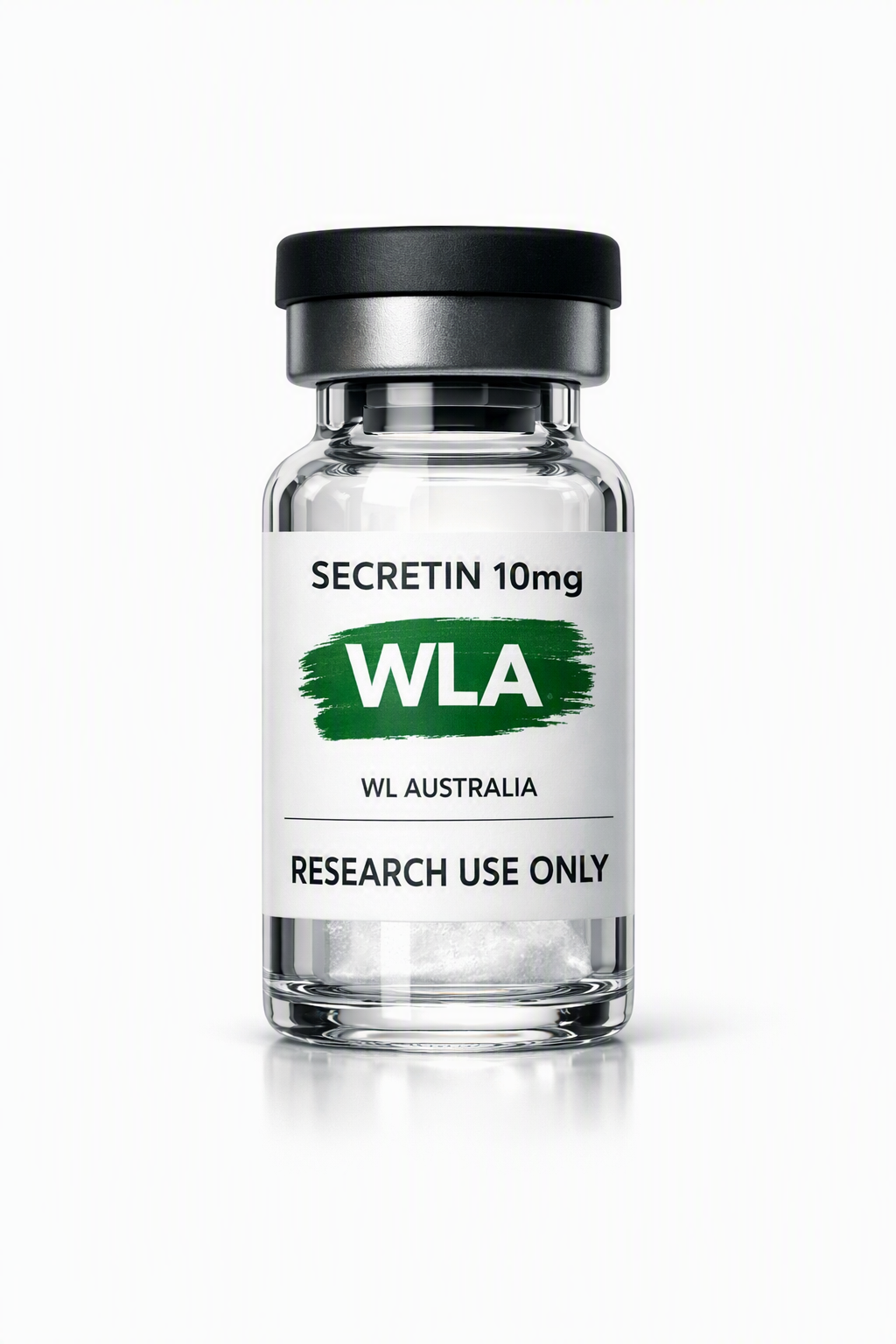
Secretin: The Original Gut Hormone and Its Unexpected Brain Research

Secretin is a 27-amino-acid peptide hormone best known for helping your digestive system handle stomach acid. It is also historically important: its discovery in 1902 helped scientists define the very idea of a hormone. A chemical messenger that travels through the body to coordinate distant organs.
Today, secretin remains a useful model for understanding the gut–pancreas connection, while modern research has also examined its presence in the brain, its receptor family and possible links with social behaviour.
This article explains what secretin does, what researchers have learned and where the evidence stops.
Important: WL Australia products are supplied for laboratory and research use only. They are not approved for human or animal use, self-treatment or personal supplementation. Do not use Secretin without appropriate clinical oversight.
Secretin at a glance
| Feature | What researchers understand |
|---|---|
| Peptide length | 27 amino acids |
| Main source | S cells in the duodenum and upper small intestine |
| Primary trigger | Acidic stomach contents entering the duodenum |
| Main target | Pancreatic and bile duct cells |
| Key action | Stimulates bicarbonate-rich fluid to neutralise acid |
| Receptor type | Class B G protein-coupled receptor, or GPCR |
| Research areas | Digestion, fluid balance, gut–brain signalling and neurobiology |
Why was secretin historically important?
The problem: scientists could not explain how the intestine controlled the pancreas
At the beginning of the twentieth century, many researchers believed the nervous system controlled digestion almost entirely. Bayliss and Starling challenged this view in 1902 while studying pancreatic secretion.
They observed that acid placed in the intestine could cause the pancreas to release digestive fluid, even when normal nerve connections were not responsible for the response. They then prepared an extract from intestinal tissue and found that it could stimulate pancreatic activity when introduced into the bloodstream.
They named the substance secretin.
The solution: a new model of internal communication
Secretin showed that one organ could release a chemical messenger into the blood, which then travelled to another organ and changed its behaviour. This helped establish the modern endocrine concept.
Think of the body as a large construction site:
- The stomach delivers a load of acidic material.
- The duodenum acts as the site supervisor.
- Secretin is the urgent radio message.
- The pancreas and bile ducts receive the message and send alkaline bicarbonate to neutralise the load.
That discovery made secretin more than another digestive molecule. It helped create the scientific language used to describe hormones today.
Short summary: Secretin helped prove that the body communicates through chemical messages, not only nerves.
How is secretin released in the gut?
The problem: acidic stomach contents can irritate the small intestine
After a meal, the stomach releases partially digested food called chyme into the duodenum. The first section of the small intestine. This chyme can be highly acidic because it has mixed with gastric acid.
Your small intestine needs a protective buffer before digestive enzymes can work efficiently.
The solution: duodenal S cells release secretin
Specialised cells called S cells detect the acidic environment. When the duodenal contents become sufficiently acidic, these cells release secretin into the bloodstream.
Secretin then travels to the pancreas and biliary system.
This process resembles a pH alarm in a swimming pool. When acidity rises beyond the safe range, the alarm activates a neutralising response. Secretin is part of that biological alarm system.
Fatty acids and other digestive conditions can also influence secretin release, but acid entering the duodenum is the classic trigger.
What does secretin do to the pancreas?
The problem: pancreatic enzymes work poorly in excessive acid
The pancreas supplies digestive enzymes that help break down fats, proteins and carbohydrates. However, the chemical environment must be carefully controlled. Too much acid can interfere with enzyme activity and irritate the intestinal lining.
The solution: secretin stimulates bicarbonate-rich pancreatic fluid
Secretin acts mainly on pancreatic duct cells. These cells release fluid containing bicarbonate, an alkaline substance that helps neutralise acid.
You can think of bicarbonate as the fire-control system in a commercial kitchen. It does not remove the food being processed; it brings the environment back into a safer operating range.
Secretin also helps coordinate broader pancreatic secretion. However, it is important to understand the division of labour:
- Secretin: strongest role in bicarbonate and fluid secretion.
- Cholecystokinin (CCK): a major signal for pancreatic digestive enzyme release.
- Acetylcholine and other gut signals: also help regulate pancreatic activity.
So, secretin contributes to the digestive enzyme environment, but it does not work alone. Digestion is a team sport, not a single-player system.
For broader background on gut signalling and intestinal research, see WL Australia’s gut health restoration protocol and Enterogen intestinal bioregulator research guide.
How does secretin affect bile and stomach acid?
The problem: the digestive tract must control acid at several points
Neutralising acid in the duodenum is only one part of the process. The stomach must also regulate acid production and emptying, while the biliary system must move fluid into the intestine.
The solution: secretin coordinates several linked responses
Secretin has several connected actions:
-
Pancreatic bicarbonate release
It encourages the pancreas to send alkaline fluid into the duodenum. -
Bile duct secretion
Secretin stimulates cholangiocytes, the cells lining the bile ducts, to release water and bicarbonate. This supports bile flow and helps create a more alkaline environment. -
Gastric acid regulation
Secretin can reduce gastric acid secretion, decrease gastrin release and slow gastric emptying. These actions help limit the amount of acid arriving in the duodenum at one time. -
Negative feedback
As bicarbonate neutralises the acid, the original trigger for secretin release becomes weaker. This is a classic negative feedback loop.
A thermostat works in a similar way. When a room becomes too warm, the cooling system activates. Once the temperature returns to the target range, the signal reduces. Secretin follows the same basic logic for intestinal acidity.
The core principle: acid enters, secretin signals, bicarbonate responds, acidity falls.
Video placeholder: Secretin 101. How the duodenum, pancreas and bile ducts work together to control digestive pH.
Why is secretin being studied in the brain?
The problem: hormones are often treated as organ-specific
It is tempting to place secretin in a single category: “a gut hormone.” But many biological messengers operate across multiple systems.
Research has identified secretin and secretin-receptor expression in parts of the central nervous system, including areas involved in fluid balance and homeostasis. The processes that keep internal conditions stable.
Secretin has been studied in relation to neurons in the hypothalamus, a brain region that helps regulate:
- Body-water balance
- Appetite and energy signals
- Stress responses
- Endocrine communication
- Social and behavioural circuits
The brain is not an isolated computer. It is more like a control room connected to the rest of the building. Signals from the gut, pancreas, liver and immune system can all influence its activity.
Secretin belongs to the class B GPCR family. GPCR means G protein-coupled receptor, a type of cell-surface receptor that converts an outside chemical message into an internal cellular response. Related receptors include those for:
- Vasoactive intestinal peptide, or VIP
- Glucagon
- Pituitary adenylate cyclase-activating polypeptide, or PACAP
The shared receptor family is scientifically interesting because it shows how similar molecular “locks” can respond to different chemical “keys,” producing different effects depending on the tissue.
For related educational reading, explore Cerluten and brain research and WL Australia’s article on neural plasticity research.
What happened with secretin and autism research?
The problem: early reports created high expectations
In the late 1990s, case reports and uncontrolled observations suggested that secretin might improve communication, language or behaviour in some children with autism spectrum disorder.
The reports attracted significant public and media attention. However, uncontrolled observations cannot reliably separate a treatment effect from expectation, natural development, changes in routine or other influences.
The solution: controlled clinical trials
Researchers subsequently conducted placebo-controlled trials. These studies compared secretin with an inactive placebo under more rigorous conditions.
The overall result was clear: controlled trials did not demonstrate a reliable benefit for secretin in the core features of autism, including language, behaviour or social interaction.
This is an important example of why promising early observations must be tested properly. A biological mechanism can be interesting without becoming an effective treatment.
Secretin’s presence in the brain does not prove that administering secretin will improve social behaviour. It only tells researchers that the molecule and its receptor system may be relevant to further investigation.
Honest conclusion: secretin is important in digestive physiology and neurobiology, but it is not an established treatment for autism.
Video placeholder: From early hypothesis to controlled trials, what secretin and autism research actually showed.
What is the WL Australia Secretin product?
The Secretin 10 mg research listing is presented for laboratory research. It is not a registered medicine, approved supplement or recommendation for human use.
When reviewing any research peptide, focus on:
- Identity: Is the compound clearly labelled?
- Documentation: Are appropriate quality documents available for the intended research setting?
- Storage: Does the laboratory follow the supplier’s handling information?
- Regulatory status: Is the proposed use lawful in Australia?
- Oversight: Has a qualified professional reviewed the project?
Do not translate a research listing into a personal treatment plan.
Safety, legal compliance and responsible research
Secretin interacts with digestive and neuroendocrine signalling systems. That makes responsible handling essential.
In Australia, regulations can depend on the substance, its classification, how it is supplied and how it is used. Review the WL Australia legal disclaimer and obtain independent advice about applicable Australian and state or territory requirements.
You should also remember:
- Do not self-administer research-grade Secretin.
- Do not use it to treat autism, digestive disease or any other condition.
- Do not use research material in humans or animals.
- Do not assume that “naturally occurring” means safe when supplied externally.
- Ask a qualified clinician about symptoms such as persistent reflux, abdominal pain, unexplained weight loss or ongoing diarrhoea.
Secretin is a classic example of biological synergy: the stomach, duodenum, pancreas, bile ducts and brain communicate through overlapping signals. Understanding that system can help you take control of your health education, but education must remain separate from unsupervised treatment.
Final takeaway
Secretin began as a discovery that changed physiology. It showed that the gut could send a chemical message through the bloodstream, helping establish the modern concept of hormones.
Its main job is practical and protective: when acidic stomach contents enter the duodenum, secretin helps coordinate bicarbonate-rich pancreatic and biliary secretions while moderating gastric acid activity.
Its presence in the brain has opened a second research pathway involving fluid balance, receptor biology and social behaviour. Yet the autism treatment story also provides a necessary lesson: interesting biology is not the same as proven therapy.
Research with discipline. Prioritise evidence, clinician review, legal compliance and safety at every stage.
 Immune Support, ant bacterial, anti viral, auto immune.
 Bioregulators
 Brain
 Skin & Hair Products