
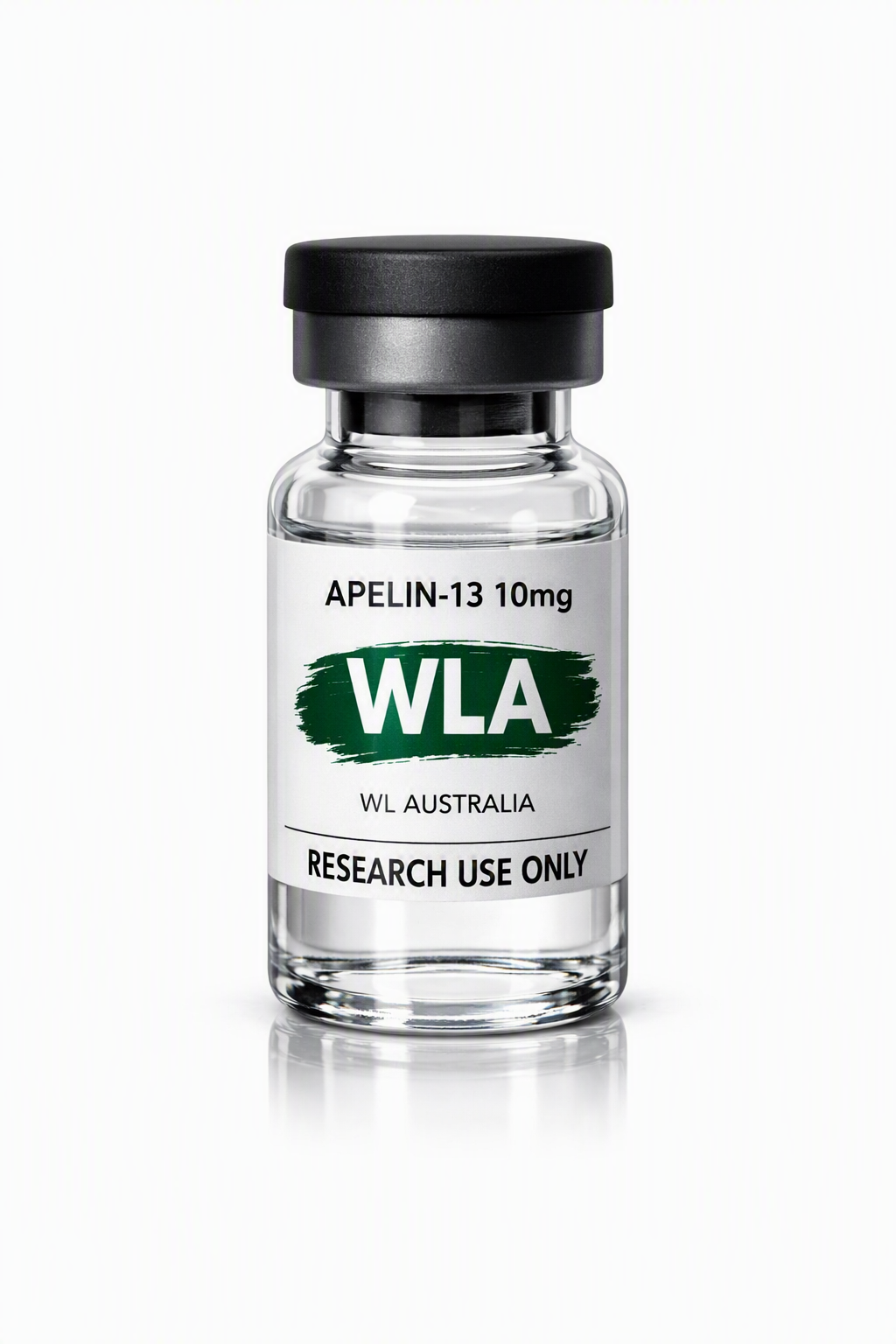
Apelin-13: The APJ Receptor Peptide for Cardiovascular and Metabolic Research

Apelin-13 is a short, naturally occurring peptide attracting interest across cardiovascular, metabolic, fluid-balance and neuroscience research. It contains 13 amino acids and is widely described as one of the most potent and biologically active forms of the apelin family.
The key point is simple: Apelin-13 is a signalling molecule, not a conventional nutrient. It acts through the APJ receptor, now formally called APLNR, short for apelin receptor, to influence several systems at once.
This makes it scientifically important, but also complex. Think of Apelin-13 as a message sent through a large biological communications network. The same message may produce different results depending on the tissue receiving it, the condition of that tissue and the other signals active at the same time.
Research status: Apelin-13 remains an active preclinical research subject. The product discussed in this article is listed as a research chemical and not for human use.
What is Apelin-13?
The problem: one peptide family, many names
The apelin system can be confusing because the body produces several related peptide fragments from a larger precursor molecule called preproapelin.
Researchers commonly discuss:
- Apelin-36
- Apelin-17
- Apelin-13
- [Pyr¹]-apelin-13, a pyroglutamyl form with a modified first amino acid
These peptides share a common origin but do not behave identically. Their stability, distribution and receptor activity can differ, rather like different keys cut from the same original design.
The solution: focus on the most active short form
Apelin-13 draws particular attention because it is a small, potent fragment with strong activity at the APJ/APLNR receptor. It is frequently studied in cardiovascular experiments because of its effects on:
- Vascular tone
- Cardiac contractility
- Blood pressure regulation
- Ischaemia and reperfusion injury
- Glucose utilisation
- Insulin sensitivity
- Brain and blood-brain barrier protection
Apelin was first identified as the endogenous ligand, the body’s natural activating messenger, for the previously “orphan” APJ receptor. The term orphan receptor means researchers had identified the receptor before they knew which natural molecule activated it.
In short: Apelin-13 helps researchers study how one receptor can coordinate heart, blood-vessel and metabolic signals.

The APJ receptor: a cardiovascular system with two faces
The problem: cardiovascular signalling is rarely one-directional
Many people expect a biological pathway to be either protective or harmful. The APJ system does not fit neatly into that category.
In healthy experimental settings, Apelin-13 signalling may support:
- Nitric oxide-dependent vasodilation
- Improved blood flow
- Increased cardiac contractility
- Lower peripheral vascular resistance
- Better tissue resilience during low-oxygen stress
However, the same pathway can behave differently in disease models, altered vascular beds or abnormal tissue environments. Apelin/APLNR signalling has also been linked to vascular remodelling, angiogenesis and disease-related changes. This is why researchers describe the receptor as context-dependent.
The solution: study the whole system, not one claim
The APJ receptor is unusual because it sits close to several major control systems, including the renin-angiotensin system, or RAS. RAS helps regulate blood pressure, vascular constriction, kidney function and fluid balance.
Apelin/APLNR signalling is often described as a counter-regulatory partner to parts of the RAS. A simple analogy is a car with both an accelerator and a braking system. Angiotensin II acting through the AT₁ receptor can promote vasoconstriction and other pressure-raising effects, while apelin signalling may support vasodilation and cardiac performance.
That analogy is useful, but it is not a complete explanation. Apelin-13 is not a replacement for blood-pressure medication, and it should not be treated as a natural RAS blocker. Human and animal findings vary according to dose, timing, species and disease state.
For a detailed comparison of cardiovascular peptide research, explore The Heart-Guard: Exploring the Cardioprotective Power of Hexarelin and Cardiogen: Keeping Your Heart in the Right Rhythm.
Video placeholder: Apelin-13 and the APJ/APLNR receptor
Insert an educational video explaining receptor signalling, vasodilation and the relationship between the apelin system and the renin-angiotensin system.
Cardiovascular research: vessels, contractility and recovery
The problem: the heart must pump strongly without placing excess strain on the circulation
Cardiac performance depends on more than how forcefully the heart contracts. The heart must also pump against an appropriate level of vascular resistance.
Research on Apelin-13 focuses on both sides of this equation:
- Vasodilation: relaxation of blood vessels can reduce resistance and improve flow.
- Positive inotropy: increased force of heart-muscle contraction may improve cardiac output.
In this context, cardiac output means the amount of blood the heart pumps per minute. Inotropy refers to the strength of cardiac contraction.
Experimental studies suggest that apelin peptides can activate endothelial pathways involving nitric oxide, a short-lived signalling molecule that helps blood vessels relax. Other work indicates that Apelin-13 may increase the sensitivity of heart-muscle contractile machinery to calcium, helping the heart generate force without necessarily causing the same calcium overload associated with some forms of cellular stress.
Researchers are also examining Apelin-13 during ischaemia and reperfusion. Ischaemia means reduced blood and oxygen delivery. Reperfusion occurs when blood flow returns. Although restoring circulation is essential, the sudden return of oxygen can create oxidative stress and cellular injury. Similar to restarting machinery after it has been running without sufficient lubrication.
Preclinical models have reported potential effects involving:
- Reduced cardiomyocyte apoptosis, meaning less programmed cell death in heart-muscle cells
- Reduced oxidative stress
- Smaller areas of experimental myocardial injury
- Improved post-ischaemic mechanical recovery
- Possible effects on cardiac remodelling and fibrosis
These findings are promising for research, but they do not establish Apelin-13 as a treatment for heart attack, heart failure or high blood pressure.

Metabolic research: insulin sensitivity and glucose uptake
The problem: insulin resistance can make glucose harder for cells to use
Insulin acts like a delivery instruction. It tells cells to take glucose from the bloodstream and use or store it. In insulin resistance, that instruction becomes less effective. The body may produce more insulin, while muscle and fat cells still struggle to move glucose inside.
Apelin-13 is being studied as part of this metabolic communication system.
Research models suggest that apelin signalling may:
- Improve insulin sensitivity
- Increase glucose utilisation
- Promote glucose uptake in peripheral tissues
- Interact with AMPK, or adenosine monophosphate-activated protein kinase
- Influence GLUT4, the glucose transporter that helps move glucose into muscle and fat cells
An analogy can help. GLUT4 is like a loading-bay door. Insulin provides one opening signal, while apelin-related pathways may influence whether that door opens efficiently under certain conditions.
In animal and cell models, Apelin-13 has been associated with improved glucose tolerance and increased glucose uptake. Pathways involving PI3K/Akt, AMPK and endothelial nitric oxide synthase, also called eNOS, are among those being investigated.
However, metabolic research remains complicated. Studies of circulating apelin levels in obesity and diabetes have not always produced consistent results. Differences in age, sex, body composition, insulin status, tissue type and peptide form may explain some of this variation.
The practical message: Apelin-13 is a valuable research tool for investigating glucose regulation, but it is not a substitute for diabetes diagnosis, dietary care or prescribed treatment.
For broader reading on bioregulators and vascular research, see Vitamins Are Bricks, Peptides Are the Blueprint.
Fluid balance and emerging neuroprotection
The problem: circulation and hydration depend on coordinated signalling
Fluid balance is not simply a matter of drinking more water. The body constantly adjusts blood pressure, kidney activity, vascular tone and thirst to keep fluid levels within a safe range.
The apelin/APLNR system is distributed through tissues involved in cardiovascular and neuroendocrine regulation. Research has connected it with:
- Blood-pressure control
- Vascular relaxation
- Kidney and fluid-balance signalling
- Interaction with vasopressin-related pathways
- Central nervous system regulation
This places Apelin-13 within a wider biological “control panel” that helps coordinate circulation and hydration.
Researchers are also exploring neuroprotection. Preclinical studies have examined Apelin-13 in models of ischaemic stroke, blood-brain barrier injury and neuronal stress. Reported mechanisms include reduced apoptosis, changes in oxidative stress, altered inflammatory signalling and possible support for blood-brain barrier integrity.
The important limitation is the evidence level. Most of this work is experimental, involving animals, isolated cells or laboratory models. It does not show that Apelin-13 prevents stroke, repairs brain injury or treats neurological disease in humans.

Video placeholder: Apelin-13 in metabolic, fluid-balance and neurological research
Insert an educational video outlining glucose uptake, vascular signalling and the early preclinical evidence for neuroprotection.
What researchers should keep in mind
Apelin-13 is most useful when viewed as a research pathway, not a guaranteed outcome. The system involves multiple tissues, receptors and signalling partners. Results may change depending on:
- The specific apelin form used
- Whether the study uses Apelin-13 or [Pyr¹]-apelin-13
- Experimental concentration and exposure time
- Species and tissue type
- Baseline cardiovascular or metabolic condition
- The presence of inflammation, hypoxia or altered RAS activity
Safety and Australian regulatory context
The Apelin-13 10 mg product page identifies the product as a research chemical only, not for human use.
Do not self-administer Apelin-13, use it to manage blood pressure or glucose, or combine it with cardiovascular, diabetic or hormonal medicines without qualified medical oversight. Peptide research products may have uncertain purity, stability, sterility, pharmacokinetics and interaction profiles.
If you have cardiovascular disease, diabetes, kidney disease, neurological symptoms or take prescription medicines, speak with a doctor or pharmacist. In Australia, therapeutic goods, advertising claims, supply and clinical use are subject to regulatory requirements that can change. Check current guidance from the Therapeutic Goods Administration and obtain professional advice before making any health decision.
Research responsibly. Protect recovery. Prioritise safety over optimisation.
Apelin-13 remains an exciting subject because it connects the heart, blood vessels, metabolism, fluid balance and brain through one signalling network. Its potential is real enough to justify continued investigation, but the most responsible conclusion today is that it remains a promising preclinical research peptide, not an established human therapy.
 Immune Support, ant bacterial, anti viral, auto immune.
 Bioregulators
 Brain
 Skin & Hair Products