
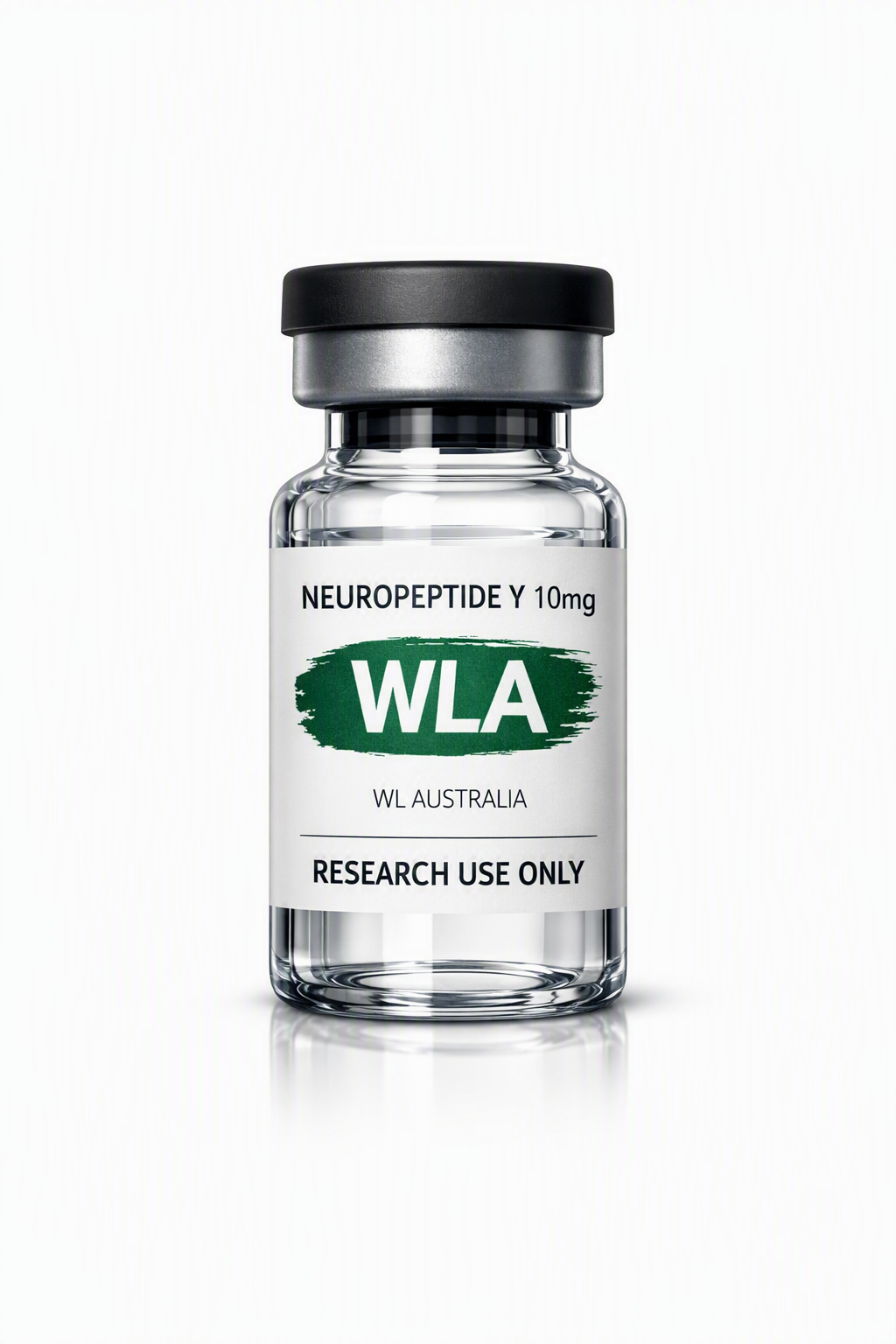
Neuropeptide Y: The Appetite and Stress Peptide at the Centre of Metabolic Research

Neuropeptide Y (NPY) is a 36-amino-acid signalling peptide found throughout the mammalian nervous system. It is one of the most abundant neuropeptides in the brain and is also active in peripheral tissues such as blood vessels, the heart, the gastrointestinal tract and adipose tissue.
You can think of NPY as part of the body’s internal control network. It helps coordinate hunger, energy use, stress responses and vascular tone, rather like a control room receiving information from several departments at once.
The important point: NPY is a major research molecule, but it is not a proven treatment for obesity, anxiety, cardiovascular disease or any other medical condition.
What is Neuropeptide Y?
The problem: biological signals can seem disconnected
Hunger, stress, blood pressure and body composition are often discussed as separate issues. In reality, they share communication pathways.
The solution: follow the signal
NPY is produced from a larger precursor protein called preproNPY. Once processed, the mature 36-amino-acid peptide can be released by neurons and bind to specific receptors on nearby or distant cells.
NPY is found in two broad locations:
- Central nervous system: the brain and spinal cord, particularly regions involved in appetite, stress, emotion and autonomic control.
- Peripheral nervous system: sympathetic nerves serving blood vessels, the heart, gastrointestinal tract and adipose tissue.
In the brain, NPY is strongly associated with the hypothalamus: the body’s biological thermostat and control centre for hunger, body temperature, sleep and hormonal coordination.
In the periphery, NPY often works alongside norepinephrine, a sympathetic neurotransmitter involved in the “fight-or-flight” response.
In short: NPY links the brain, metabolism and circulation.
NPY and appetite regulation
The problem: hunger is more than willpower
When energy intake falls, stress rises or food availability changes, your brain does not simply “decide” to make you hungry. It adjusts a network of signals designed to protect energy stores.
Within the hypothalamus, NPY is produced by neurons that commonly also release AgRP, or agouti-related peptide. These neurons act like an emergency fuel-management team. When activated, they can:
- Increase food-seeking behaviour
- Stimulate appetite
- Reduce energy expenditure
- Encourage the storage of energy
- Influence how the body responds to fasting and food scarcity
NPY also interacts with POMC, or pro-opiomelanocortin, neurons. POMC signalling is generally associated with satiety and reduced food intake. A useful analogy is a car with two pedals: NPY/AgRP signalling presses the accelerator for feeding, while POMC-related pathways help apply the brake.
Research in animal models shows that increased central NPY signalling can produce strong feeding responses. Chronic elevation has also been associated with increased adiposity and changes in energy expenditure.
However, appetite is not controlled by NPY alone. Leptin, insulin, ghrelin, peptide YY, glucagon-like peptide-1 and many other signals influence the same network.
One peptide is not the whole appetite system.
The Y-receptor family
The problem: “NPY activity” does not mean one uniform effect
NPY acts through a family of G-protein-coupled receptors, or GPCRs. These receptors work like locks on the surface of cells, while NPY and related peptides act as keys.
The main human NPY receptor subtypes are Y1, Y2, Y4 and Y5.
| Receptor | Main research interest | Simplified role |
|---|---|---|
| Y1 | Appetite, anxiety research, vascular tone and adipose tissue | Often associated with feeding and vasoconstriction |
| Y2 | Presynaptic signalling, autonomic control and appetite pathways | Helps regulate neurotransmitter release and can influence feeding |
| Y4 | Pancreatic polypeptide signalling and satiety research | Associated with appetite-suppressing pathways in some models |
| Y5 | Hypothalamic feeding circuits and cardiac research | Strongly linked with NPY-driven feeding in preclinical studies |
The receptor environment matters. It is similar to a sports team: the same coach may give different instructions depending on which players are on the field. NPY can produce different outcomes in the brain, blood vessels, heart or adipose tissue because receptor distribution varies between tissues.
Related peptides also use these receptors differently. For example, peptide YY and pancreatic polypeptide are being studied for their effects on Y2 and Y4 pathways.
NPY, stress resilience and anxiety research
The problem: chronic stress can disrupt appetite and metabolism
Short-term stress can temporarily change appetite and alertness. Chronic stress is more complicated. It can affect sleep, food preferences, insulin sensitivity, body fat distribution and emotional regulation.
The solution: study the brain’s buffering systems
NPY is released during stress and is considered part of the brain’s stress-response network. In several animal studies, central NPY signalling appears to have stress-buffering or anxiolytic effects, meaning it may reduce anxiety-like behaviours.
Receptor subtype effects are not identical:
- Y1 signalling is often associated with anxiolytic or stress-resilience effects in preclinical research.
- Y2 signalling can produce different, and sometimes anxiety-promoting, effects depending on the brain region, stress model and timing.
- NPY may also influence fear conditioning, emotional memory and the interaction between stress and food-seeking behaviour.
Think of NPY as a shock absorber in a vehicle. A well-functioning shock absorber can reduce the impact of a sudden bump. But the result depends on the road, the speed and the condition of the rest of the suspension system.
Human research remains less conclusive than laboratory research. NPY levels and receptor activity have been investigated in relation to trauma exposure, anxiety, depression and stress resilience, but this does not establish that taking NPY will improve mental health.
Research association is not clinical proof.
Video placeholder 1: How Neuropeptide Y connects appetite, stress and energy balance
[Insert approved educational video embed here.]
Vasoconstriction and cardiovascular effects
The problem: the same signal that helps manage stress can affect blood vessels
NPY is a major sympathetic co-transmitter. This means it is released alongside other sympathetic nervous system signals, particularly during increased neural activity.
In blood vessels, NPY can:
- Promote contraction of vascular smooth muscle
- Increase or prolong norepinephrine-related vasoconstriction
- Influence vascular tone and blood pressure
- Interact with pathways involved in vascular growth and inflammation
The Y1 receptor is especially important in research on vascular contraction. NPY signalling has also been investigated in relation to hypertension, atherosclerosis, cardiac hypertrophy and heart failure.
This is why NPY cannot be viewed only as an “appetite peptide”. It is more like a control cable connected to multiple systems. Changing one part of the signal may affect circulation as well as hunger.
If you have high blood pressure, heart disease, an irregular heartbeat or take cardiovascular medicines, discussing NPY-related research with a qualified clinician is essential.
Why NPY is studied in obesity and metabolic research
The problem: obesity involves multiple interacting systems
Obesity is not simply a matter of food choices. It can involve appetite signalling, sleep, stress hormones, insulin resistance, adipose tissue biology, energy expenditure and cardiovascular regulation.
The solution: study the network, not one isolated target
NPY is being investigated because it sits at the intersection of several relevant pathways:
- Central appetite: NPY can stimulate food intake in animal models.
- Energy expenditure: Elevated NPY signalling may reduce energy use in some preclinical settings.
- Adipose tissue: Peripheral NPY may influence fat-cell development, lipogenesis and blood-vessel formation within adipose tissue.
- Stress-induced weight gain: Chronic stress may alter NPY signalling and encourage changes in appetite and fat storage.
- Cardiometabolic risk: NPY’s effects on blood vessels and sympathetic activity may connect metabolic dysfunction with cardiovascular disease.
Researchers are exploring whether selective Y1, Y2, Y4 or Y5 receptor modulation could produce useful metabolic effects while avoiding unwanted cardiovascular or neurological effects.
So far, this remains an active research area. Much of the mechanistic evidence comes from cell studies, rodents and other preclinical models. Human physiology is more complex, and receptor-selective therapies require careful safety evaluation.
Neuropeptide Y products and responsible research
You can view the Neuropeptide Y 10 mg product page for product information.
This material is supplied for research and educational purposes only. It is not a recommendation for self-treatment, weight loss, anxiety management, blood-pressure control or any other personal health use. Do not inject, ingest or otherwise use research peptides in humans or animals unless specifically directed within an appropriate, legally authorised research setting.
In Australia, product status and permitted use can depend on the formulation, claims, supply pathway and intended purpose. Review the WL Australia legal information and the Australian Therapeutic Goods Administration (TGA) requirements before planning any research activity.
Before considering any peptide-related research involving your health:
- Speak with a qualified Australian clinician.
- Review cardiovascular risk, medications and existing conditions.
- Do not replace prescribed treatment with an unapproved peptide.
- Use appropriate laboratory, storage and handling controls.
- Treat online claims as hypotheses, not established medical evidence.
Safety comes before optimisation.
Video placeholder 2: NPY receptors explained: Y1, Y2, Y4 and Y5
[Insert approved educational video embed here.]
Related peptide research
Explore the Neuropeptide S product page alongside WL Australia’s educational article on neural plasticity and neuropeptide research.
You can also compare the research context for Neurotensin, a peptide studied in relation to the nervous system, gastrointestinal function and metabolic signalling.
For a broader look at related signalling molecules, see the Neurokinin A product page and the WL Australia article on mitochondrial peptides and metabolic research.
The key takeaway
NPY is a central and peripheral signalling peptide with important roles in appetite, energy balance, stress biology and cardiovascular regulation. Its Y1-Y5 receptor family gives researchers a detailed map of how one peptide can produce different effects across different tissues.
The opportunity is significant, but the biology is not simple.
NPY research may help scientists understand why stress, hunger, adipose tissue and blood pressure interact. For now, the evidence remains largely preclinical and ongoing.
Understand the signal. Respect the system. Keep safety at the centre of every research decision.
 Immune Support, ant bacterial, anti viral, auto immune.
 Bioregulators
 Brain
 Skin & Hair Products