
Neuropeptide S: The Arousal and Wakefulness Peptide for Anxiety and Cognition Research

You can think of Neuropeptide S (NPS) as a biological “alertness messenger” being studied for its unusual ability to increase wakefulness while also reducing anxiety-like behaviours in some animal models.
That combination makes NPS different from a traditional stimulant. A stimulant may increase alertness but also make some people feel tense or restless. NPS research explores a more complex picture: arousal, emotional regulation, memory and sleep–wake control operating together.
However, the evidence remains preclinical, meaning it comes mainly from laboratory, cellular and animal research. NPS is not an approved treatment for anxiety, insomnia, cognitive decline or any other medical condition.
What is Neuropeptide S?
A neuropeptide is a short chain of amino acids used by nerve cells to communicate. You can picture it as a specialist message sent between departments in a large organisation: rather than controlling the entire system, it adjusts the activity of specific circuits.
NPS is a 20-amino-acid peptide. It acts mainly through the NPS receptor, commonly written as NPSR1. A receptor is a protein on or inside a cell that receives a biological signal, much like a lock receiving a particular key.
When NPS activates NPSR1, laboratory research indicates that it can increase intracellular signalling involving:
- Cyclic adenosine monophosphate (cAMP), a chemical messenger inside cells
- Calcium signalling, which helps regulate neuronal activity
- Excitatory pathways involved in arousal and behavioural activation
The problem: brain signalling can sound more complicated than it is
Terms such as cAMP, G-protein-coupled receptor and intracellular calcium can make the biology feel distant.
The solution: use the control-panel analogy
Think of NPSR1 as a control panel connected to several systems. NPS does not act like a single on/off switch. Instead, it may adjust the settings for wakefulness, movement, fear responses and learning depending on the brain circuit involved.
The key point: NPS is a signalling molecule being investigated for how it coordinates several brain functions at once.
How was NPS discovered?
NPS was identified in 2004 through a process called reverse pharmacology. Researchers began with an “orphan” receptor, a receptor whose natural messenger had not yet been identified, and searched for the molecule that activated it.
The receptor was initially associated with names such as GPR154 and GPRA. After the natural ligand was found, the system became known as the NPS–NPSR1 pathway.
The name Neuropeptide S refers to a conserved serine residue near the peptide’s N-terminal end. The discovery was important because it revealed a previously unrecognised signalling system linking brain regions involved in vigilance, emotional processing and autonomic control.
NPS-producing neurons appear to be concentrated in a small region of the brainstem, while NPSR1 is found across a broader network that includes areas such as the amygdala, hypothalamus, thalamus and limbic cortex.
That arrangement resembles a broadcast station with many receivers: a relatively small source can influence multiple brain circuits.
NPS and arousal: why wakefulness is its strongest research theme
The problem: staying awake is not the same as thinking clearly
Sleepiness affects attention, reaction time and memory. It is tempting to assume that increasing wakefulness automatically improves cognition. Biology is rarely that simple.
A car engine can be running, but that does not mean the vehicle is travelling efficiently. Similarly, a brain can be highly active without being focused or well regulated.
The solution: study arousal and cognition separately
In rodent research, central administration of NPS has been associated with:
- Increased locomotor activity
- More exploration of unfamiliar environments
- Reduced slow-wave sleep
- Reduced rapid eye movement (REM) sleep
- Longer periods of behavioural wakefulness
Researchers also study how NPS interacts with established arousal networks, including orexinergic and histaminergic neurons in the hypothalamus. These systems are important parts of the brain’s wakefulness network.
Orexin neurons, for example, help stabilise wakefulness. You can think of them as the brain’s “keep the lights on” crew. NPS appears to influence this wider network rather than acting as a simple replacement for it.
Research summary: NPS is strongly associated with arousal and wakefulness in preclinical models, but increased wakefulness should not be interpreted as a proven cognitive benefit in humans.
Video placeholder, NPS and the sleep–wake system: Insert an educational video explaining how NPSR1 signalling may interact with orexin and histamine pathways in preclinical research.
The unusual anxiety connection: alert but less fearful?
The most interesting feature of NPS research is its biphasic profile. Biphasic means that two apparently contrasting effects may occur within the same biological system.
NPS can be arousing, increasing movement and wakefulness. At the same time, it has produced anxiolytic-like effects in several animal tests. “Anxiolytic-like” means that an animal displays fewer behaviours associated with anxiety; it does not prove that the animal experienced anxiety in the same way a person does.
The problem: alertness and anxiety often rise together
Many people know the feeling of being tired but wired. The body is activated, yet the mind is tense. Conventional stimulants can sometimes worsen this pattern.
The solution: investigate emotional regulation alongside arousal
In studies using tests such as the elevated plus maze, NPS has been associated with:
- More exploration of open or exposed areas
- Less avoidance of novelty
- Reduced freezing or fear-related responses in certain paradigms
- Changes in stress-related behaviour
This has led researchers to describe a possible “alert but not anxious” profile.
The mechanism appears to differ from that of benzodiazepines. Some research indicates that NPS-related behavioural effects are not blocked by flumazenil, a compound that interacts with the benzodiazepine site on the gamma-aminobutyric acid type A (GABA-A) receptor.
That matters because it suggests NPS may influence anxiety-related circuits through a different route from conventional GABAergic sedatives.
But do not overstate the finding. Results can vary by dose, brain region, experimental design and animal model. An anxiolytic-like effect in rodents is not evidence that NPS treats human anxiety.
NPS, memory and cognitive performance
The problem: stress can interfere with learning
Memory is not only about storing information. It also depends on attention, emotional state and the ability to consolidate new material. High stress can act like static on a telephone line, making it harder for important signals to get through.
The solution: study memory under different emotional conditions
Preclinical research has connected NPS signalling with memory and learning processes. Some studies have reported effects on:
- Social memory
- Recognition and exploration
- Memory consolidation
- Performance during stressful or unfamiliar tasks
One possible explanation is that NPS may create a state with more wakefulness and less avoidance. If an animal explores more freely, it may encounter more information and have greater opportunity to form memories.
However, this does not mean NPS is a confirmed nootropic. A nootropic is a substance investigated for effects on cognition, such as attention, learning or memory. The human evidence for NPS remains limited, and there are no established clinical protocols for improving cognition with NPS.
For a broader overview of research compounds discussed in the cognitive field, see WL Australia’s Complete Guide of Nootropic Peptides. For a different research direction, you can also read about Semax research.
Why NPS is being studied for sleep, anxiety and cognition
NPS is attractive as a research target because it sits at the intersection of several systems:
| Research area | What investigators are examining | Current evidence |
|---|---|---|
| Wakefulness | Whether NPS promotes sustained arousal | Strong preclinical interest |
| Sleep | How NPS changes slow-wave and REM sleep | Mainly animal and laboratory research |
| Anxiety | Whether NPS reduces avoidance and fear-like responses | Promising but model-dependent |
| Memory | Whether arousal and emotional regulation influence learning | Early and developing |
| Appetite and pain | Broader effects reported in some animal studies | Secondary research areas |
This multi-system profile makes NPS similar to a traffic controller at a busy intersection. It may influence several directions, but the result depends on timing, signal strength and the surrounding traffic.
Researchers are therefore investigating:
- NPSR1 antagonists, which block receptor activity
- Modified NPS analogues
- Brain-region-specific signalling
- Links between NPSR1 genetics and anxiety-related traits
- Potential applications in sleep–wake disorders and neuropsychiatric research
NPS compared with sleep-focused and cognition-focused research
NPS should not be confused with every peptide associated with sleep or cognition.
For example, DSIP, or Delta Sleep-Inducing Peptide, is studied in connection with sleep regulation and restorative sleep research. NPS has a different profile: it is more strongly associated with wakefulness and arousal, even though it may influence anxiety-like behaviour.
This contrast is useful:
- NPS research: alertness, wakefulness and emotional regulation
- DSIP research: sleep-related signalling and sleep architecture
- Semax research: attention, neuroprotection and memory-related pathways
These are research categories, not recommendations for combining compounds. There is no established evidence that combining them is safe or effective.
Video placeholder, Comparing NPS with other neuropeptides: Insert a video comparing NPS, DSIP and Semax by research focus, receptor systems and strength of available evidence.
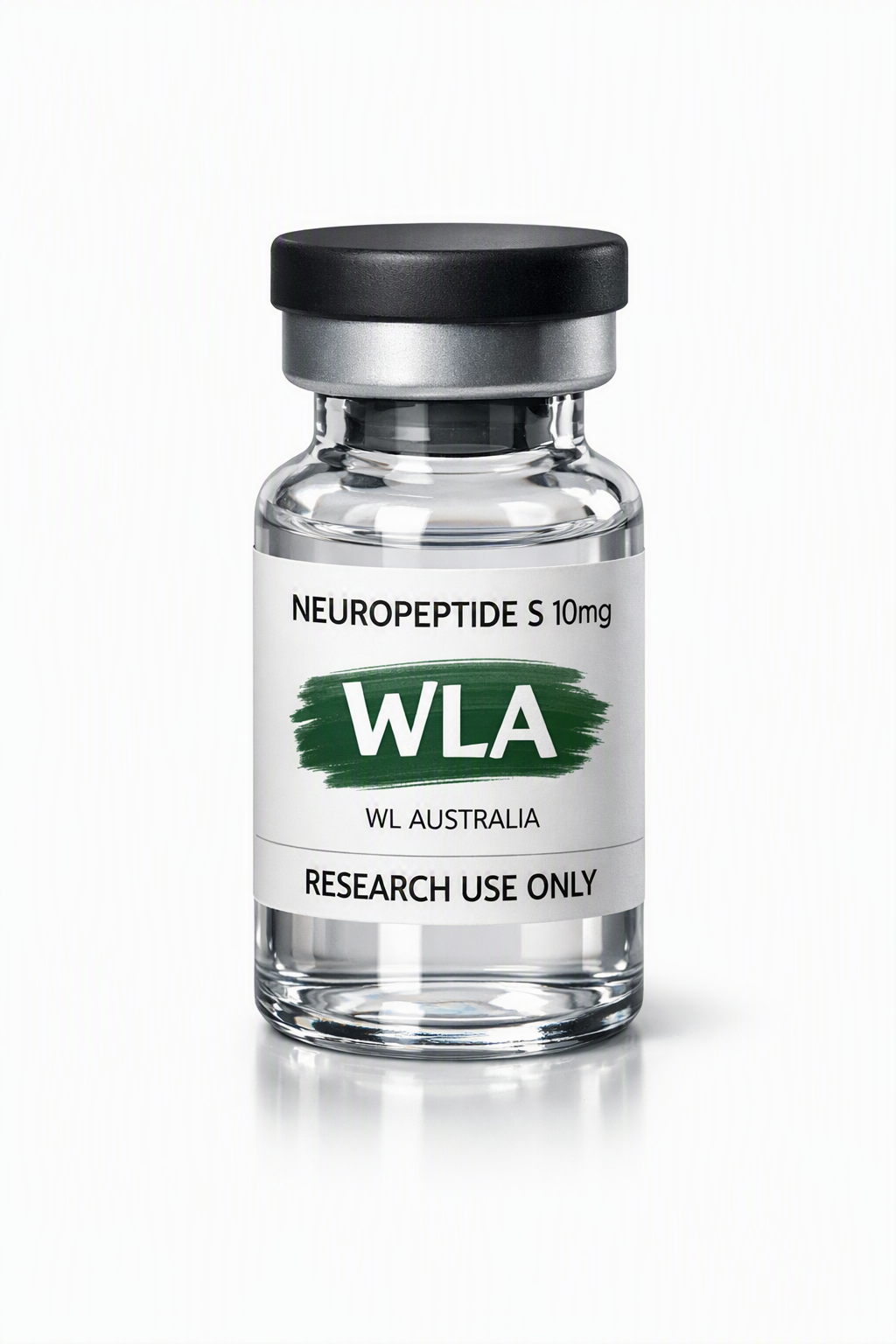
Neuropeptide S 10mg at WL Australia
WL Australia lists Neuropeptide S 10mg as a research chemical only product. The product page states that it is not for human use or consumption.
The page does not provide a human dosing protocol, treatment recommendation or medical indication. That distinction is essential. A product being available for laboratory research does not mean it has been approved as a supplement, medicine or therapeutic good.
Responsible research and safety notes
Before considering any peptide-related research involving people, discuss the project with an appropriately qualified clinician, pharmacist, toxicologist or institutional research supervisor.
You should also:
- Review Australian regulatory requirements before importing, possessing or using any research chemical
- Treat product labels and certificates of analysis as research documentation, not proof of clinical safety
- Avoid self-treatment, self-injection or unapproved human experimentation
- Avoid combining NPS with stimulants, sedatives, antidepressants or sleep medicines without qualified oversight
- Never use preclinical findings as a substitute for diagnosis or medical care
- Seek urgent medical help for severe agitation, chest pain, breathing difficulty, confusion or other serious symptoms
Australia’s rules can change depending on the substance, intended use, import pathway and state or territory requirements. Obtain current advice from the Therapeutic Goods Administration (TGA) and a qualified Australian professional before proceeding.
Final takeaways
NPS is a distinctive 20-amino-acid neuropeptide discovered through orphan-receptor research. It acts through NPSR1 and is being studied as a regulator of:
- Wakefulness and arousal
- Sleep architecture
- Anxiety-like and fear-related behaviour
- Memory and learning
- Broader appetite and pain pathways
Its unusual research profile can be summarised in three words: alert, emotionally regulated and still experimental.
The potential is scientifically interesting, but the limits are equally important. NPS remains a preclinical research compound, not a proven treatment for anxiety, sleep problems or cognitive performance. Study the mechanism, respect the uncertainty and keep safety and legal compliance at the centre of every decision.
 Immune Support, ant bacterial, anti viral, auto immune.
 Bioregulators
 Brain
 Skin & Hair Products