
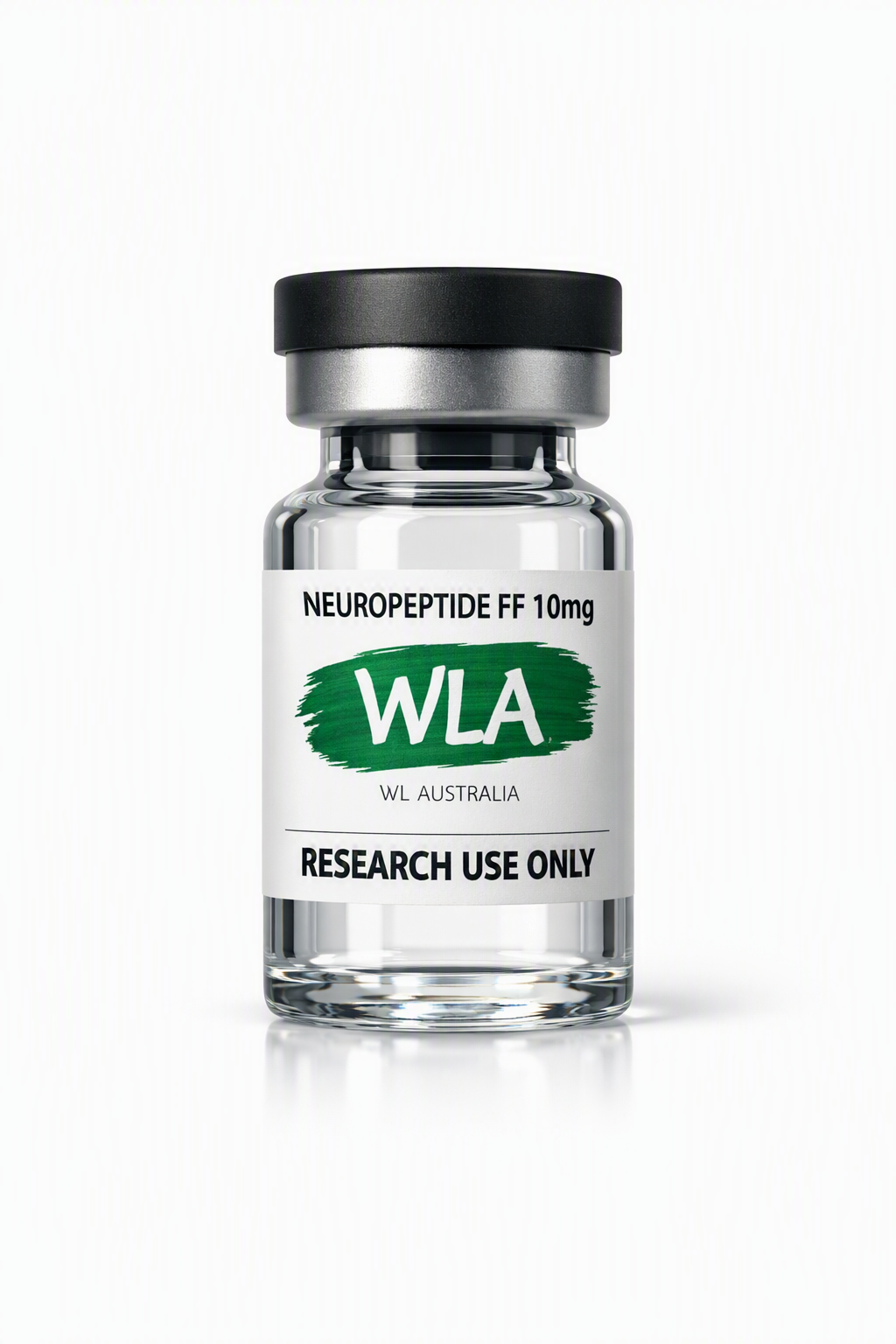
Neuropeptide FF: The RF-Amide Peptide Modulating Pain and Opioid Responses

Neuropeptide FF (NPFF) is a small amidated octapeptide attracting attention in pain and neuropharmacology research. It belongs to the RF-amide peptide family, a group named for a shared chemical feature at the end of the molecule: an arginine–phenylalanine sequence followed by an amide group.
That ending works like a biological “address label”. It helps the peptide interact with specific receptors and signalling systems involved in pain, opioid responses, cardiovascular regulation, body temperature and feeding.
The important point is simple: NPFF is a research molecule, not an established treatment. Most findings come from laboratory and animal studies. They help researchers understand biology, but they do not prove that NPFF is safe or effective for treating pain or any other human condition.
What is Neuropeptide FF?
The frustration researchers face is that pain biology is not controlled by one switch. It is more like a complex control room, with many dials influencing how strongly a signal is felt, how long it lasts and how the body responds to pain-relieving medicines.
NPFF was first isolated from bovine brain tissue in the 1980s. Its commonly cited sequence is Phe-Leu-Phe-Gln-Pro-Gln-Arg-Phe-amide, abbreviated FLFQPQRF-NH₂.
The “NH₂” indicates that the peptide is amidated at its C-terminus. Amidation is a natural chemical modification that can influence peptide stability and receptor activity.
NPFF sits within a wider RF-amide network that includes related signalling molecules involved in:
- Nociception, meaning the detection and processing of potentially harmful stimuli
- Opioid system regulation
- Energy balance and feeding
- Cardiovascular control
- Thermoregulation, or the management of body temperature
- Autonomic and neuroendocrine signalling
Think of the RF-amide family as a communications team. Different members deliver different messages, but they often work in overlapping biological circuits.
Core principle: NPFF is best understood as a regulator of signalling, not as a simple “pain-off” peptide.
NPFF1 and NPFF2: Two receptor gateways
A major research challenge is determining where NPFF acts and which receptor is responsible. NPFF primarily signals through two G-protein-coupled receptors (GPCRs):
- NPFF1, also called NPFFR1
- NPFF2, also called NPFFR2
GPCRs are cell-surface receptors that act like security gates. When a signalling molecule fits the receptor, the gate changes shape and activates internal messenger systems.
Both NPFF1 and NPFF2 are commonly associated with Gi/o proteins, which can reduce adenylyl cyclase activity and alter cyclic adenosine monophosphate (cAMP) signalling. In plain English, the receptor can adjust how easily a nerve cell becomes active.
| Research feature | NPFF1 | NPFF2 |
|---|---|---|
| Alternative name | NPFFR1 | NPFFR2 |
| Receptor class | G-protein-coupled receptor | G-protein-coupled receptor |
| Common signalling association | Gi/o-mediated pathways | Gi/o-mediated pathways |
| Research focus | Pain, feeding, energy balance, stress and opioid responses | Pain, cardiovascular regulation and thermogenesis |
| Key limitation | Effects vary by tissue and experimental model | Effects vary by tissue and experimental model |
The solution to oversimplification is to look at receptor subtype, brain region, dose, timing and route of administration together. The same peptide may produce different outcomes in different biological settings.
That is why NPFF research requires careful experimental design rather than broad claims.
Pain modulation: why NPFF can appear contradictory
Pain research often produces a frustrating result: one molecule may reduce pain-related behaviour in one model but increase pain sensitivity in another.
NPFF demonstrates this complexity. Depending on the experimental site and conditions, researchers have observed both:
- Antinociceptive effects, meaning reduced responses to harmful stimuli
- Pronociceptive effects, meaning increased pain sensitivity or pain-related responses
In some spinal models, NPFF signalling has been associated with analgesic or antinociceptive effects. In some supraspinal models, particularly those involving administration into the brain, NPFF has been linked with anti-opioid or pronociceptive activity.
Use an orchestra as the analogy. NPFF is not the entire performance. It is one section interacting with opioid receptors, neurotransmitters, spinal circuits and brain regions. Change the section, timing or tempo, and the outcome can change.
A useful review of these mechanisms is available through this peer-reviewed overview of NPFF and opioid-related pain research.
For comparison, Opiorphin research at WL Australia focuses on protecting endogenous enkephalins, while NPFF research centres on RF-amide receptor signalling and opioid-system modulation. These are different biological strategies.
NPFF and morphine analgesia
One of the best-documented areas of NPFF research concerns its interaction with morphine.
Morphine produces analgesia primarily through mu-opioid receptors (MORs). NPFF does not simply act as another opioid. Instead, it can influence how opioid signalling is expressed, maintained or reduced.
In several preclinical models, NPFF has been reported to:
- Reduce or modulate morphine-induced analgesia
- Produce anti-opioid effects in certain brain circuits
- Alter pain sensitivity after opioid exposure
- Participate in research into opioid tolerance and withdrawal
This has led to NPFF being described as part of an anti-opioid system. In this context, “anti-opioid” does not mean that NPFF blocks every opioid effect in every situation. It means that NPFF signalling can counterbalance or reshape opioid receptor activity.
The process resembles a car’s accelerator and braking system. Morphine may press the accelerator on opioid analgesia, while NPFF-related signalling can apply a regulatory brake. But the balance depends on which circuit is active and how long the system has been exposed to opioids.
Research also suggests that NPFF receptors may contribute to opioid tolerance, where repeated opioid exposure produces a reduced response. NPFF receptor antagonists, compounds that block NPFF receptor activity, have reduced tolerance and opioid-induced hyperalgesia in some animal studies.
Important: These findings do not support self-treatment with NPFF or NPFF receptor blockers. They identify possible mechanisms for future drug development.
This differs from Beta Endorphin research, where the focus is an endogenous opioid peptide that can activate mu-opioid receptors directly. NPFF is more like a systems regulator influencing the opioid network around the receptor.
Cardiovascular regulation, temperature and feeding
The frustration in neuropeptide research is that many molecules do not stay inside one biological “department”. NPFF is distributed across central and autonomic pathways, so its research profile extends beyond pain.
Cardiovascular regulation
Preclinical studies link NPFF signalling with changes in cardiovascular function, including blood pressure and heart rate. It has also been studied in relation to respiratory and autonomic responses associated with opioid activation.
These effects matter because pain, stress and opioid exposure can all influence the cardiovascular system. Researchers therefore study NPFF as part of a wider homeostatic network: the body’s internal balancing system.
Body temperature and thermogenesis
NPFF is also connected with thermoregulation, the process that keeps body temperature within a functional range. NPFF2 has received particular research interest in diet-induced thermogenesis, where energy intake influences heat production and energy expenditure.
This does not mean NPFF is a proven weight-management compound. It means researchers are investigating how RF-amide receptors may connect appetite, energy use and temperature control.
Feeding and energy balance
Central NPFF administration has reduced food intake in some animal studies. Researchers have also explored interactions between NPFF, opioid antagonists and feeding circuits.
The best analogy is a thermostat linked to a fuel gauge. Appetite, energy availability and body temperature are not isolated systems. They exchange information constantly. NPFF may be one of the signalling links between them.

NPFF should not be confused with repair-focused candidates such as ARA-290, which is researched for tissue-protective and nerve-related pathways. The mechanisms and evidence bases are different.
Research status and responsible use
The central problem is that promising animal data can sound like a finished medical solution. It is not.
NPFF remains an area of preclinical research interest. Important questions remain about:
- Human pharmacokinetics, meaning how the body absorbs, distributes and clears NPFF
- Receptor-selective effects in humans
- Long-term safety
- Interactions with opioids and other medicines
- Cardiovascular, temperature and feeding effects
- Appropriate clinical formulation and delivery
The Neuropeptide FF 10mg product page identifies the material as “research chemical only, not for human use.” No human dose, treatment schedule or self-administration protocol should be inferred from laboratory studies or product strength.
If you live in Australia and are researching neuroactive compounds, consider the local regulatory environment, laboratory requirements, quality documentation and institutional ethics obligations. A clinician should review any pain, opioid use, withdrawal symptoms or unexplained changes in temperature, appetite or blood pressure.
Do not use NPFF to treat yourself. Do not change, stop or combine opioid medicines based on this article.
Video placeholders
Video Placeholder 1: How NPFF1 and NPFF2 receptors regulate pain and opioid-system signalling
Video Placeholder 2: NPFF in preclinical research: linking pain modulation, thermoregulation and feeding circuits
Final perspective
Neuropeptide FF is interesting because it sits at the crossroads of several biological systems. It may influence pain like a traffic controller, directing signals through different neural routes. It may interact with opioid pathways like a braking system that changes tolerance and analgesic responses. It may also help connect cardiovascular function, body temperature and feeding.
That complexity is the reason for continued research, and the reason for caution.
The takeaway is simple: NPFF is a promising research tool for studying neuropeptide signalling, but it is not an approved human therapy. Use the evidence responsibly, prioritise clinician oversight and keep research separate from self-treatment.
 Immune Support, ant bacterial, anti viral, auto immune.
 Bioregulators
 Brain
 Skin & Hair Products