
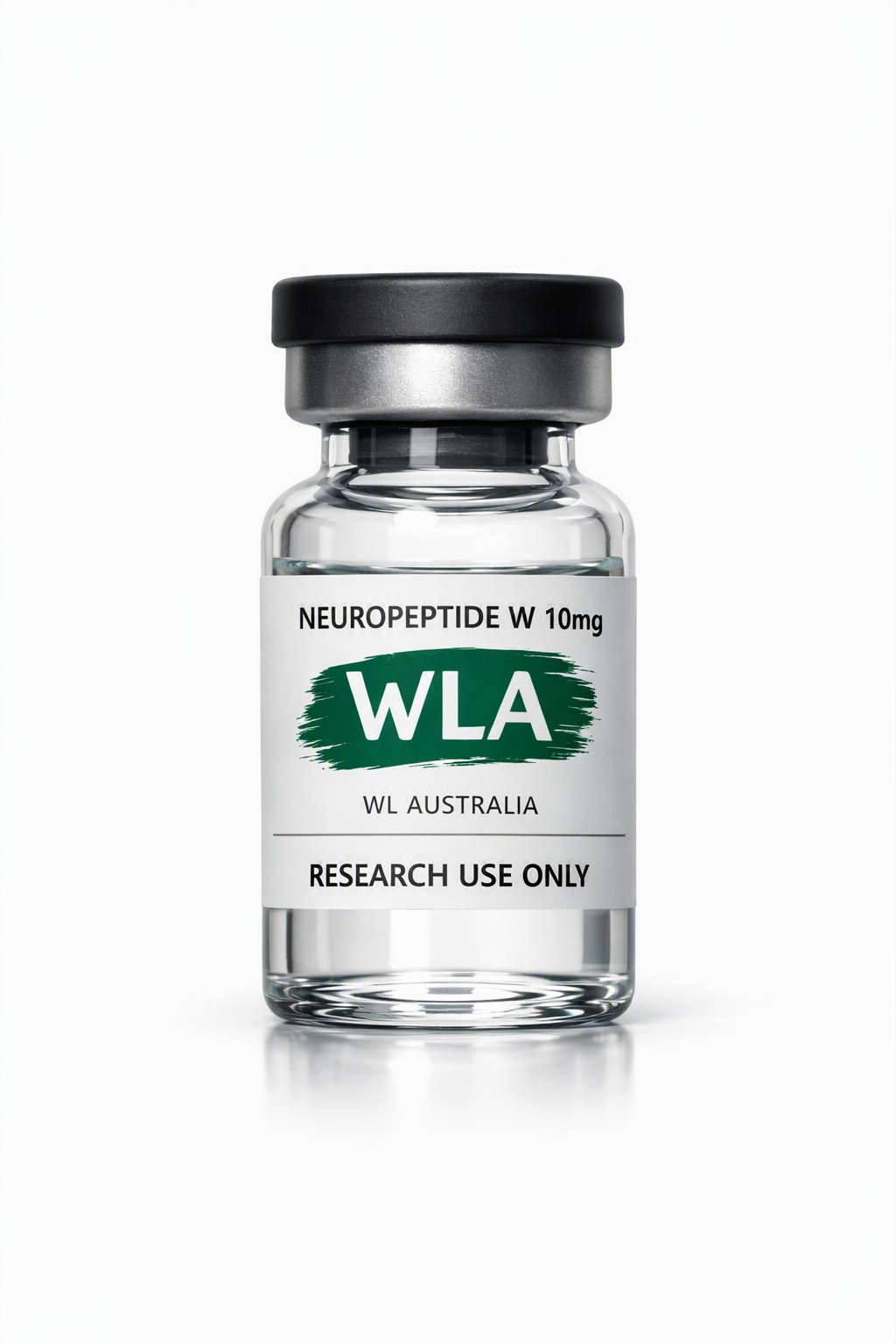
Neuropeptide W: The Emerging Peptide for Feeding, Stress and Neuroendocrine Research

Your appetite, stress response, pain sensitivity and hormone signals are not controlled by separate systems working in isolation. They behave more like departments in the same control room, constantly exchanging information.
Neuropeptide W (NPW) is an emerging research peptide that may help explain how those departments communicate. Early studies link NPW with feeding behaviour, energy expenditure, stress signalling, pain perception and pituitary hormone release.
The evidence is growing, but it remains early-stage and largely preclinical. That distinction matters. NPW is a valuable research tool, not an established treatment for weight management, anxiety, pain or endocrine disorders.
You can view the Neuropeptide W 10mg product page for product information. WL Australia lists this product as research chemical only, not for human use.
What is Neuropeptide W?
The problem: complex biology can make a simple peptide difficult to understand
NPW was identified in the early 2000s during research into previously “orphan” receptors. An orphan receptor is like an empty lock: scientists know the lock exists, but they have not yet identified the natural key that fits it.
Researchers isolated NPW as a natural ligand for two G protein-coupled receptors (GPCRs):
- GPR7, now commonly called NPBWR1 or NPBW1
- GPR8, now commonly called NPBWR2 or NPBW2
A ligand is simply a molecule that binds to a receptor and changes its activity. Think of NPW as a message delivered to a cellular switchboard.
NPW is part of the same broader peptide family as neuropeptide B (NPB). Two mature forms are commonly discussed:
- NPW-23
- NPW-30
The numbers refer to the approximate number of amino acids in each mature peptide form.
The solution: start with the receptor pair
The NPW receptor system is important because it connects a small molecule with several major biological circuits. These receptors are found in brain regions involved in:
- Feeding and appetite
- Arousal and emotional behaviour
- Stress responses
- Pain processing
- Autonomic regulation
- Hormone communication
Most receptor studies suggest that NPW signalling can influence cyclic adenosine monophosphate, or cAMP, inside cells. cAMP acts like an internal relay runner, carrying the message from the receptor deeper into the cell.
Short summary: NPW is not a single-purpose molecule. It is a research signal positioned at the intersection of metabolism, stress and neuroendocrine function.
NPW and feeding behaviour
The problem: appetite is not controlled by willpower alone
Your hunger system works more like a vehicle’s dashboard than a simple on/off switch. It receives signals about stored energy, stomach contents, temperature, stress and activity levels.
The hypothalamus acts as one of the main control centres. It monitors these signals and helps adjust food intake and energy expenditure.
In animal studies, centrally administered NPW has been associated with:
- Reduced food intake
- Lower body-weight gain
- Increased energy expenditure
- Increased heat production
- Changes in body temperature
- Reduced feeding during the active period of the day
This has led researchers to describe NPW as a potentially catabolic signal. Catabolic means that the body is encouraged to use stored energy rather than simply store more of it.
However, you should not translate a rodent feeding study directly into a human weight-loss claim. A laboratory finding is like a test drive on a closed track: it shows what may be possible under controlled conditions, but it does not prove how a vehicle will perform in every real-world environment.
NPW may influence feeding through interactions with other hypothalamic systems, including pathways involved in satiety, thermogenesis and autonomic output. The final effect may depend on dose, location, receptor distribution, species and the overall metabolic state of the subject.
The research takeaway: NPW is being investigated as part of the biological “energy budget,” not as a proven appetite-control therapy.
For comparison, Neuropeptide Y 10mg represents another research pathway involved in appetite, stress and energy regulation. The two peptides should not be treated as interchangeable. They act through different receptor families and may produce different biological outcomes.
NPW, stress and the HPA axis
The problem: stress is a full-body alarm system
When you face a threat, your body does not activate only one “stress chemical.” It coordinates the brain, pituitary gland, adrenal glands, cardiovascular system and behaviour.
This network is often called the hypothalamic–pituitary–adrenal (HPA) axis:
- The hypothalamus detects or interprets a challenge.
- The pituitary gland releases signalling hormones.
- The adrenal glands respond by producing glucocorticoids such as cortisol in humans and corticosterone in many laboratory animals.
You can think of the HPA axis as a three-stage emergency communication chain.
Research places NPW near this chain, particularly in hypothalamic regions connected with stress integration. In animal experiments, central NPW administration has been associated with increased circulating corticosterone and prolactin.
Other studies connect NPW signalling with:
- Behavioural arousal
- Novel-environment responses
- Anxiety-like behaviour in animal models
- Blood-pressure changes linked to arousal
- Communication between limbic and hypothalamic circuits
The important question is whether NPW simply increases stress output or helps coordinate an appropriate response. Biology is rarely a single-direction process. A peptide can increase one stress marker while influencing behaviour in a more complicated way.
Human research remains limited. Therefore, NPW should not be described as a proven calming, anti-anxiety or stress-treatment compound.
Video placeholder 1, NPW and the HPA axis:
Insert an explainer video showing how hypothalamic, pituitary and adrenal signalling may interact with NPW research.
Pain perception and neuroprotection research
The problem: pain is both a warning signal and a processing problem
Pain begins with signals from the body, but the experience is shaped by the spinal cord and brain. The nervous system acts like a volume-control panel: it can amplify, reduce or redirect incoming signals.
NPW and its receptor system have been studied in pain models, including inflammatory pain. Researchers are examining whether NPW-related signalling can alter nociception. The nervous system’s detection and processing of potentially harmful stimuli.
Preclinical research has explored possible associations with:
- Pain sensitivity
- Inflammatory pain responses
- Analgesic-like effects
- Seizure activity
- Neuronal excitability
Some engineered NPW analogues have also been investigated in seizure models. These findings are scientifically interesting, but they do not establish NPW as a safe human analgesic or anticonvulsant.
This is where responsible interpretation matters most. A laboratory peptide that changes pain behaviour in animals is not automatically suitable for self-treatment. Pain can signal infection, nerve injury, inflammation or another condition that requires diagnosis.
For broader nervous-system research, you may also be interested in WL Australia’s educational article, The Neuroprotective Giant: A Deep Dive into Cerebrolysin Research.
Prolactin and neuroendocrine signalling
The problem: hormones work in feedback loops
Hormones are not isolated switches. They operate more like a sports team. One player may start the play, another changes the pace, and a third determines the final result.
Prolactin is a pituitary hormone best known for its role in lactation, although it also interacts with reproductive, immune and stress-related systems.
In mammalian animal studies, central NPW administration has been associated with:
- Increased prolactin
- Increased corticosterone
- Suppressed growth hormone release
These findings suggest that NPW may influence communication between the brain and pituitary gland.
There is also an important species difference. Research in birds has reported that NPW can act directly at the pituitary through NPBWR2 and inhibit growth hormone and prolactin secretion. That differs from some mammalian central-administration findings.
This is a valuable reminder: species matters. A receptor pathway may act like the same electrical circuit wired differently in two buildings. The components may share a name, but the final output can change.
For related research, Neuropeptide S 10mg explores another neuropeptide system associated with arousal, wakefulness and stress-related behaviour. It should not be used to predict the effects of NPW.
How NPW compares with related metabolic peptides
NPW sits within a wider network of appetite and energy signals. For example:
| Research peptide | Main research theme | Key caution |
|---|---|---|
| Neuropeptide W | Feeding, stress, pituitary signalling and pain pathways | Evidence is early and mainly preclinical |
| Neuropeptide Y | Appetite, stress resilience and energy regulation | Can produce context-dependent effects |
| Ghrelin | Hunger signalling and growth-hormone release | May increase appetite rather than suppress it |
| Neurotensin | Satiety, gastrointestinal signalling and pain research | Human therapeutic evidence remains limited |
You can explore the broader WL Australia metabolism collection for related research compounds. These products are not substitutes for approved medical care.
Safety, evidence and responsible research
The problem: promising biology can be mistaken for proven medicine
NPW has an attractive research profile because it touches several important systems. But multi-system activity also increases the need for caution.
Before considering any peptide research material, you should:
- Discuss your situation with a qualified clinician.
- Review current Australian regulatory requirements.
- Avoid self-treatment for weight, pain, anxiety, seizures or hormone problems.
- Consider possible effects on blood pressure, appetite, sleep, stress hormones and pituitary signalling.
- Avoid combining experimental peptides without professional oversight.
- Never assume that a rodent dose, route or outcome applies to humans.
- Use only appropriately documented research material in a lawful laboratory setting.
The Neuropeptide W product page clearly states that the product is for research use only and not for human use.
Video placeholder 2, Feeding, pain and hormone signalling:
Insert a research-focused video explaining how NPW may connect appetite circuits, nociception and pituitary communication.
Final perspective
Neuropeptide W is best understood as an emerging biological messenger rather than a finished therapy. Its receptor pair: NPBWR1 and NPBWR2-acts like a communication gateway linking energy balance, stress adaptation, pain processing and neuroendocrine output.
The most useful approach is to focus on evidence, context and safety.
NPW may eventually help researchers understand how the brain coordinates appetite, stress and hormones. For now, it remains a promising but experimental research peptide, and any human use would require appropriate clinical, regulatory and scientific oversight.
 Immune Support, ant bacterial, anti viral, auto immune.
 Bioregulators
 Brain
 Skin & Hair Products