
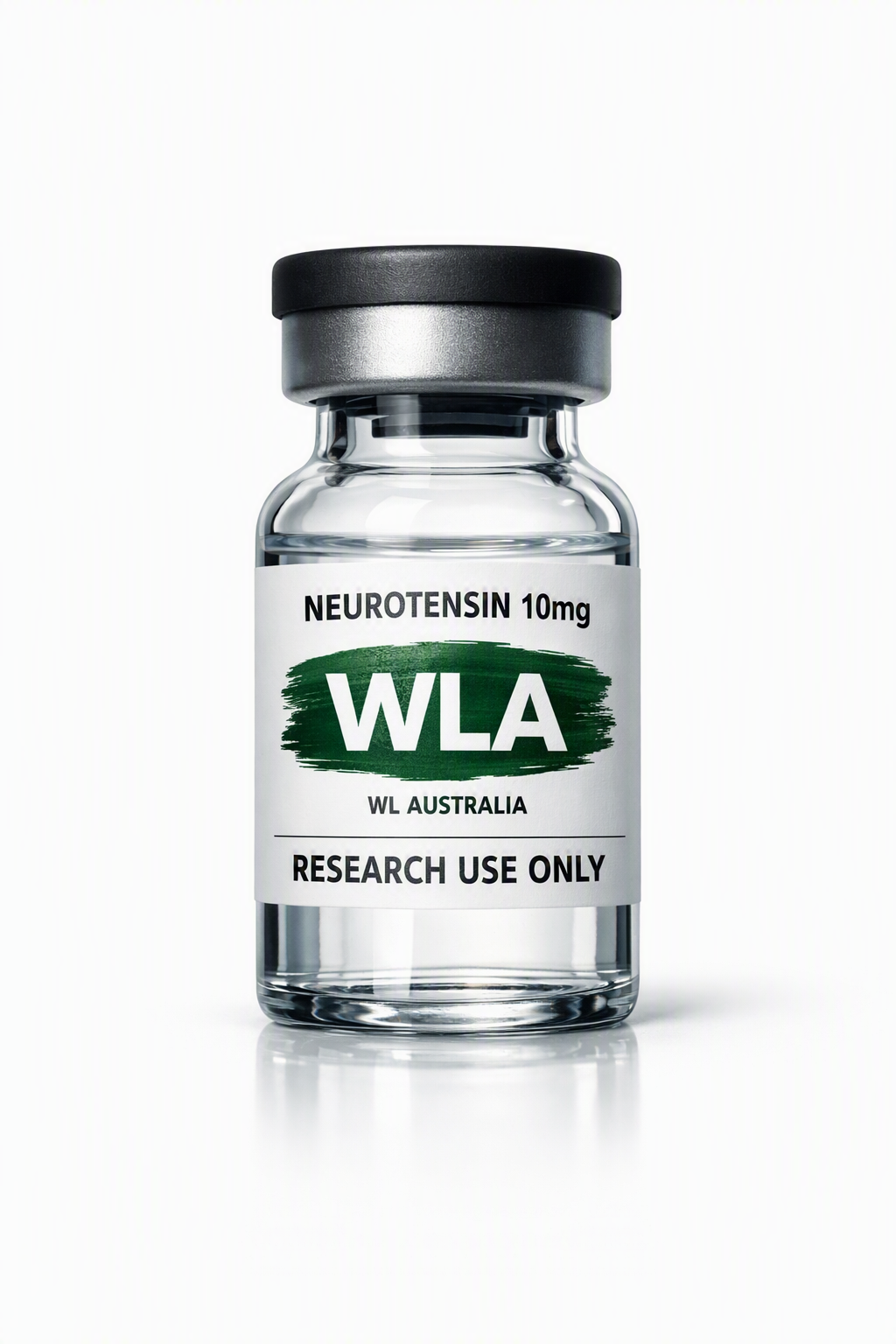
Neurotensin: The Gut-Brain Peptide for Dopamine, Pain and Digestive Research

Neurotensin is a 13-amino-acid peptide with an unusual dual identity. In the brain, it acts as a neuropeptide. A chemical messenger that helps nerve cells communicate. In the digestive system, it also behaves like a gut hormone, helping coordinate secretion, movement and communication between the gut and brain.
That makes neurotensin interesting to researchers studying dopamine signalling, pain modulation, body temperature, appetite, digestion, schizophrenia, addiction and cancer biology.
Think of it as a biological courier travelling between two major departments: the brain and the gut. The message changes depending on which receptor receives it, where the receptor is located and what other signalling systems are active.
Important: WL Australia’s Neurotensin 10mg is listed as a research chemical for research use only and not for human use. This article is educational and does not provide medical advice, dosing instructions or a self-treatment protocol.
What is neurotensin?
The problem: one peptide, many descriptions
Neurotensin can be difficult to understand because it does not belong to just one biological “team”. It is present in the central nervous system (CNS), the brain and spinal cord, and in the gastrointestinal tract.
The research solution: separate its two major roles
Neurotensin was first isolated from the hypothalamus, a brain region involved in temperature, appetite, hormones and autonomic regulation. It was later recognised as an important peptide in the gut, particularly in the small intestine.
In simple terms:
- In the brain: neurotensin helps tune neuronal circuits.
- In the gut: neurotensin helps coordinate digestive activity.
- Between the two: it contributes to gut–brain signalling, similar to a two-way telephone line between the digestive system and the nervous system.
The molecule itself is short, but its effects can be broad. Researchers often examine the full neurotensin sequence as well as its biologically active C-terminal fragment, NT(8–13).
The key point is simple: small molecule, wide research footprint.
Neurotensin receptors: the biological control panel
The problem: receptor names can make the science feel inaccessible
Neurotensin does not produce one automatic response. Its effects depend on the receptor it activates. You can think of the receptor family as a control panel with different switches.
The research solution: understand NTS1, NTS2 and NTS3
Neurotensin signals through three main receptor types:
| Receptor | Receptor class | Research focus |
|---|---|---|
| NTS1 | High-affinity G-protein-coupled receptor (GPCR) | Dopamine modulation, analgesia, hypothermia, appetite and antipsychotic-like research |
| NTS2 | Lower-affinity GPCR | Pain modulation and selective analgesic research |
| NTS3 | Also called sortilin; a sorting receptor | Cellular trafficking, internalisation and cancer biology |
A G-protein-coupled receptor (GPCR) is a receptor embedded in the cell membrane. When a signalling molecule attaches to it, the receptor passes instructions into the cell, much like a receptionist receiving a message and forwarding it to the correct department.
NTS3, also known as sortilin, works differently. It is more like a logistics manager, helping move molecules and organise signalling partners inside the cell.
This receptor diversity explains why neurotensin research spans both neuroscience and gastroenterology. Researchers are not studying one simple switch. They are studying an interconnected control panel.
Neurotensin and dopamine signalling
The problem: dopamine is often reduced to “pleasure”
Dopamine is commonly described as a pleasure chemical, but that is incomplete. It is involved in motivation, movement, learning, reward prediction and salience. The process of deciding what deserves attention.
The research solution: study neurotensin as a dopamine system modulator
Neurotensin is found in brain regions that contain important dopamine pathways, including circuits involved in movement, reward and motivation.
Research suggests that neurotensin can:
- Influence the firing of dopamine-producing neurons.
- Modify dopamine release in selected brain regions.
- Interact with dopamine receptor signalling, including pathways associated with the D2 receptor.
- Alter activity in circuits involved in reward and reinforcement.
This is why neurotensin has attracted long-standing research interest in schizophrenia and addiction.
Some neurotensin agonists, compounds that activate neurotensin receptors, have produced antipsychotic-like effects in animal and laboratory models. That does not mean neurotensin is an approved antipsychotic treatment. It means researchers are investigating whether neurotensin receptors could provide a non-dopamine-based route for influencing psychosis-related signalling.
The analogy is useful: existing medicines may adjust the main volume control on the dopamine system, while neurotensin research explores whether a secondary mixing desk can tune the same sound with greater selectivity.
Research interest is not proof of clinical effectiveness.
Pain modulation and hypothermia research
The problem: pain research needs alternatives to opioid pathways
Pain is not controlled by a single wire. It is a network involving sensory nerves, the spinal cord, the brain and chemical messengers. Opioid receptors are important, but researchers continue to explore other systems that may influence pain without directly relying on opioid signalling.
The research solution: investigate NTS1 and NTS2 separately
Neurotensin has demonstrated analgesic, or pain-reducing, effects in preclinical research. These effects appear to involve both NTS1 and NTS2, although the receptor subtypes may produce different physiological profiles.
- NTS1 activation has been associated with analgesia, but also with effects such as lowered blood pressure and reduced body temperature.
- NTS2 activation has attracted interest because it may support analgesic effects with less pronounced hypothermia or hypotension in some experimental models.
Neurotensin can also produce hypothermia, meaning a reduction in body temperature. This is particularly associated with central NTS1 signalling.
That finding is not a minor side effect to ignore. Temperature regulation is a core physiological function, like the thermostat in a building. Altering it may affect cardiovascular, neurological and metabolic processes.
For this reason, pain and temperature research involving neurotensin requires careful laboratory controls and medical oversight. It should not be treated as a basis for self-experimentation.
Neurotensin in the gut: secretion, movement and the gut–brain axis
The problem: digestive symptoms often involve more than the stomach
Digestion is not simply a conveyor belt moving food from one end to the other. It is more like a coordinated production line, with timing signals controlling acid, enzymes, bile, pancreatic secretions and intestinal movement.
The research solution: study neurotensin as a digestive coordinator
In the gut, neurotensin is produced by specialised N cells, particularly in the jejunum and ileum. The middle and later sections of the small intestine. Food intake can stimulate its release.
Research has linked neurotensin to:
- Pancreatic secretion, helping regulate the release of digestive fluids.
- Bile secretion, supporting the delivery of bile into the digestive process.
- Reduced gastric acid secretion in specific experimental settings.
- Changes in gastric emptying and motility.
- Reduced jejunal and ileal movement in some contexts.
- Increased colonic motility in other contexts.
This may sound contradictory, but the gut is not one uniform tube. Different sections have different jobs, receptors and timing. Neurotensin can act like a traffic controller: slowing movement in one lane while increasing flow further down the road.

Neurotensin is also relevant to appetite research. Its interaction with brain reward circuits and digestive signals has made it a subject of investigation in feeding behaviour and energy balance.
However, research interest does not establish that neurotensin products are suitable for weight management or digestive treatment.
Schizophrenia, addiction and cancer biology
Neurotensin’s research history extends beyond isolated receptor experiments.
Schizophrenia and addiction
Because neurotensin influences dopamine pathways, researchers have studied its potential role in:
- Psychosis-related signalling.
- Antipsychotic-like behavioural effects.
- Drug reward and reinforcement.
- Changes in motivation and compulsive behaviour.
These areas remain scientifically complex. Human psychiatric conditions involve genetics, environment, brain development, immune signalling and many neurotransmitter systems. Neurotensin is one research pathway, not a complete explanation or a proven therapy.
Cancer biology
Neurotensin receptors have also been examined in cancer biology, particularly in relation to cell growth, survival, migration and signalling within certain tumour models.
NTS1 and NTS3/sortilin have been detected in research involving cancers such as:
- Pancreatic cancer.
- Colorectal cancer.
- Prostate cancer.
- Lung cancer.
Researchers are investigating whether neurotensin receptor biology could help explain tumour behaviour or support targeted diagnostic and therapeutic strategies. Some experimental work has explored neurotensin fragments as targeting components for imaging or drug-delivery systems.
Again, this is an active research field. Neurotensin is not a cancer treatment, and its presence in cancer research should not be interpreted as a clinical recommendation.
How to approach Neurotensin research responsibly
If you are reviewing the Neurotensin 10mg product page, focus on research quality rather than dramatic claims.
A responsible research checklist
- Confirm that the material is clearly labelled for research use only.
- Do not use it for self-treatment or human administration.
- Review the receptor subtype being studied: NTS1, NTS2 or NTS3.
- Separate animal, cell and human evidence.
- Consider cardiovascular, neurological, temperature and gastrointestinal effects.
- Discuss any health concerns with a qualified Australian clinician.
- Check current Australian regulatory requirements through the Therapeutic Goods Administration.
- Do not combine experimental peptides with prescription medicines without clinician review.
For broader context, see the gut health blend research page and the article on neural plasticity and brain research.

Video placeholder 1: Neurotensin explained, the brain–gut connection and the NTS receptor family.
Video placeholder 2: Neurotensin research overview, dopamine, pain, temperature and digestive signalling.
The takeaway
Neurotensin is a compact peptide with a wide biological reach. It operates in the brain as a neuromodulator and in the gut as a hormone-like signalling molecule. Through NTS1, NTS2 and NTS3, it has become a research tool for studying dopamine, pain, hypothermia, digestion, appetite, schizophrenia, addiction and cancer biology.
The best way to understand it is as a systems-level messenger. It does not work in isolation. It is part of a network, and the outcome depends on location, receptor subtype, dose, timing and the surrounding biological environment.
Study the receptor. Respect the system. Keep research separate from treatment.
 Immune Support, ant bacterial, anti viral, auto immune.
 Bioregulators
 Brain
 Skin & Hair Products