
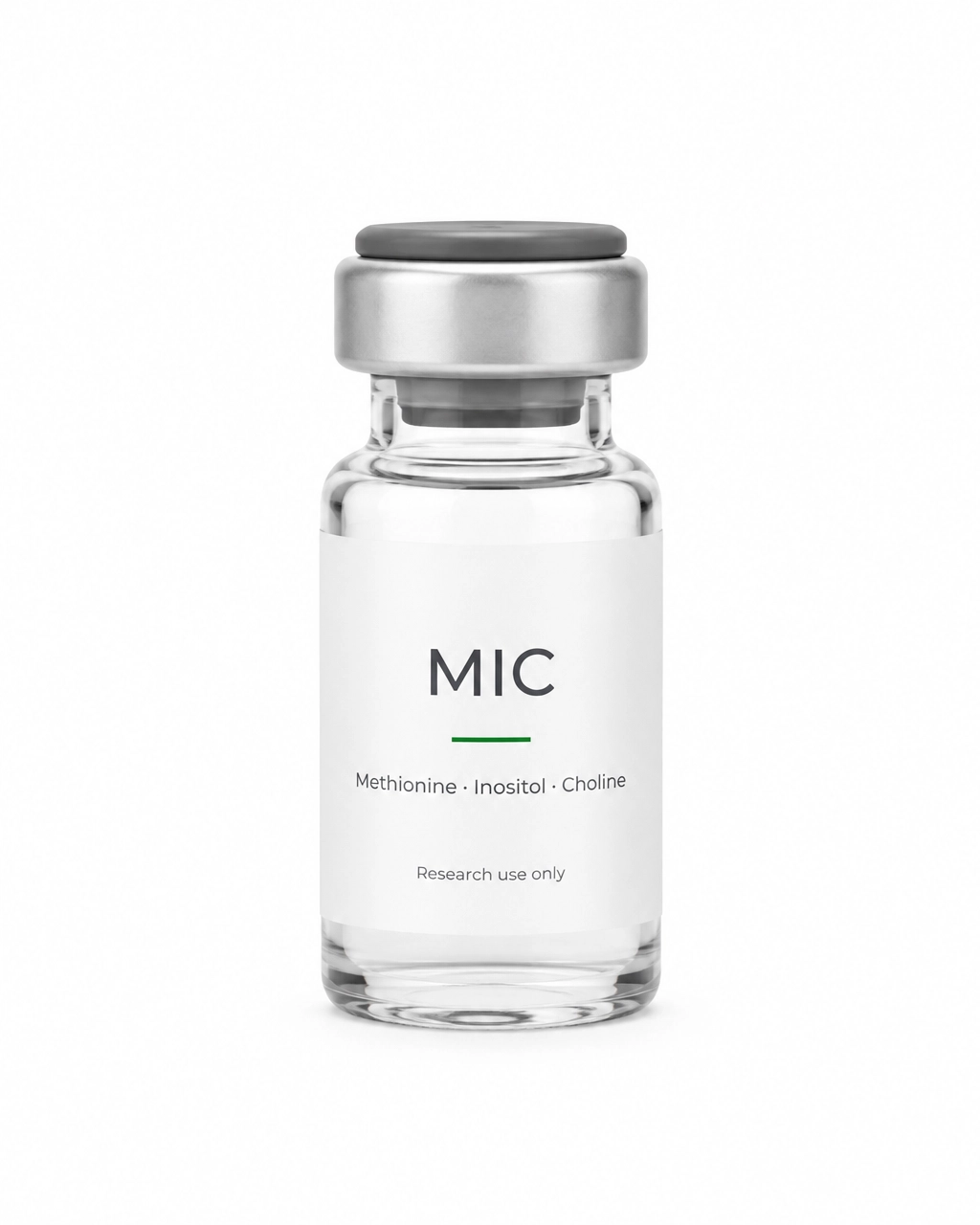
MIC Injections: The Methionine, Inositol and Choline Lipotropic Blend for Liver and Fat Metabolism Research

MIC stands for methionine, inositol and choline. It is a nutrient blend, not a peptide. Here’s what the ingredients do, what the evidence can and cannot tell you, and what to check before considering any injectable product.
What is a MIC lipotropic blend?
If you’ve seen “MIC shots” promoted at a weight-management clinic, you may wonder what is in them and whether they can help with fat loss. MIC refers to three nutrients: methionine, inositol and choline. Some clinic formulations also include vitamin B12, but blends and concentrations can vary.
The word lipotropic describes substances involved in the body’s handling of fats. Think of fat metabolism like a busy transport depot: nutrients take part in moving, processing or using materials, but their presence does not prove that a product will make the depot run faster, or lead to weight loss.
MIC is often marketed for weight-management or “liver support” protocols. That popularity should not be confused with proof. The ingredients have established biological roles, but evidence that injecting them as a combination produces meaningful weight loss is limited.
Important: The WL Australia Lipo-C product page labels the product “research chemical only, not for human use.” This article is educational and is not an invitation or instruction to inject it.

What each ingredient does
Methionine: an essential amino acid involved in methylation
Methionine is an essential amino acid, which means you need to obtain it from food. Your body uses it to make proteins and to produce a compound called S-adenosylmethionine (SAM). SAM donates small chemical units called methyl groups in a process known as methylation.
Think of methylation as a set of switches and labels used throughout the body. It helps cells modify molecules and regulate many normal processes. Methionine also participates in pathways related to fat metabolism, but that does not mean additional methionine automatically “burns” stored body fat. The body’s metabolic pathways are a coordinated system, not a single accelerator pedal.
Inositol: a cell-signalling participant
Inositol is a sugar alcohol found in the body and in foods. It is part of molecules involved in cell signalling. The messages cells use to coordinate activity. Researchers have studied inositol-related compounds in connection with insulin signalling and insulin sensitivity.
A helpful analogy is a team communication network: signalling pathways help a cell receive and respond to instructions. Research into one nutrient or pathway does not establish that an injected blend improves blood sugar control or weight in everyday clinical use. Results can differ by inositol type, dose, health condition and route of use.
Choline: a nutrient for membranes, liver function and acetylcholine
Choline is an essential nutrient. The body uses it to make phospholipids, including phosphatidylcholine, which are important building blocks of cell membranes. Choline also contributes to normal liver function and is a precursor of acetylcholine, a neurotransmitter that helps nerve cells communicate with muscles and other parts of the body.
Picture a cell membrane as the flexible wall of a building: it separates the inside from the outside while helping regulate what passes through. Choline has important jobs in that system. But an ingredient’s role in normal physiology is not the same as evidence that extra injectable choline treats fatty liver disease or causes fat loss.
For more on choline’s roles and dietary reference information, see the US National Institutes of Health Office of Dietary Supplements fact sheet.
Why combine them, and what does “lipotropic” really mean?
The three ingredients are grouped because each is connected, in different ways, to nutrient metabolism, cell function or the handling of lipids. In this sense, “lipotropic” describes a proposed relationship to fat metabolism. It is not a guarantee of fat reduction, a formal measure of treatment effectiveness or proof of a “detox” effect.
A useful comparison is a construction crew: having workers with relevant skills on site does not guarantee that a building project will finish faster. Outcomes also depend on the plans, materials, working conditions and the task itself. Likewise, weight change involves factors such as food intake, activity, sleep, health conditions, medicines and long-term habits, not just a nutrient blend.
MIC injections are popular in some weight-management clinic protocols, sometimes alongside B12. However, B12 is not a general energy booster for everyone; correcting a deficiency is different from taking extra B12 when levels are already adequate.

What does the evidence say about weight loss?
The most important question is not whether the ingredients have biological functions. They do. It is whether the injectable combination has been shown in robust human studies to produce meaningful, lasting weight loss.
At present, evidence for MIC injections specifically is limited. There is not a strong body of large, well-designed clinical trials establishing how much weight people can expect to lose from the MIC blend, whether any change is caused by the injection itself, or how long an effect might last. Mechanistic explanations (how a nutrient might participate in a pathway) can help researchers decide what to study. They cannot replace clinical outcome data.
Research on individual ingredients, dietary intake or laboratory processes also cannot automatically be applied to an injectable combination. For example, studies of oral inositol or choline do not establish the safety or effectiveness of a particular compounded injection.
The practical takeaway: treat claims such as “melts fat,” “detoxifies the liver” or “boosts metabolism” cautiously unless they are supported by reliable clinical evidence for the exact product and formulation.
MIC compared with peptides and GLP-1 medicines
These approaches are not interchangeable.
| Approach | What it is | What the comparison means |
|---|---|---|
| MIC | A blend of methionine, inositol and choline | Nutrients with roles in normal biology; injectable weight-loss benefits remain unproven. |
| Peptides | Short chains of amino acids that can act as signals in the body | A broad category. A peptide’s research interest does not establish that it is an approved or effective weight-management treatment. |
| GLP-1 medicines | Medicines that act on the glucagon-like peptide-1 pathway | Certain prescription medicines have been tested in large clinical trials for specific uses. They have their own risks, eligibility criteria and medical oversight requirements. |
Some GLP-1 medicines can affect appetite and blood-glucose regulation, but they are not comparable to a nutrient blend simply because both may be discussed in a weight-management setting. Their evidence and regulatory status depend on the specific medicine and its approved use.
For related reading, see WL Australia’s articles on metabolic stacking and SLU-PP-915, as well as the SANA product information. These pages discuss research products and should not be read as evidence that they are approved weight-loss treatments or suitable for human use.

Safety, regulation and clinician review
Injectable products require particular care. The risks depend on the exact ingredients, concentration, preparation, sterility, route and the person receiving them. Possible problems with injections include pain, bruising, infection, allergic reactions or other adverse effects. A product supplied by a clinic or pharmacy is not automatically approved or proven effective.
In Australia, regulatory status can vary by product and formulation. Check the exact product, not just the ingredient names: ask for its full name, ingredients, strength, route and any Australian Register of Therapeutic Goods (ARTG) details. You can search the TGA’s ARTG database. Compounded products may have different regulatory arrangements from ARTG-listed medicines; compounding does not mean a product has been assessed by the TGA for safety, quality or effectiveness. See the TGA’s guidance on compounded medicines.
Before considering any weight-management treatment, discuss your goals, medical history and medicines with a qualified clinician. Ask what evidence supports the specific product, what alternatives are available, and how possible side effects would be monitored. Do not self-inject, use research-only products in people, or treat MIC as a substitute for medical care.
In short: methionine, inositol and choline have real roles in the body. The claim that their injectable combination reliably causes weight loss is a separate question, and strong clinical evidence for that claim is lacking. Understand the product, check its Australian regulatory status and seek clinician guidance before making treatment decisions.
Video placeholders
- Video placeholder: MIC explained, A clinician-led overview of methionine, inositol and choline, with a clear distinction between biological roles and proven clinical outcomes.
- Video placeholder: Questions to ask about injectable products, A general guide to checking product details, ARTG status, evidence and safety with a qualified health professional.
 Immune Support, ant bacterial, anti viral, auto immune.
 Bioregulators
 Brain
 Skin & Hair Products