
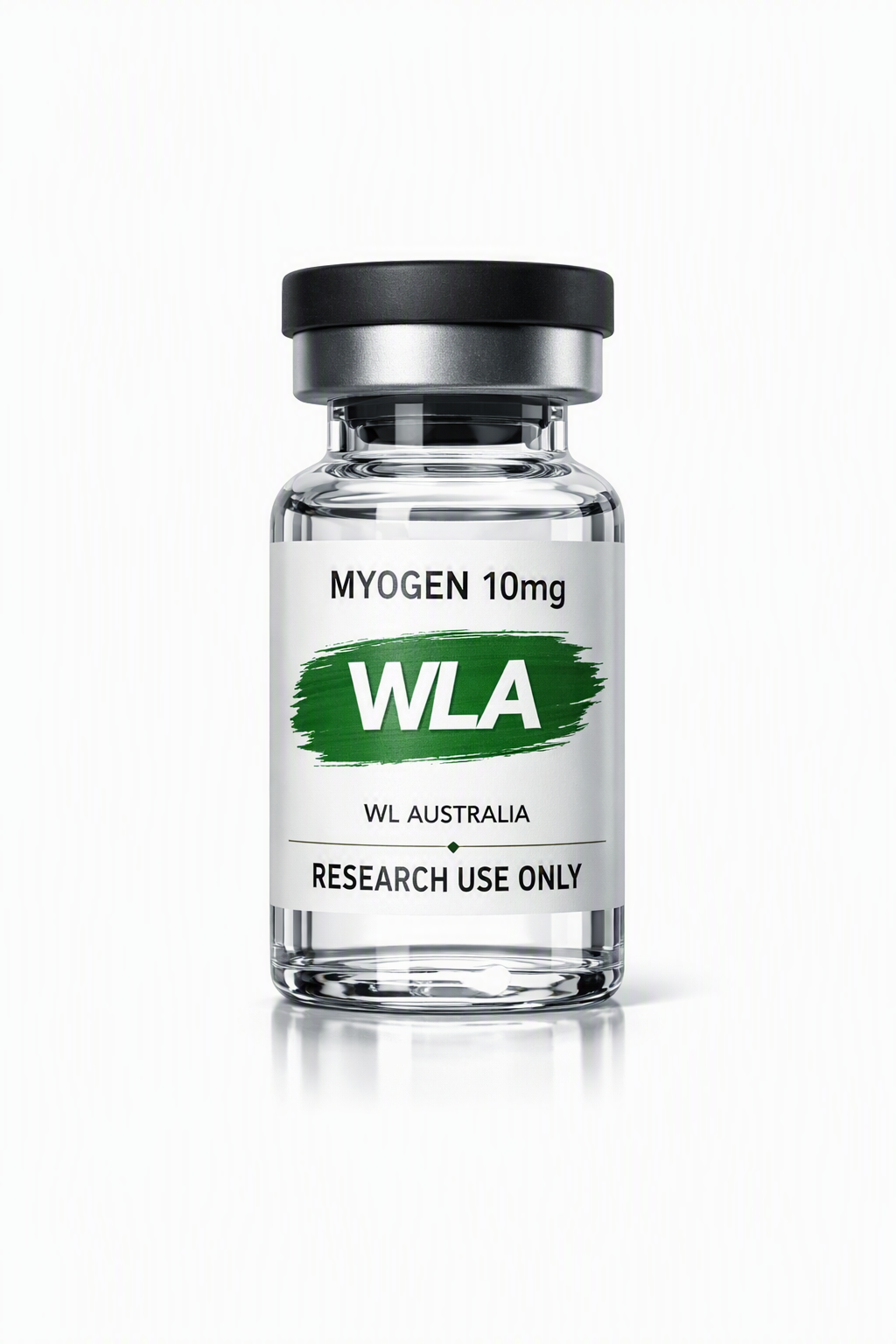
Myogen: The Muscle Growth Factor Behind Myostatin and Hypertrophy Research

If you want to understand modern muscle-growth research, start with one simple idea: muscle development is controlled by both accelerators and brakes.
Training, nutrition and growth signals act like the accelerator. Myostatin acts more like the brake. Myogen is listed by WL Australia as a research peptide designed to help scientists study myogenesis, the formation and repair of muscle tissue, within this wider biological landscape.
The important point is precision. Myogen is a research chemical only and not for human use. Its commercial description discusses myoblast activity, myotube differentiation, protein-synthesis signalling and anti-fibrotic research. However, its exact sequence, receptor profile and clinical performance are not established in publicly available human evidence.
That makes Myogen interesting, but still experimental.
The muscle-growth problem: your biology has a built-in brake
Your skeletal muscles are not static slabs of tissue. They are more like a construction site that is constantly repairing, adapting and replacing materials.
Muscle growth depends on a coordinated process:
- Satellite cells become activated.
- These muscle stem cells multiply into myoblasts.
- Myoblasts differentiate, meaning they develop into specialised muscle cells.
- They fuse into longer structures called myotubes.
- Myotubes mature into functioning muscle fibres.
Myostatin can slow this process.
Myostatin is also called growth and differentiation factor 8 (GDF-8). It belongs to the transforming growth factor beta (TGF-β) superfamily, a large group of signalling proteins that help regulate tissue growth and repair.
Think of myostatin as a governor fitted to a car engine. The governor prevents the engine from running beyond a safe limit. In muscle, that restraint can reduce myoblast proliferation, differentiation and hypertrophy. The enlargement of existing muscle fibres.
The research question is simple: what happens when you carefully reduce the brake without disrupting the rest of the vehicle?

The Belgian Blue story: nature’s myostatin experiment
The myostatin story became widely known through unusually muscular cattle breeds, especially Belgian Blue cattle.
These animals carry naturally occurring changes in the MSTN gene, which encodes myostatin. In simplified terms, reduced myostatin activity removes part of the normal restraint on muscle development. The result is the famous “double-muscled” appearance.
This was not a laboratory marketing concept. It was a natural biological experiment visible in a large mammal.
The discovery helped researchers understand three important principles:
- Myostatin is a genuine regulator of muscle mass.
- Removing or reducing its activity can increase muscle size.
- More muscle does not automatically mean better overall health or function.
The Belgian Blue phenotype also highlights the trade-offs. Extreme muscle development can be associated with reproductive and structural complications in livestock. This is a reminder that biology is a connected system, not a collection of isolated switches.
Bigger is not always better. Function, balance and safety still matter.
Where Myogen fits into muscle biology research
The WL Australia product listing describes Myogen as a myogenesis-promoting research peptide. It specifically refers to research into:
- Myoblast proliferation
- Myotube differentiation
- Muscle-fibre repair
- Protein-synthesis signalling
- Muscle wasting and atrophy models
- Fibrosis and collagen deposition
- Grip strength and functional outcomes in experimental models
These claims should be read as areas of investigation, not established human outcomes.
A useful analogy is a construction project. Myostatin may act like a site manager who limits the number of workers and slows the schedule. A myogenesis-promoting compound may be studied to see whether more workers become available, whether they mature correctly and whether the finished structure is strong, not merely larger.
That distinction is crucial. Increasing the number of muscle-related cells in a dish is not the same as restoring coordinated strength in a person.
Myoblast proliferation: expanding the workforce
Proliferation means cell multiplication.
If muscle tissue is injured or weakened by disuse, researchers may study whether a compound increases the number of available myoblasts. More myoblasts could, in theory, provide a larger pool of cells for repair and fibre formation.
But proliferation alone is not enough. A construction site full of workers is not useful if nobody knows how to assemble the building.
Myotube differentiation: turning workers into structure
Differentiation is the process by which a less specialised cell develops into a more specialised one.
In muscle research, myoblasts can fuse to form myotubes. These are early muscle structures that later mature into muscle fibres. Researchers may measure markers such as myogenin, MyoD and myosin to understand whether this maturation process is occurring.
The research goal is not simply “more cells”. It is better-organised, contractile muscle tissue.
Anti-fibrotic research: preventing the wrong repair
After injury, tissue can repair itself with functional muscle, or it can accumulate excessive scar-like connective tissue. This process is called fibrosis, and it involves abnormal collagen deposition.
Fibrosis is like repairing a flexible bridge with concrete. The structure may close the gap, but it can lose movement and performance.
The Myogen product description refers to anti-fibrotic activity in degenerative models. At present, this should be treated as a preclinical research concept requiring independent validation. Human outcomes, optimal exposure and long-term safety remain unresolved.
[VIDEO PLACEHOLDER] Myogen and the muscle-repair pathway: from satellite cells to mature myofibres
Myostatin, follistatin and IGF-1: three parts of the wider research map
Myogen should not be viewed in isolation. Muscle biology is more like an orchestra than a solo performance.
| Research pathway | Simple explanation | Muscle research focus |
|---|---|---|
| Myostatin/GDF-8 | A biological brake | Limits muscle growth and myogenic activity |
| Follistatin | A binding protein that can neutralise myostatin and other ligands | Studies of myostatin inhibition and hypertrophy |
| IGF-1 | An anabolic growth signal | Protein synthesis, satellite-cell activity and repair |
| Myogen | A product listed for myogenesis-focused research | Myoblast activity, differentiation and repair models |
Follistatin is particularly important because it can bind myostatin and related members of the TGF-β family. Researchers are studying whether more selective approaches can encourage muscle growth while limiting unwanted effects elsewhere in the body.
You can read more in our FLGR-242 and follistatin research guide.
IGF-1, or insulin-like growth factor 1, works more like an accelerator. It is involved in pathways that support protein synthesis and muscle adaptation. It is also a reminder that growth signals can have effects beyond skeletal muscle.
For related reading, see our MGF and IGF-1 muscle-repair article and the IGF1-DES research product page.
Myogen compared with ACE-083
ACE-083 provides a useful comparison because it represents a different strategy.
ACE-083 is a follistatin-based, locally acting ligand trap designed to bind myostatin, activin and related proteins near a targeted muscle. Rather than broadly changing muscle biology throughout the body, the concept focuses on localised exposure.
| Feature | Myogen | ACE-083 |
|---|---|---|
| Main research angle | Myogenesis, differentiation and repair | Localised inhibition of myostatin-related ligands |
| Biological concept | Encourage muscle-development processes | Remove selected growth restraints |
| Research status | Experimental and preclinical in its publicly described applications | Investigational; human studies showed volume increases but limited functional translation |
| Key uncertainty | Exact mechanism and human relevance | Whether larger muscle volume produces meaningful strength or function |
Our ACE-083 research guide explains why muscle volume and muscle performance must be measured separately.
A larger muscle is not automatically a stronger muscle. Nerve supply, fibre quality, tendon integrity, coordination and metabolic health all influence performance.

Who should be cautious?
Anyone considering Myogen outside a laboratory setting should stop and review the evidence.
Myogen is listed as “research chemical only, not for human use.” It is not a TGA-approved treatment for muscle wasting, injury recovery, sarcopenia or athletic performance. There is no established human dosing protocol that can be safely recommended from the available information.
You should not use it to self-treat:
- Muscle injuries
- Sarcopenia, or age-related muscle loss
- Muscular dystrophy
- Chronic weakness
- Fibrosis
- Post-operative recovery
- Athletic performance concerns
If you have persistent weakness, muscle loss or delayed recovery, seek assessment from a qualified Australian health professional. A clinician may investigate nutrition, hormones, nerve function, medication effects, inflammation and underlying disease before considering any treatment.
Do not confuse a promising pathway with a proven therapy. Do not use research chemicals without appropriate institutional oversight, validated materials, ethical approval and specialist expertise.
Final perspective: study the brake, but respect the whole system
Myogen is part of a fascinating research story: the discovery that muscle growth is actively restrained, the natural example provided by Belgian Blue cattle, and the continuing effort to understand myostatin, follistatin, IGF-1 and myogenic repair.
The potential research value lies in asking better questions:
- Can myoblast proliferation be increased without abnormal tissue growth?
- Can differentiation produce functional fibres rather than excess connective tissue?
- Can fibrosis be reduced without impairing normal healing?
- Can muscle volume translate into strength and movement?
- Can local action reduce systemic risk?
These questions keep the focus where it belongs: synergy, recovery and optimisation grounded in evidence.
To explore the product listing, visit the Myogen 10mg product page. Remember that it is intended strictly for laboratory research and is not for human use.
[VIDEO PLACEHOLDER] Myogen in context: comparing myostatin inhibition, follistatin binding and IGF-1 signalling
This article is for educational purposes only. Myogen and related products discussed here are experimental research chemicals, not medicines or supplements for human use. Do not self-treat or attempt to reproduce laboratory protocols. Speak with a qualified clinician about any muscle, recovery or health concern.
 Immune Support, ant bacterial, anti viral, auto immune.
 Bioregulators
 Brain
 Skin & Hair Products