
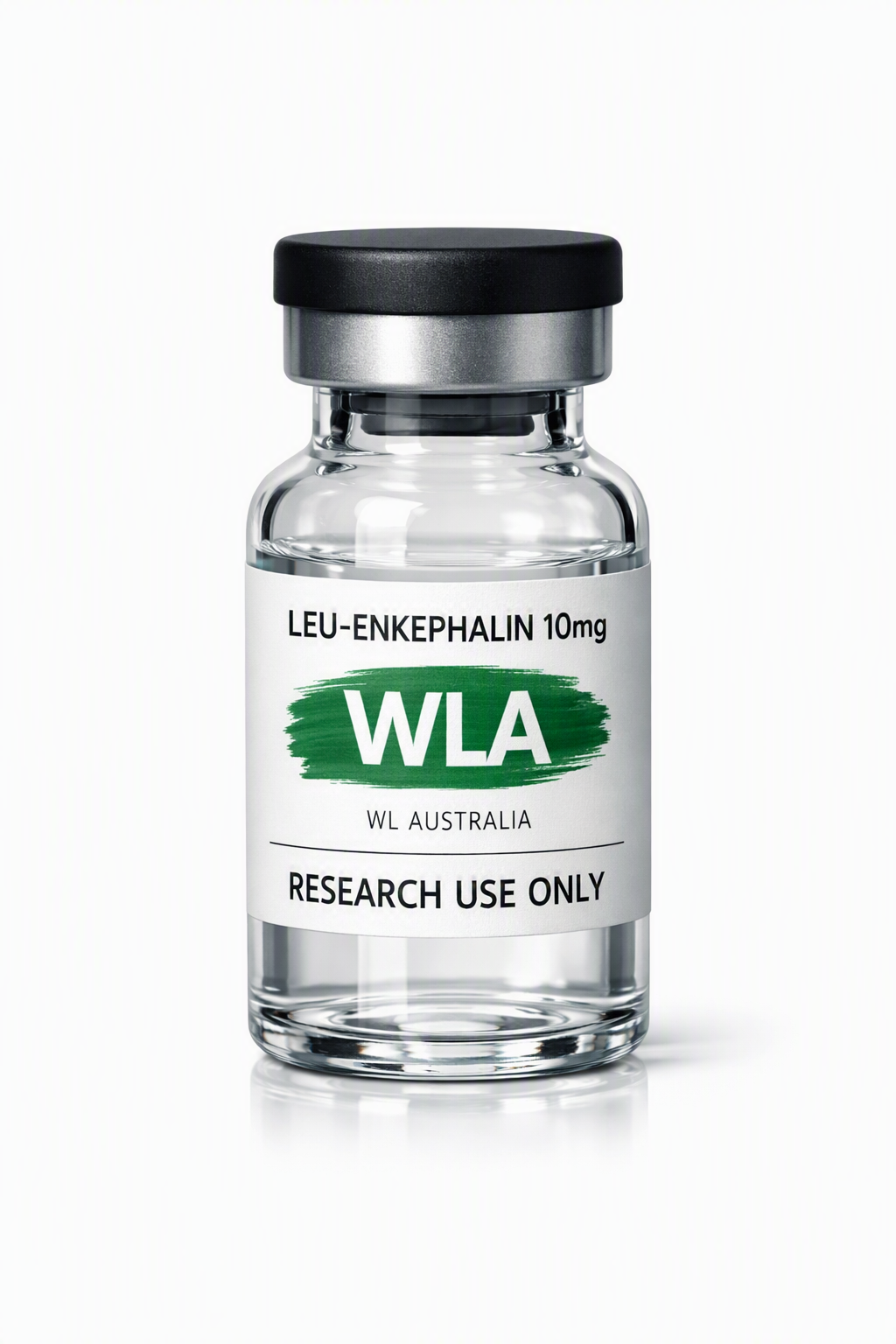
Leu-Enkephalin: The Endogenous Opioid Peptide in Pain and Mood Research

Leu-enkephalin, also called leucine enkephalin, is a naturally occurring five-amino-acid peptide with the sequence Tyr-Gly-Gly-Phe-Leu. It belongs to the body’s endogenous opioid system: a built-in signalling network involved in pain processing, stress responses, mood, reward and gastrointestinal function.
In simple terms, your nervous system uses leu-enkephalin like a local communication signal. It does not behave like a single-purpose “off switch” for pain. Instead, it helps adjust the volume across several biological circuits.
This article explains what researchers know, how leu-enkephalin compares with met-enkephalin, why its short duration presents a design challenge, and where current research is focused. You can also view the Leu-Enkephalin 10 mg product page.
Research-use notice: Leu-enkephalin products discussed by WL Australia are for laboratory research only and are not for human consumption, self-treatment or unsupervised use. They are not approved medicines or treatments. Discuss any health concern with a qualified Australian clinician.
The discovery: when scientists found the brain’s own opioid signals
The problem: opioid effects were known, but the natural signal was not
By the early 1970s, researchers understood that drugs such as morphine acted on specialised opioid receptors. The major unanswered question was simple: why would the body have receptors for an external drug?
The solution came from searching for naturally produced molecules that could fit those receptors.
In 1975, John Hughes, Hans Kosterlitz and colleagues published the landmark identification of two related pentapeptides, met-enkephalin and leu-enkephalin, isolated from brain tissue and shown to possess opiate-like activity. Their Nature paper described enkephalin as a natural ligand for opiate receptors and identified the sequences of both peptides.
The name enkephalin comes from the Greek phrase en kephalos, meaning “in the head”. It reflects the original discovery of these molecules in brain tissue.
The discovery changed opioid biology. Researchers were no longer studying only plant-derived drugs or synthetic medicines. They could now examine the body’s own opioid “maintenance system”: a network involved in pain control, emotional processing and stress adaptation.
Key point: Leu-enkephalin is not an artificial imitation of opioid biology. It is part of the biology.
For the primary discovery paper, see Hughes et al., Nature, 1975.
One amino acid separates leu-enkephalin from met-enkephalin
The problem: two nearly identical peptides can look interchangeable
Leu-enkephalin and met-enkephalin share the first four amino acids:
Tyr-Gly-Gly-Phe-
The difference is at position five:
| Feature | Leu-enkephalin | Met-enkephalin |
|---|---|---|
| Full sequence | Tyr-Gly-Gly-Phe-Leu | Tyr-Gly-Gly-Phe-Met |
| Position 5 | Leucine | Methionine |
| Peptide length | Five amino acids | Five amino acids |
| Main research profile | Relatively more δ-opioid preference | More balanced μ/δ activity |
| Native duration | Very short | Very short |
Leucine and methionine are both hydrophobic amino acids, but their side chains are not identical. Leucine is a branched hydrocarbon, while methionine contains sulphur. Think of the two peptides as matching keys with the same first four teeth but a slightly different final tooth.
That small structural change can alter:
- How the peptide fits within the opioid receptor binding pocket
- The balance between δ-opioid receptor and μ-opioid receptor activity
- How enzymes recognise and cleave the peptide
- The shape and duration of downstream signalling
Leu-enkephalin is generally described as having a stronger relative preference for δ-opioid receptors, while met-enkephalin tends to show a more balanced μ/δ profile. These are relative pharmacological tendencies, not absolute categories. Receptor behaviour depends on the assay, tissue, concentration and experimental conditions.
The position-five change also influences degradation, but you should not interpret this as meaning one native peptide lasts dramatically longer in every situation. Both are broken down rapidly in biological fluids. Their measured duration depends on the research model, enzyme environment and route of exposure.
Short summary: One residue can change receptor preference, enzyme recognition and signalling, but both native enkephalins remain short-lived.
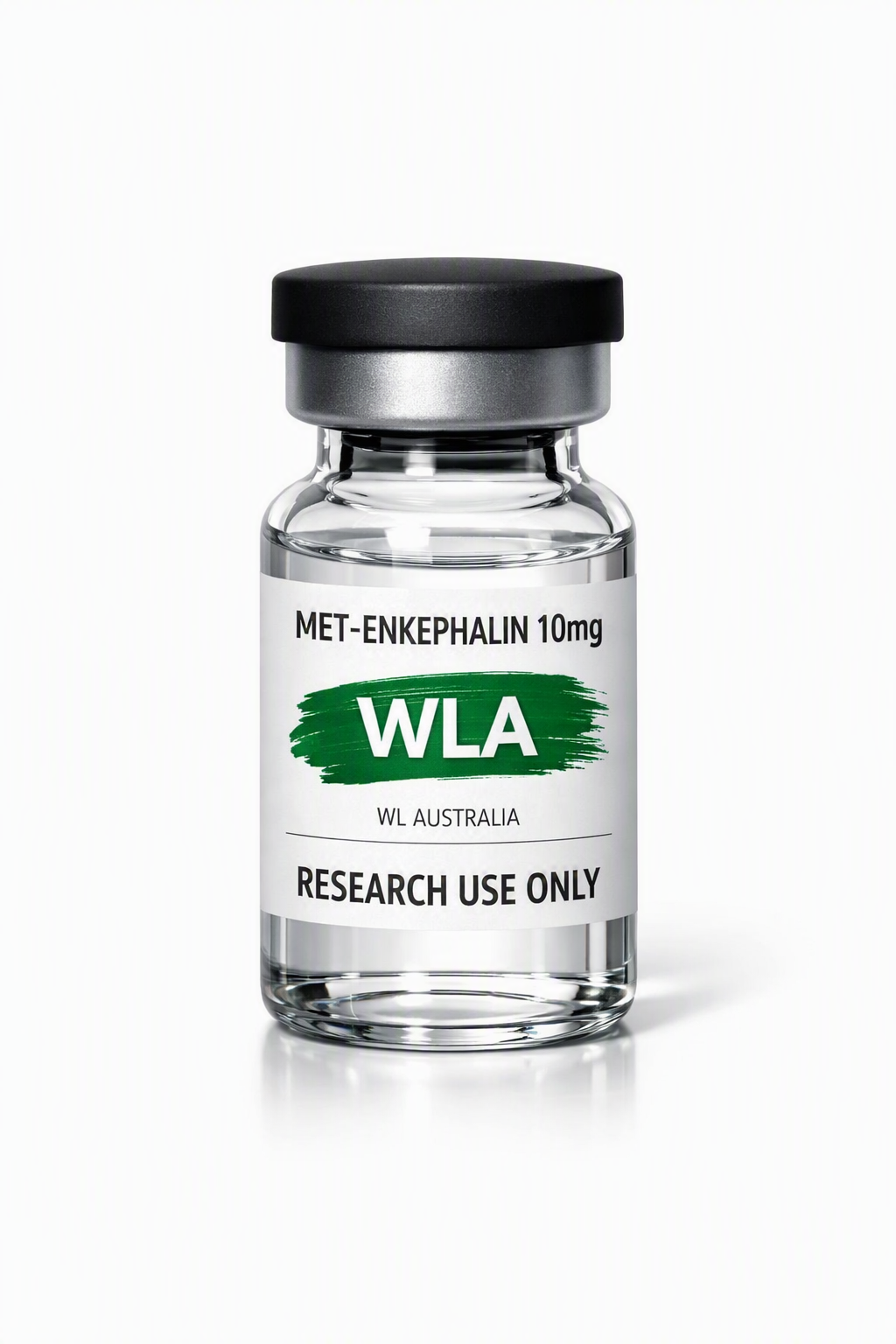
For a direct companion resource, see the Met-Enkephalin 10 mg page.
Where leu-enkephalin is found
The problem: location determines function
A signalling molecule does not have one universal effect everywhere in the body. Its role depends on where it is released, which receptor is present and what other signals surround it.
Research has identified enkephalin-related signalling across the:
- Brain
- Spinal cord
- Brainstem
- Hypothalamus
- Amygdala
- Hippocampus
- Basal ganglia
- Adrenal medulla
- Peripheral and autonomic nervous systems
- Gastrointestinal tract
In the spinal cord, enkephalinergic pathways are found in regions involved in processing incoming pain signals. You can picture these circuits as a railway junction: sensory information arrives, is sorted and either amplified or dampened before travelling upward to the brain.
In the periaqueductal grey, or PAG, a midbrain region involved in descending pain control, endogenous opioids form part of a larger “top-down” system. The brain can influence how strongly it experiences incoming signals, particularly during threat, stress or injury.
Leu-enkephalin and related peptides are also found in the adrenal medulla, the inner region of the adrenal gland. This tissue releases hormones and signalling molecules during stress. Enkephalin biology therefore connects neural signalling with neuroendocrine responses. The communication between the nervous and hormonal systems.
Pain research: adjusting the signal rather than erasing it
The problem: pain is protective, but excessive signalling is disruptive
Pain is an alarm system. It helps you withdraw from danger and protect injured tissue. The difficulty arises when the alarm becomes too loud, lasts too long or remains active after the original threat has changed.
Leu-enkephalin is studied as part of the body’s descending and spinal pain-modulation systems. When opioid receptors are activated, several effects may occur at the cellular level:
- Reduced release of certain pain-related neurotransmitters
- Lower excitability of pain-transmitting neurons
- Changes in how sensory signals pass through spinal circuits
- Altered communication between peripheral tissues, the spinal cord and the brain
This is similar to a building’s security system. The goal is not necessarily to destroy every alarm. It is to regulate the sensitivity, timing and volume of the warning.
The δ-opioid receptor, often abbreviated DOR, has attracted particular interest in research on analgesia, affective behaviour and neuroprotection. However, receptor activity should not be confused with an established clinical treatment. Native leu-enkephalin is rapidly degraded and is not an approved pain medicine.
Mood, reward and stress biology
The problem: emotional states are not controlled by one chemical
Mood and reward involve networks rather than single molecules. Enkephalin signalling is distributed through limbic and motivational regions, including the amygdala, hippocampus and basal ganglia.
Researchers study leu-enkephalin in relation to:
- Emotional reactivity
- Stress adaptation
- Motivation and reward
- Feeding-related behaviour
- Learning and memory circuits
- Anxiety- and depression-related models
Think of the endogenous opioid system as part of a sports team. Enkephalins are one player among many, working alongside dopamine, serotonin, glutamate, gamma-aminobutyric acid and stress hormones. Changing one player can alter the team’s performance, but it does not explain the entire match.
Stress may also regulate met- and leu-enkephalin systems differently in specific brain regions. This is important because the peptides are related but not identical. Researchers are investigating whether changes in their balance help explain differences in stress resilience, emotional processing and reward behaviour.
The practical research lesson: mood biology requires network-level analysis, not a single-peptide explanation.
Gastrointestinal function and the enteric nervous system
The problem: the gut is not only a digestive tube
The gastrointestinal tract contains its own extensive neural network, known as the enteric nervous system. It coordinates movement, secretion and communication between the gut and brain.
Enkephalin-related signalling has been detected in enteric tissues, including the myenteric plexus. A nerve network involved in intestinal motility. Researchers study these pathways in connection with:
- Peristalsis, or coordinated intestinal movement
- Visceral pain
- Gastrointestinal secretion
- Communication between the gut and central nervous system
The analogy is a conveyor belt in a factory. If the belt moves too quickly, material may pass before it is processed. If it moves too slowly, congestion develops. Enteric opioid signalling is one of several systems that helps regulate the pace and coordination of that conveyor belt.
These findings do not mean leu-enkephalin should be used to manage digestive symptoms. They show why the peptide remains relevant in gastrointestinal physiology and drug-design research.
Why native leu-enkephalin is difficult to study
The problem: the body breaks it down quickly
Native leu-enkephalin is a short peptide, and short peptides are vulnerable to enzymatic cleavage. Enzymes commonly described as enkephalinases, including neutral endopeptidase and other peptidases, can break down enkephalins rapidly.
The result is a signal that behaves more like a brief text message than a long broadcast:
- It acts locally
- It is quickly removed
- Its activity is difficult to maintain
- Results can change depending on the experimental environment
This short duration is not a design failure. It may be useful for precise, temporary signalling in normal physiology. It becomes a challenge when researchers want to measure or reproduce the effect in a controlled experiment.
Analogue design: how researchers work around rapid degradation
Researchers address the stability problem through structure–activity design. They modify the peptide while trying to preserve useful receptor interactions.
One example is Dalargin, a synthetic hexapeptide analogue associated with the leu-enkephalin scaffold. Its reported sequence is:
Tyr-D-Ala-Gly-Phe-Leu-Arg
The design includes two notable changes:
- D-alanine at position 2: A D-amino acid can make the peptide less vulnerable to some aminopeptidases.
- C-terminal arginine: Adding arginine changes charge, polarity and distribution, which can influence how the analogue behaves in biological systems.
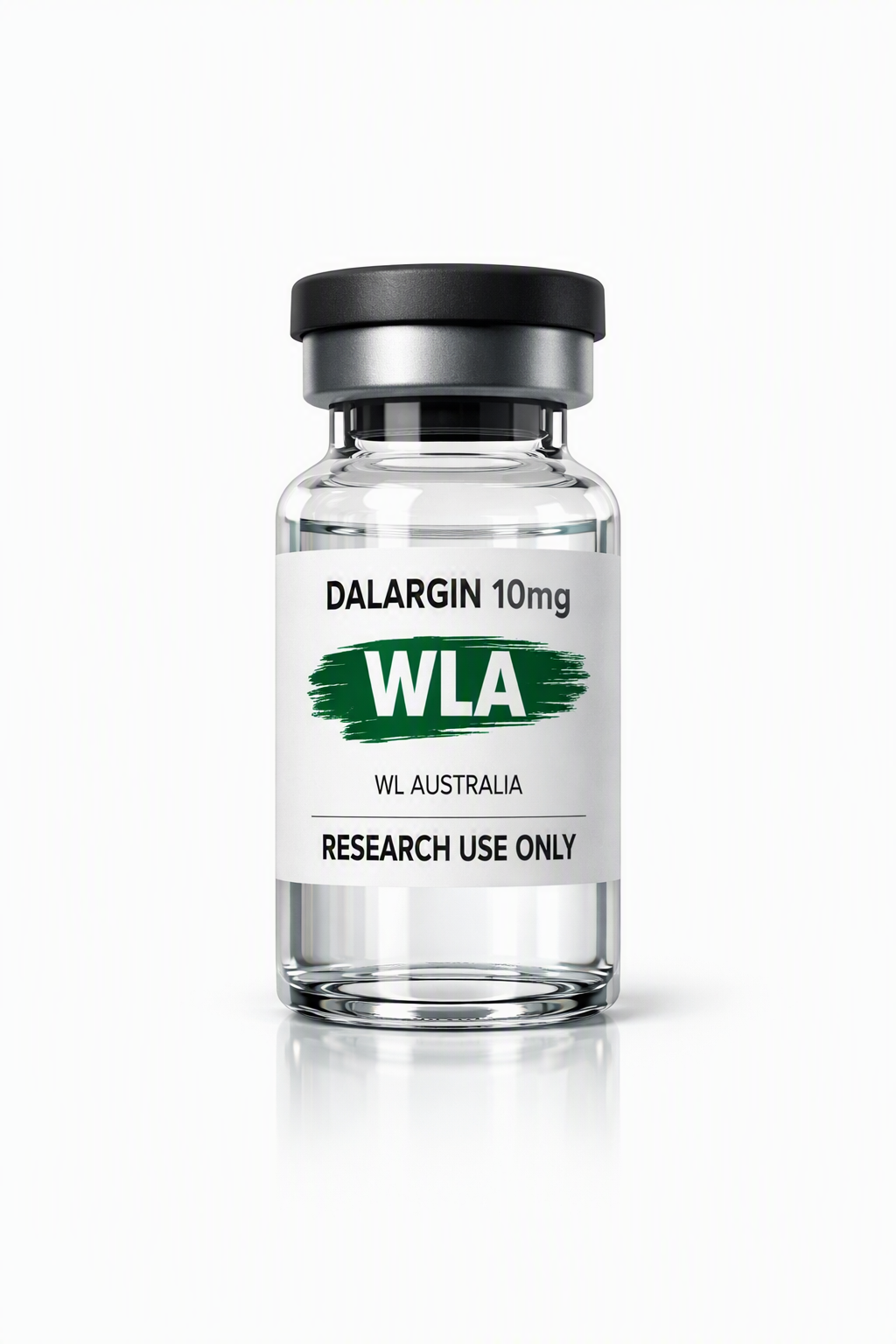
Dalargin illustrates the basic strategy: preserve a biologically informative core, then reinforce the “weak points” that enzymes normally attack.
You can read more in Dalargin: The Synthetic Opioid Hexapeptide for Gastroprotection and Pain Research.
Other research strategies include D-amino-acid substitutions, halogenation, cyclic structures and backbone modifications. Each may improve stability or selectivity, but every change can also alter receptor activity, distribution and safety. There is no universal upgrade.
Research principle: Longer-lasting does not automatically mean better. Optimisation requires balancing stability, selectivity, distribution and biological effect.
How to interpret leu-enkephalin research responsibly
Leu-enkephalin is valuable because it sits at the intersection of pain biology, mood research, stress physiology and gut neuroscience. But it is not a general-purpose wellness product or self-treatment tool.
Before interpreting any study, check:
- Whether the work used native leu-enkephalin or a modified analogue
- Which receptor was studied
- Whether the research was conducted in cells, animals or humans
- How quickly the peptide degraded
- Whether the route and concentration resemble human physiology
- Whether the result measured pain behaviour, receptor binding or another endpoint
In Australia, research chemicals and peptide products must be handled according to applicable regulations, laboratory standards and institutional oversight. A clinician should review any health-related plan, particularly where pain, mood, opioid receptors, gastrointestinal symptoms or other medicines are involved.
Final perspective
Leu-enkephalin is a small peptide with a large research footprint. Its five-amino-acid sequence helps the body fine-tune pain signalling, emotional circuits, stress responses and gastrointestinal activity.
Its closest partner, met-enkephalin, differs by only one residue. Yet that small change can influence receptor preference, enzyme interaction and signalling behaviour. Both peptides also share the same central limitation: they are rapidly degraded.
That limitation has driven decades of analogue design, including Dalargin and other modified enkephalin scaffolds. The broader lesson is clear: biological optimisation is rarely about finding one powerful switch. It is about understanding timing, location, receptor balance and recovery of the whole system.
Study the signal. Respect the limits. Let the evidence lead.
Video placeholder 1: 1975 discovery of met-enkephalin and leu-enkephalin. How endogenous opioid ligands were identified.
Video placeholder 2: Leu-enkephalin versus met-enkephalin. Sequence, receptor preference and rapid degradation explained.
This article is for educational and research-information purposes only. It does not provide medical advice, dosing instructions or treatment recommendations. WL Australia research products are not intended for human consumption. Always seek advice from a qualified healthcare professional and follow Australian regulatory and laboratory requirements.
 Immune Support, ant bacterial, anti viral, auto immune.
 Bioregulators
 Brain
 Skin & Hair Products