
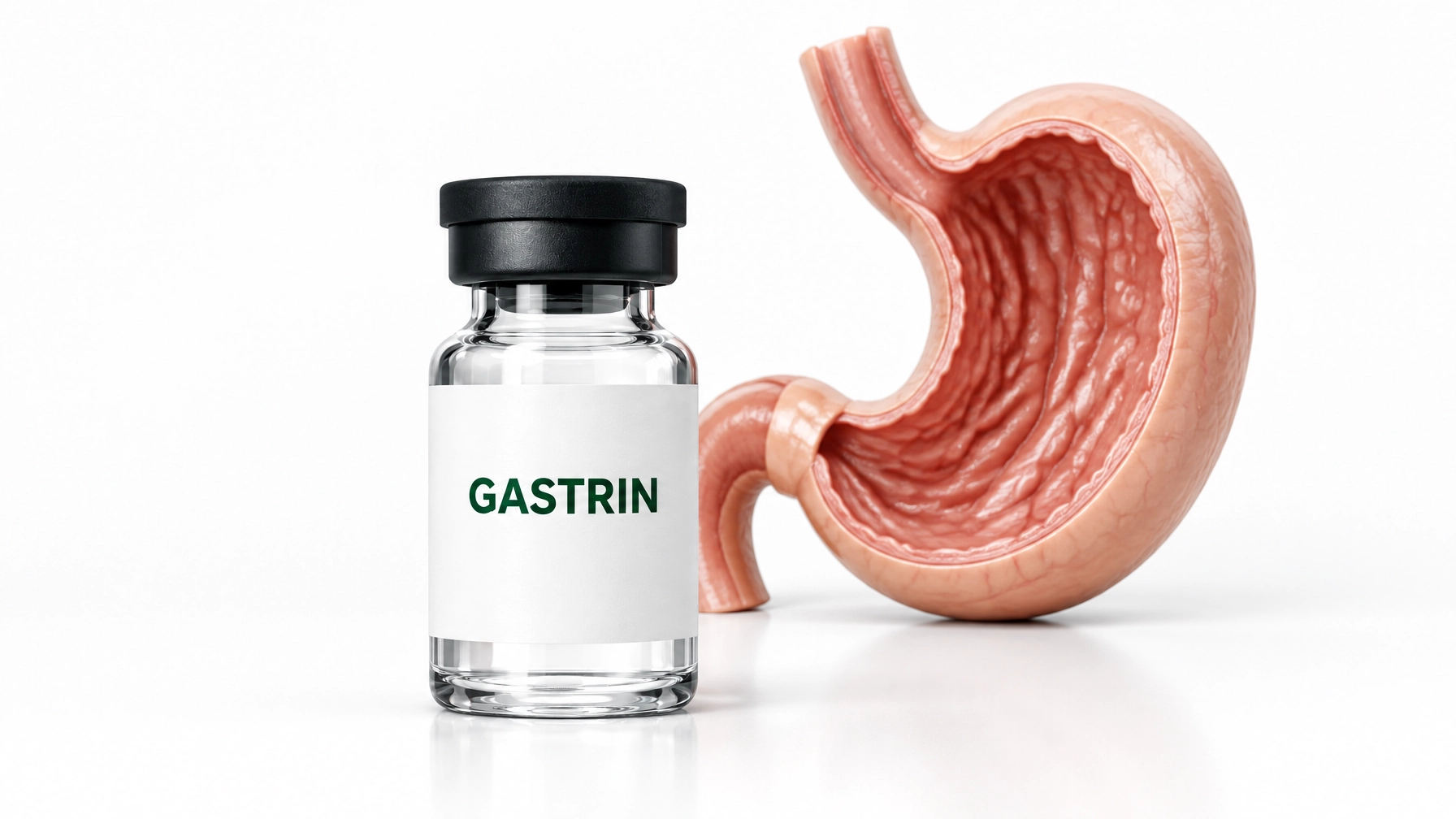
Gastrin: The Stomach Hormone That Built Endocrinology

Gastrin is one of the body’s classic signalling hormones. It helps your stomach coordinate acid production, digestion and maintenance of the gastric lining. More than that, gastrin has an important place in medical history: its discovery helped establish the idea that organs communicate using chemical messengers carried through the bloodstream.
Today, gastrin remains important in gastroenterology. The medical specialty focused on the digestive system. It is studied as an endogenous hormone, meaning your body naturally produces it. It is also measured as a diagnostic marker when clinicians investigate unusual acid secretion, stomach-lining disorders and certain tumours.
This article explains what gastrin is, how it works and why it matters. It is educational only. Gastrin is not a self-treatment option, and research-grade products must not be used in people.
A discovery that helped build endocrinology
The problem: digestion was once explained mainly through nerves
In the early twentieth century, scientists understood that nerves influenced digestion. However, they did not yet fully appreciate how strongly organs could communicate through chemical signals travelling in the blood.
That changed with the discovery of secretin in 1902. Physiologists William Bayliss and Ernest Starling showed that the intestine released a blood-borne substance that stimulated pancreatic secretion. They introduced the term hormone for this type of chemical messenger.
The discovery created a new question: could the stomach also release a hormone?
The solution: Edkins proposed “gastrin”
In 1905 and 1906, British physiologist John Sydney Edkins studied extracts from the pyloric region of the stomach. The pylorus is the lower section that connects the stomach to the small intestine.
When Edkins injected these extracts into experimental animals, gastric acid and digestive secretions increased. He proposed that the pyloric mucosa produced a chemical messenger and called it gastrin, from “gastric”.
The idea was controversial. Histamine was already known to stimulate acid secretion, and some researchers believed histamine explained the activity in stomach extracts. Later work by Simon Komarov helped demonstrate that the stomach contained a distinct acid-stimulating substance separate from histamine.
In the 1960s, Roderic Gregory and Hilda Tracy isolated and characterised gastrin peptides. Their work confirmed that gastrin was a genuine peptide hormone rather than an experimental illusion.
Short summary: gastrin helped move medicine from a nerve-only model of digestion to a broader model involving hormones, receptors and feedback loops.
Where gastrin is made
The problem: the stomach must respond to food without producing acid constantly
Acid is useful. It helps break down proteins, activates digestive enzymes and creates a hostile environment for many swallowed microorganisms. But continuous, uncontrolled acid production could damage the stomach lining.
The body solves this problem with a signalling network. One of its central components is the G cell.
G cells are specialised enteroendocrine cells. Hormone-producing cells within the digestive tract. They are found mainly in:
- The gastric antrum, the lower part of the stomach
- The pyloric region
- The upper small intestine, especially the duodenum
You can think of G cells as sensors and dispatchers at a food-processing plant. They detect changes in the digestive environment and release gastrin when the system needs more coordinated stomach activity.
Gastrin release can be stimulated by:
- Protein fragments called peptides
- Individual amino acids
- Stretching of the stomach after a meal
- Vagal signalling through gastrin-releasing peptide, or GRP
- Reduced acidity in the stomach
The hormone then travels locally and through the circulation to influence other cells.
Gastrin-17 and gastrin-34: the main forms
Gastrin is not one single molecule. It exists in several related forms produced from the same precursor protein.
The two main forms are:
| Form | Common name | General feature |
|---|---|---|
| Gastrin-17 | Little gastrin | Shorter, strongly associated with meal-related acid secretion |
| Gastrin-34 | Big gastrin | Longer form with an extended amino-terminal region |
A third, smaller form called gastrin-14, or mini-gastrin, has also been described.
The important biological activity sits near gastrin’s carboxyl-terminal end. This region acts like the key that fits the gastrin receptor. The longer gastrin-34 molecule contains the same active ending but has additional amino acids attached at the other end.
In the stomach antrum, gastrin-17 is present at much higher concentrations than gastrin-34. After a meal, gastrin-17 generally dominates the immediate post-meal response. Gastrin-34 tends to have a longer circulating half-life and contributes to the background pool of circulating gastrin.
The difference is similar to two versions of the same instruction: one is released quickly for an immediate task, while the other remains available for longer.

How gastrin stimulates stomach acid
The problem: the stomach needs a powerful acid response, but parietal cells need coordination
The stomach’s acid-producing cells are called parietal cells. They secrete hydrochloric acid, or HCl, into the stomach lumen.
Gastrin does not work alone. Its most important pathway involves enterochromaffin-like cells, usually shortened to ECL cells.
The sequence works like a relay team:
- G cells release gastrin.
- Gastrin binds to CCK2 receptors on ECL cells. CCK2 means cholecystokinin-2, also called the gastrin receptor.
- ECL cells release histamine.
- Histamine binds to H2 receptors on parietal cells.
- Parietal cells increase HCl secretion.
This is why histamine is so important in gastric physiology. Gastrin effectively presses the accelerator, but ECL-cell histamine carries much of the signal to the acid-producing parietal cell.
Gastrin can also act directly on parietal cells, but the ECL-cell pathway is considered a major route for its acid-stimulating effect.
The practical lesson: stomach acid is controlled by a team, not one switch. Gastrin, histamine, acetylcholine and somatostatin all contribute to the final result.
Gastrin and the stomach lining
The problem: acid secretion must be balanced with tissue maintenance
The stomach is a demanding environment. Its lining is exposed to acid, enzymes, food particles and mechanical movement. It needs regular maintenance, much like a busy road needs resurfacing.
Gastrin has trophic effects. “Trophic” means related to growth, maintenance or nourishment of tissue.
Research indicates that gastrin can influence:
- Growth and renewal of gastric epithelial cells
- Mucosal thickness
- Cell survival
- Differentiation, meaning the development of specialised cell functions
- The activity and number of ECL cells
This does not mean more gastrin is automatically better. Biology depends on balance. A useful repair signal can become problematic if it remains elevated for long periods.
The gastric lining is also supported by mucus, bicarbonate, healthy blood flow and rapid cell replacement. Gastrin is one part of this maintenance system, not the entire repair department.
For broader context on stomach-lining research, read WL Australia’s Stamakort article on gastric mucosal support and review the Stamakort 5 mg research product page. Stamakort is presented as a research chemical only and is not intended for human use.
The gastrin–somatostatin feedback loop
The problem: acid production must not run without a brake
A good biological system needs both an accelerator and a brake.
Gastrin is part of the accelerator. Somatostatin provides an important brake. Somatostatin is released mainly by D cells in the stomach and intestine.
When stomach acidity rises, the lower pH stimulates somatostatin release. Somatostatin then inhibits:
- G cells, reducing gastrin release
- ECL cells, reducing histamine release
- Parietal cells, reducing acid secretion
The sequence can be summarised like this:
Food enters → G cells release gastrin → ECL cells release histamine → parietal cells produce acid → acidity rises → D cells release somatostatin → gastrin and acid secretion fall.
This is negative feedback. It works like a thermostat: when the room becomes warm enough, the heating system switches down.
If acid levels remain low, this feedback signal may weaken. G cells can continue releasing gastrin because the stomach is not receiving the normal “enough acid” message.
Hypergastrinemia: when gastrin remains high
The problem: an elevated gastrin result has more than one possible explanation
Hypergastrinemia means an abnormally high level of gastrin in the blood. It is not a diagnosis by itself.
Common clinical situations associated with increased gastrin include:
- Atrophic gastritis, where chronic inflammation damages the stomach lining
- Autoimmune gastritis and pernicious anaemia, which can destroy acid-producing parietal cells
- Long-term use of acid-suppressing medicines, including proton-pump inhibitors
- Gastrinoma, a gastrin-secreting neuroendocrine tumour
- Reduced or absent stomach acid production
A gastrinoma can cause Zollinger–Ellison syndrome, a condition involving excessive gastrin and excessive acid production. Possible features include recurrent or difficult-to-treat peptic ulcers, abdominal pain, diarrhoea and malabsorption.
Atrophic gastritis creates a different pattern. The stomach may produce too little acid because parietal cells have been damaged, yet gastrin rises because the normal acid-based brake is missing.
Same hormone. Different mechanism.
That distinction matters.
Gastrin as a diagnostic marker
The problem: a blood result cannot be interpreted in isolation
Clinicians may request fasting serum gastrin when investigating:
- Suspected gastrinoma or Zollinger–Ellison syndrome
- Recurrent peptic ulcers
- Unexplained high or low stomach acid
- Atrophic gastritis
- Pernicious anaemia
- Certain neuroendocrine tumours
The solution is a complete assessment. Gastrin is usually interpreted alongside:
- Gastric pH or acid output
- Medication history, especially proton-pump inhibitors
- Vitamin B12 and related tests
- Parietal-cell and intrinsic-factor antibodies
- Imaging or endoscopy when clinically indicated
- Symptoms and medical history
A high gastrin level with high acid production suggests a different clinical pathway from a high gastrin level with little or no acid.
Do not stop prescribed medication or attempt to manipulate acid levels before testing without medical advice. Proton-pump inhibitors can significantly affect gastrin results, and sudden changes may create their own risks.

Video placeholder 1: Insert a clinician-led explainer showing the G-cell → ECL-cell → parietal-cell pathway and the role of histamine.
Where a gastrin product fits into research
Gastrin is an endogenous hormone studied in laboratory models of:
- Gastric acid secretion
- CCK2-receptor signalling
- ECL-cell biology
- Gastric epithelial growth
- Mucosal maintenance
- Gastrointestinal tumour biology
It is not a general digestive supplement, a proven treatment for reflux or an appropriate self-directed method for changing stomach acid.
WL Australia’s current online catalogue does not provide a verified dedicated Gastrin product page in the sources reviewed for this article. For current availability and product information, check the WL Australia shop or the bioregulator catalogue. Do not assume that a research listing is approved for human use.
For related gut research, see:
These products are not interchangeable with gastrin. The stomach, intestine and acid-regulation systems are related, but they are not the same target.
Video placeholder 2: Insert an educational video explaining fasting gastrin testing, medication confounders and why gastric pH helps clinicians interpret the result.
Final thoughts
Gastrin is more than a stomach hormone. Its discovery helped establish endocrinology as the study of chemical communication between organs.
You can understand its role through four connected principles:
- Production: G cells release gastrin, mainly in the gastric antrum and duodenum.
- Forms: Gastrin-17 dominates the meal-related response, while gastrin-34 contributes to longer-lasting circulating activity.
- Action: Gastrin stimulates ECL-cell histamine, which activates parietal-cell acid secretion.
- Control: Rising acidity triggers somatostatin, creating a feedback brake.
Gastrin also supports the growth and maintenance of the stomach lining. But persistent elevation can be clinically important, especially in gastrinoma, atrophic gastritis and related conditions.
The safest approach is straightforward: treat gastrin as a subject for research and medical assessment, not self-treatment. If you have persistent pain, recurrent ulcers, unexplained diarrhoea, vomiting, black stools, weight loss or difficulty swallowing, arrange medical review promptly.
Understand the signal. Check the context. Let qualified clinicians interpret the result.
 Immune Support, ant bacterial, anti viral, auto immune.
 Bioregulators
 Brain
 Skin & Hair Products