
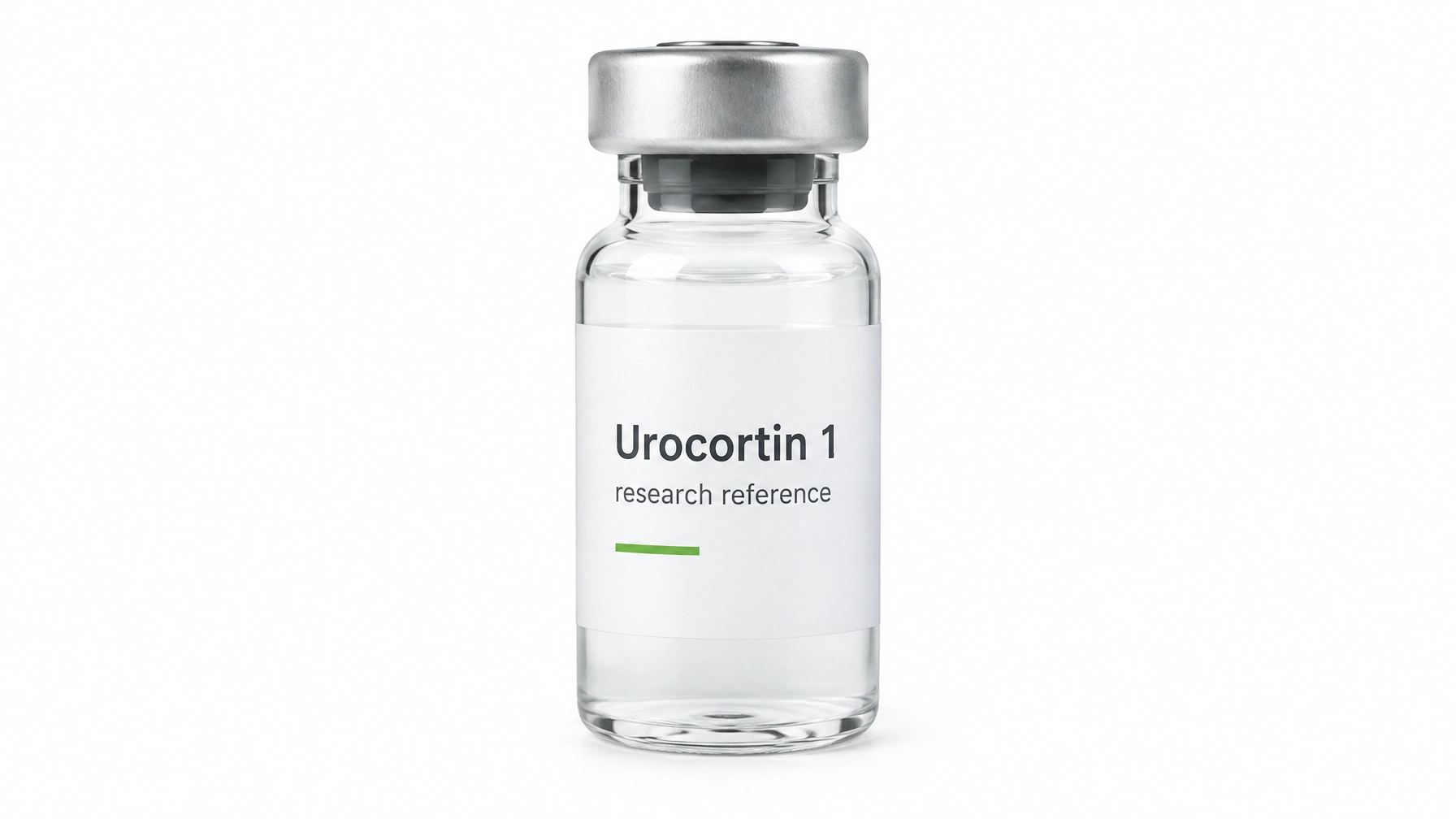
Urocortin 1: The CRF-Family Peptide at the Intersection of Stress and Cardiovascular Research

Urocortin 1 is a 40-amino-acid peptide from the corticotropin-releasing factor family, often abbreviated as the CRF family. This group of signalling molecules helps coordinate stress responses, cardiovascular function, appetite, energy balance and mood-related biology.
Urocortin 1 is particularly interesting because it can activate both major CRF receptor subtypes: CRF1 and CRF2. Think of these receptors as two control panels connected to the same biological network. CRF1 is more closely associated with the classic stress response, while CRF2 is strongly involved in stress adaptation, vascular regulation and cardiovascular signalling.
The result is a peptide with a broad research profile, but also a complex one.
Important: Urocortin 1 research remains largely preclinical. This article is for education only and is not medical advice, a treatment protocol or a recommendation for self-administration.
What is the CRF peptide family?
The problem: stress biology involves several overlapping signals
The stress response is not controlled by one isolated molecule. It works more like an emergency management system, with different teams coordinating hormones, blood vessels, the heart, appetite and behaviour.
The CRF family includes:
- CRF, also called corticotropin-releasing hormone or CRH
- Urocortin 1
- Urocortin 2
- Urocortin 3
These peptides interact with CRF receptors located in the brain, pituitary gland, heart, blood vessels and other tissues.
The solution: map the system before focusing on one peptide
The main receptors are:
| Receptor | General research association |
|---|---|
| CRF1 | Classical stress signalling, hypothalamic–pituitary–adrenal axis activity and stress-related behaviour |
| CRF2 | Stress adaptation, vasodilation, cardiovascular signalling, appetite suppression and energy balance |
The hypothalamic–pituitary–adrenal axis, commonly called the HPA axis, is the body’s central stress-response chain:
- The hypothalamus releases CRF-related signals.
- The pituitary gland releases adrenocorticotropic hormone, or ACTH.
- ACTH stimulates the adrenal glands to produce cortisol.
- Cortisol feeds back to the brain and pituitary to help limit the response.
You can think of the HPA axis as a thermostat. It should turn the stress response up when needed and turn it back down when the threat has passed. Problems arise when the system becomes too active, poorly regulated or slow to reset.
Short version: CRF-family peptides help coordinate the body’s stress thermostat.
Urocortin 1 versus CRF, Urocortin 2 and Urocortin 3
The problem: similar peptides can produce different biological patterns
CRF and the urocortins are related, but they do not interact with the receptors in exactly the same way.
CRF primarily favours CRF1, making it a key driver of the classical HPA-axis stress response. Urocortin 1, in contrast, has high affinity for both CRF1 and CRF2.
That dual activity makes Urocortin 1 more like a signal that can access two different departments:
- Through CRF1, it may contribute to arousal, HPA-axis activation and anxiety-related responses.
- Through CRF2, it may influence vasodilation, cardiovascular function, appetite and stress coping.
Urocortin 2 and Urocortin 3 are different again. They are generally described as CRF2-selective ligands. This receptor preference makes them useful research tools when scientists want to examine CRF2 biology without activating CRF1 to the same extent.
| Peptide | Main receptor profile | Why researchers study it |
|---|---|---|
| CRF | Primarily CRF1 | Stress initiation and HPA-axis regulation |
| Urocortin 1 | High affinity for CRF1 and CRF2 | Combined stress, cardiovascular, appetite and mood biology |
| Urocortin 2 | Predominantly CRF2-selective | Cardiovascular, appetite and stress-adaptation research |
| Urocortin 3 | Predominantly CRF2-selective | CRF2 signalling, energy balance and behavioural research |
Short version: Urocortin 1 is the dual-receptor member; Urocortin 2 and 3 are more CRF2-focused.

Cardiovascular research: vasodilation and cardiac protection
The problem: the cardiovascular system must respond to stress without losing control
During stress, the heart and blood vessels need to adjust quickly. Blood flow, vascular resistance and cardiac workload can all change within minutes.
Preclinical research suggests that urocortins, especially through CRF2 receptors, can influence this system in several ways.
The research solution: study CRF2 as a vascular control pathway
Urocortin-related signalling has been associated with:
- Vasodilation, meaning relaxation and widening of blood vessels
- Reduced peripheral vascular resistance
- Changes in coronary blood flow
- Positive effects on cardiac contractility in experimental models
- Protection of heart muscle cells during simulated ischaemia and reperfusion
Ischaemia means inadequate blood flow to tissue. Reperfusion is the return of blood flow after that interruption. While restoring circulation is essential, the sudden return can also create oxidative and inflammatory stress. Researchers therefore study whether urocortin signalling can help heart cells tolerate this transition.
Several pathways have been investigated, including:
- Cyclic adenosine monophosphate, or cAMP, a common intracellular messenger
- Nitric oxide and cyclic guanosine monophosphate, often written as NO–cGMP, which help regulate vascular relaxation
- Protein kinase C and other cell-survival pathways
- Changes in cardiac natriuretic peptide release, which may influence fluid balance and cardiac workload
A useful analogy is a pressure-relief system. If blood vessels relax and cardiac pumping becomes more efficient, the heart may face less resistance. Similar to an engine working against a less restrictive transmission.
However, these findings do not establish Urocortin 1 as a proven cardiovascular treatment. Much of the evidence comes from isolated tissues and animal models.
Short version: Urocortin 1 is being studied as a vascular and cardiac signalling molecule, not as an established therapy.

Video placeholder 1: Add an educational explainer showing how CRF1 and CRF2 receptors influence the HPA axis, blood vessels and cardiac tissue.
Appetite suppression and energy balance
The problem: stress and appetite often pull in opposite directions
Some people eat more under stress, while others lose their appetite. This difference reflects the interaction between stress hormones, gut signals, reward pathways and hypothalamic energy-control circuits.
Preclinical and limited human research has examined whether Urocortin 1 can influence appetite. In experimental settings, peripheral Urocortin 1 has been associated with:
- Reduced food intake
- Changes in circulating ghrelin
- Altered blood pressure
- Effects that differ depending on whether the peptide acts in the brain or the periphery
Ghrelin is a stomach-derived hormone that can stimulate hunger and influence growth-hormone signalling. If Urocortin 1 reduces ghrelin under certain experimental conditions, it may help explain its appetite-suppressing profile.
But the location of the signal matters. A message delivered to the brain is not necessarily equivalent to a message circulating through the body. It is like sending the same instruction to a company headquarters versus a local branch: the outcome may depend on where the instruction is received.
For broader appetite and peptide education, see WL Australia’s Managing Hormones with Peptides. For a related product page focused on ghrelin-pathway research, see Ghrelin.
Short version: Urocortin 1 may suppress appetite in some models, but its effects depend on receptor location, route, dose and biological context.
Anxiety, mood and stress research
The problem: activating a stress pathway may produce mixed behavioural effects
Urocortin 1 is not simply a “calming peptide” or a “stress peptide.” Its dual CRF1/CRF2 activity creates a more complicated picture.
CRF1 activation is commonly linked with:
- Increased HPA-axis activity
- Arousal and vigilance
- Anxiety-like behaviours in animal studies
- Stress-related changes in mood and behaviour
CRF2 activation has been associated in some models with:
- Stress coping
- Reduced arousal
- Anxiolytic-like effects
- Appetite suppression
- Cardiovascular adaptation
Because Urocortin 1 can activate both receptors, its effect may vary according to:
- Brain region
- Receptor distribution
- Timing
- Experimental dose
- Whether the signal is central or peripheral
- The animal model or disease model used
This is why Urocortin 2 and Urocortin 3 are valuable comparison tools. Their CRF2 preference allows researchers to examine whether a particular outcome is linked to CRF2 without relying on a dual-receptor signal.
For related stress-biology reading, see The Secretagogue Solution: How Ipamorelin Mimics Your Body’s Natural Signals and WL Australia’s Ipamorelin product page. These products are not substitutes for Urocortin 1; the links are provided for broader peptide and stress-signalling context only.
Short version: Urocortin 1’s mood-related profile is biologically interesting precisely because it can engage both sides of the CRF receptor system.

How to interpret the current research
The problem: promising mechanisms can be mistaken for proven outcomes
Urocortin 1 has a compelling research profile, but a mechanism is not the same as a validated clinical benefit.
Current research should be understood as:
- Preclinical, with substantial evidence from animal and laboratory models
- Mechanistic, focused on receptor activity and signalling pathways
- Translational, meaning researchers are investigating whether laboratory findings could eventually inform human medicine
- Not sufficient to support self-treatment
There is no established consumer dosing protocol for using Urocortin 1 to manage stress, cardiovascular disease, appetite or mood. You should not attempt to self-administer research peptides or use them as replacements for cardiovascular, psychiatric or endocrine care.
In Australia, therapeutic claims and regulated medicines are overseen through the Therapeutic Goods Administration (TGA) framework. Product status, intended use, labelling and import requirements can differ. Always check the current legal and regulatory position and speak with a qualified Australian clinician before considering any compound that could affect blood pressure, cardiac function, cortisol or mood.
WL Australia’s current catalogue did not show a dedicated Urocortin 1 product page during research for this article. For current availability and product information, visit the WL Australia shop rather than relying on third-party listings.
Video placeholder 2: Add a clinician-led video explaining the difference between preclinical peptide research, approved medical treatment and research-use-only products.
Final takeaway
Urocortin 1 is a 40-amino-acid CRF-family peptide with high affinity for both CRF1 and CRF2 receptors. That dual profile places it at the intersection of:
- HPA-axis stress biology
- Cardiovascular signalling
- Vasodilation
- Cardiac protection research
- Appetite suppression
- Energy balance
- Anxiety and mood studies
Its closest family members help clarify the picture. CRF tends to favour CRF1, while Urocortin 2 and Urocortin 3 are more selective for CRF2. Urocortin 1 sits between these patterns, offering broad biological activity but also greater interpretive complexity.
The core principle is simple: understand the receptor, understand the context and respect the evidence. Urocortin 1 may help researchers unlock new information about stress and cardiovascular biology, but it remains a preclinical research subject, not a self-treatment strategy.
 Immune Support, ant bacterial, anti viral, auto immune.
 Bioregulators
 Brain
 Skin & Hair Products