
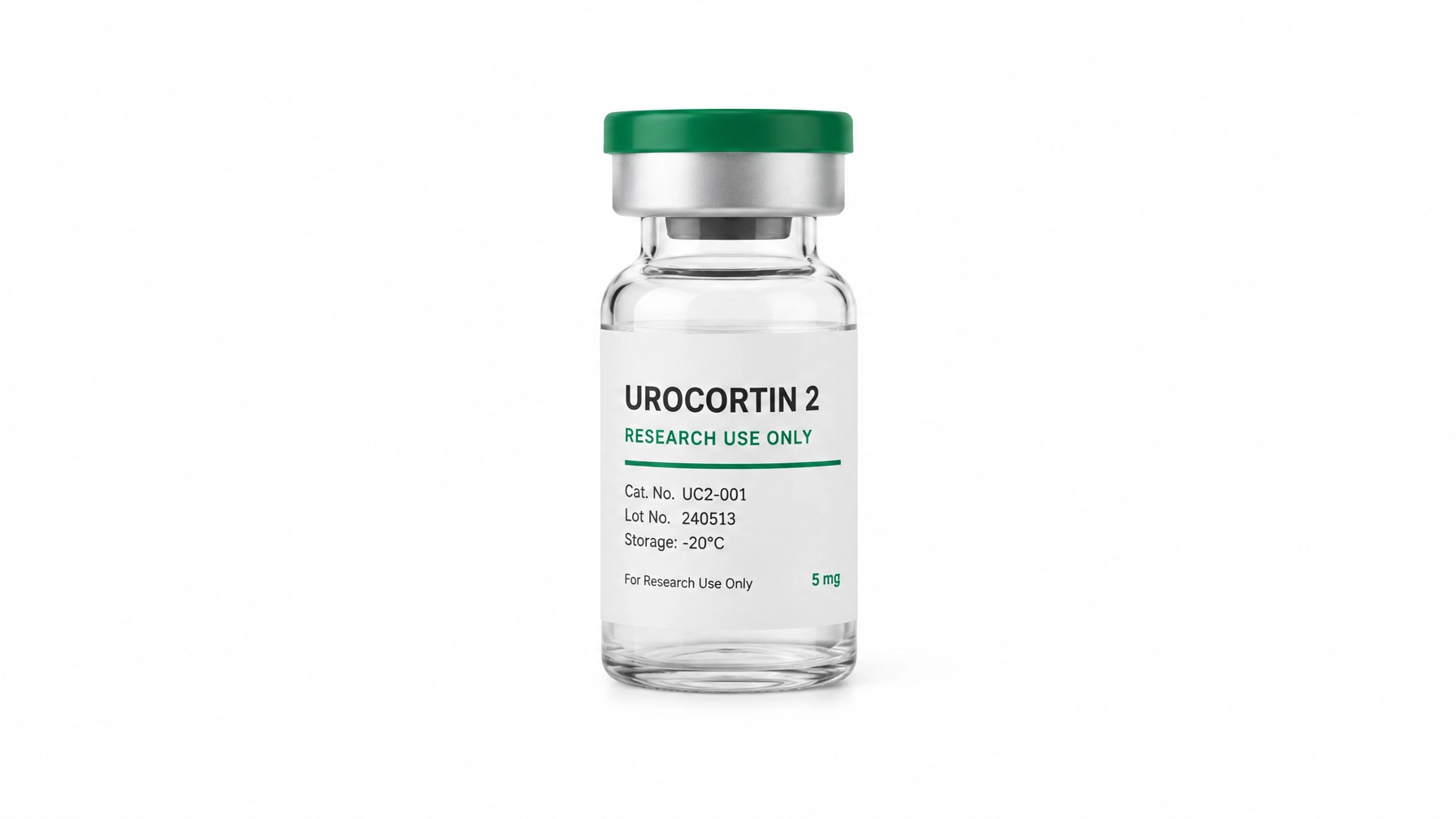
Urocortin 2: The CRF2-Selective Peptide for Cardiovascular and Appetite Research

Urocortin 2 is a 38-amino-acid peptide from the corticotropin-releasing factor (CRF) family. Its defining feature is its strong preference for the CRF2 receptor, making it a valuable research tool for studying cardiovascular function, appetite, energy balance and stress-related biology.
Think of receptor selectivity like using one key for one lock. If a compound activates several receptor types at once, it becomes difficult to identify which receptor produced a particular effect. Urocortin 2 helps researchers focus more closely on CRF2-mediated signalling.
This distinction matters. Urocortin 1 activates both CRF1 and CRF2, while Urocortin 2 is widely used as a more CRF2-selective agonist. An agonist is a molecule that binds to a receptor and activates it.
Video placeholder: Urocortin 2 explained: CRF2 selectivity, cardiovascular signalling and research applications
Why CRF2 selectivity matters
The problem: too many biological signals at once
The CRF receptor family is involved in several systems, including the nervous system, blood vessels, heart and gastrointestinal tract. When researchers use a non-selective compound, the result can be like listening to several radio stations at the same time.
Urocortin 1 can activate both CRF1 and CRF2. That makes it useful for studying broader CRF biology, but less precise when the research question is specifically about CRF2.
The research solution: isolate the CRF2 pathway
Urocortin 2 gives researchers a way to examine CRF2 signalling with less interference from CRF1. This can help answer questions such as:
- How does CRF2 activation change vascular tone?
- What happens to cardiac contraction and relaxation?
- Does CRF2 influence coronary blood flow?
- How does CRF2 affect appetite and energy balance?
- Can CRF2 signalling contribute to protection during cardiovascular stress?
CRF2 receptors are found in the myocardium, the muscular tissue of the heart, and in vascular tissues. In simple terms, the receptor is positioned in both the heart’s engine room and its plumbing system.
| Feature | Urocortin 1 | Urocortin 2 |
|---|---|---|
| Peptide family | CRF family | CRF family |
| Approximate length | About 40 amino acids | 38 amino acids |
| Main receptor profile | Activates CRF1 and CRF2 | Strongly favours CRF2 |
| Research value | Broad CRF-family activity | More focused CRF2 investigation |
| Cardiovascular research | Mixed receptor effects | CRF2-selective cardiovascular effects |
| Appetite research | Broader CRF signalling | CRF2-linked feeding and energy-balance research |
The key message is simple: selectivity improves experimental clarity.
Cardiovascular research: opening the vessels
The problem: resistance places extra load on the heart
Your circulatory system is similar to a network of pipes. When the vessels become more constricted, the heart must push harder to move blood through them. This resistance is called afterload: the pressure the heart works against when pumping blood.
Excessive vascular resistance can reduce efficiency and increase the workload placed on the heart.
The research solution: study CRF2-mediated vasodilation
Research on Urocortin 2 has reported powerful vasodilation, meaning relaxation and widening of blood vessels. In experimental models, this can reduce peripheral vascular resistance and lower blood pressure.
The same principle applies to the coronary circulation, the network of vessels that supplies the heart muscle. Increased coronary blood flow may help researchers understand how CRF2 signalling affects oxygen and nutrient delivery to cardiac tissue.
Several signalling systems may contribute, including:
- Adenylyl cyclase and cyclic AMP (cAMP): an internal cellular messaging system.
- Protein kinase A (PKA): an enzyme that helps translate cAMP signals into cellular actions.
- Nitric oxide (NO): a signalling molecule involved in vascular relaxation.
- Cyclic guanosine monophosphate (cGMP): another messenger involved in smooth-muscle relaxation.
These pathways operate like a coordinated control panel. One signal changes vessel tension, another affects cardiac calcium handling, and the combined result may alter blood flow and cardiac performance.
Cardiac contractility and coronary blood flow

The problem: a weak or stiff heart may struggle to maintain output
Cardiac output is the amount of blood the heart pumps over time. If the heart contracts weakly, or fails to relax properly between beats, cardiac output may fall.
Researchers often examine two related processes:
- Inotropy: the strength of cardiac contraction.
- Lusitropy: the ability of the heart muscle to relax.
A useful analogy is a piston engine. The engine must generate enough force on the downstroke, but it must also reset smoothly before the next cycle. A heart that contracts strongly but relaxes poorly is not operating efficiently.
The research solution: investigate CRF2 effects on cardiac performance
Experimental studies have associated Urocortin 2 with increased cardiac contractility and improved relaxation. In cardiac cells, CRF2 activation may influence calcium movement through L-type calcium channels and the sarcoplasmic reticulum, the internal calcium-storage network of muscle cells.
Better calcium handling can improve the timing of contraction and relaxation. In animal and cellular models, Urocortin 2 has also been associated with increased cardiac output and coronary blood flow.
Human research has explored short-term cardiovascular effects, including changes in cardiac output, vascular resistance and blood pressure. However, these findings do not mean Urocortin 2 is an approved treatment. They show why the peptide remains interesting as a translational research subject.
For further reading on cardiovascular peptide research, see WL Australia’s articles on Hexarelin and cardioprotection and Cardiogen’s cardiovascular research background.
Why CRF2 compounds are studied for cardiovascular protection
The problem: the heart is vulnerable during interrupted blood flow
During ischemia, tissue receives too little blood and oxygen. When blood flow returns, the restoration process is called reperfusion. Together, this is known as ischemia–reperfusion injury, or I/R injury.
Reperfusion is necessary, but the sudden return of oxygen and pressure can also trigger oxidative stress, inflammation, electrical instability and cell injury. It is similar to restarting a damaged electrical system: restoring power is essential, but the surge can expose weaknesses in the wiring.
The research solution: combine circulation, contraction and cell-survival signals
CRF2-selective compounds are studied because they may influence several protective processes at the same time:
- Vasodilation: may support blood flow through arteries and coronary vessels.
- Improved contractility: may help maintain cardiac output in experimental models.
- Better relaxation: may reduce mechanical strain between contractions.
- AMP-activated protein kinase (AMPK) signalling: AMPK is an energy-sensing enzyme that helps cells respond to metabolic stress.
- Endothelial support: the endothelium is the thin inner lining of blood vessels and an important regulator of vascular tone.
Research has linked Urocortin 2 and CRF2 activation with protection against I/R injury in experimental hearts. These findings are important because they connect receptor biology with a real cardiovascular challenge: how to protect heart tissue when circulation is disrupted and restored.
But the evidence remains primarily preclinical and investigational. Cardiovascular protection is a research direction, not a personal treatment recommendation.
Appetite and energy balance research

The problem: appetite is controlled by a network, not a single switch
Hunger, fullness and energy expenditure are regulated by a complex communication network involving the hypothalamus, gut, brainstem, hormones and autonomic nervous system.
The hypothalamus acts like a control centre. It receives information about stored energy, recent food intake and stress, then helps adjust feeding behaviour and metabolism.
The research solution: examine CRF2-linked feeding signals
Urocortin 2 has been studied for effects on feeding, drinking, gastric emptying and body-weight regulation, especially in animal models. Central CRF2 activation may reduce food intake and alter energy expenditure.
This is not the same as saying Urocortin 2 is a weight-loss product. Appetite findings are useful because they help researchers map how CRF2 communicates between the brain, gut and metabolic systems.
Researchers may examine:
- Changes in food intake after central administration.
- Delayed gastric emptying.
- Alterations in energy expenditure.
- Links between stress signalling and feeding behaviour.
- Differences between CRF1 and CRF2 pathways.
The wider lesson is that appetite control is a team sport. Receptors, hormones and neural circuits must work together, and changing one signal can affect several systems.
How Urocortin 2 fits into research planning
Urocortin 2 is most useful when the research question is clearly defined. Consider it when a study requires:
- A CRF2-preferring agonist.
- Cardiovascular receptor mapping.
- Vascular tone and coronary-flow investigation.
- Cardiac contractility or relaxation research.
- Appetite and energy-balance studies.
- Comparison with Urocortin 1 or CRF1-active compounds.
For Australian researchers, review the applicable requirements before purchasing or handling any research peptide. WL Australia’s bioregulator catalogue and research shop provide the appropriate starting points for current listings. A dedicated Urocortin 2 product page is not currently visible in the public catalogue, so confirm availability and product details directly before relying on any listing.
You can also compare cardiovascular research themes with Vesugen or Cardiogen 20mg, which investigate different biological pathways.
Video placeholder: From receptor to response: how CRF2 signalling may influence blood vessels, cardiac tissue and appetite
Safety, legality and responsible research
Urocortin 2 is a potent research peptide, not an approved self-treatment. Do not use it on yourself, another person or an animal.
Potential cardiovascular effects such as vasodilation, blood-pressure changes, tachycardia or altered cardiac workload make unsupervised use especially inappropriate. Appetite and central nervous system effects also require careful study design and oversight.
Before any lawful laboratory work:
- Obtain review from a suitably qualified clinician, researcher or institutional ethics committee where applicable.
- Confirm Australian and local requirements for purchase, storage, handling and disposal.
- Use validated analytical methods and appropriate controls.
- Do not infer human safety from cell or animal studies.
- Do not use research-grade material as a medicine, supplement or injectable product.
WL Australia states that its products are supplied for qualified laboratory and research use only. Review the company’s legal disclaimer before purchasing.
Final perspective
Urocortin 2 is valuable because it helps researchers focus on one receptor family member: CRF2. That focus supports clearer investigation of vasodilation, cardiac contractility, coronary blood flow, ischemia–reperfusion protection, appetite and energy balance.
Urocortin 1 activates both CRF1 and CRF2. Urocortin 2 provides a more selective lens for examining CRF2 biology.
The research principle is straightforward: selectivity improves understanding. Better understanding supports better study design, safer interpretation and more responsible progress in cardiovascular and metabolic research.
 Immune Support, ant bacterial, anti viral, auto immune.
 Bioregulators
 Brain
 Skin & Hair Products