
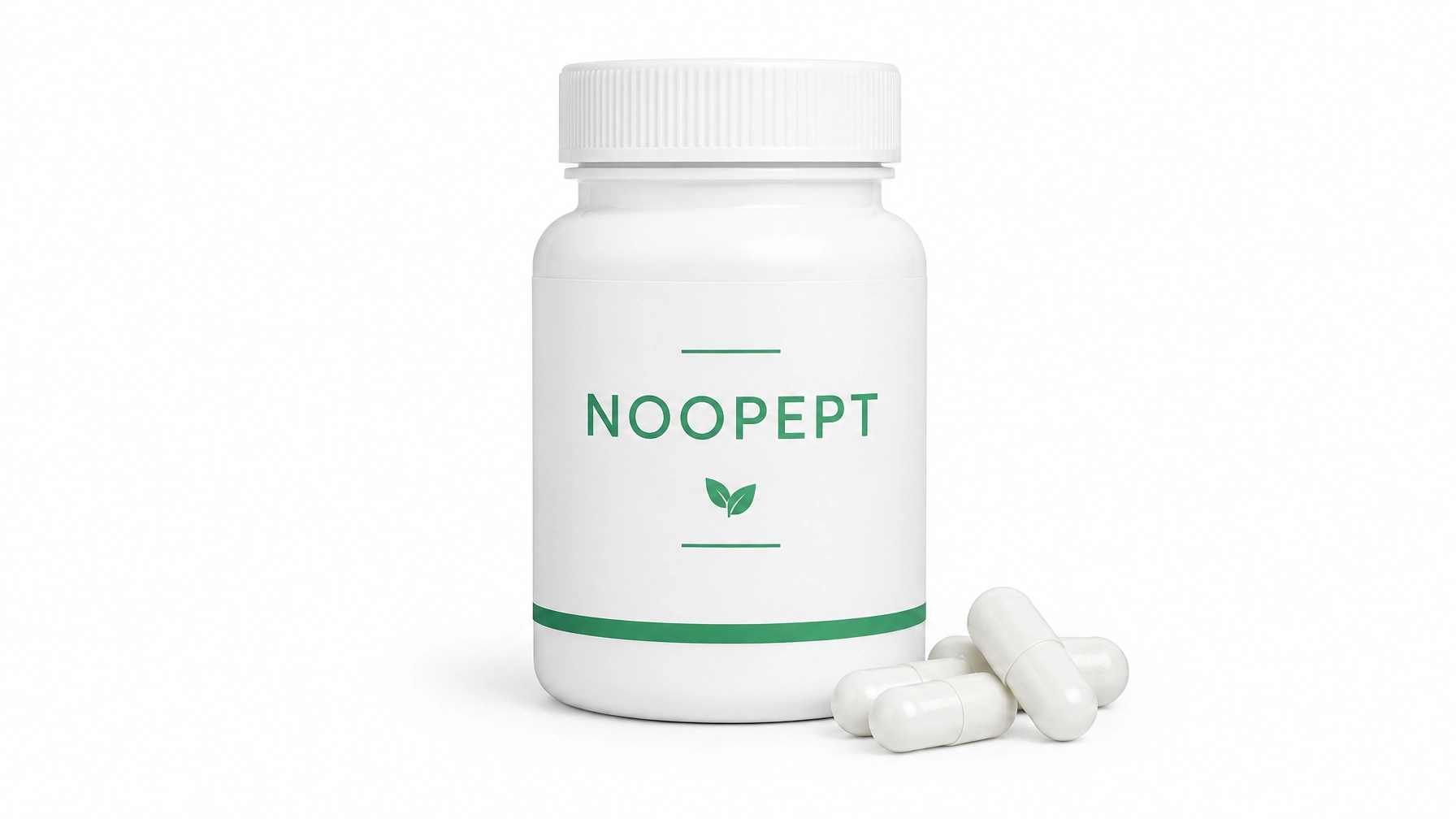
Noopept: The Dipeptide Nootropic for Memory, Focus and BDNF Research

When memory feels less reliable or focused work takes more effort, it is natural to look for tools that may support cognitive performance. Noopept is one of the better-known compounds in the modern nootropic landscape, but its reputation is stronger than its clinical evidence.
Noopept, also known as omberacetam, is a synthetic, dipeptide-derived nootropic first developed in Russia. It is studied for its possible effects on memory, attention, neurotrophic signalling and neuronal resilience.
The important distinction is this: research interest is not the same as proven treatment. Noopept is not approved by the Australian Therapeutic Goods Administration (TGA) as a medicine, and the WL Australia product listing identifies it as a research chemical only, not for human use.
What is Noopept?
The problem: the name sounds simple, but the chemistry is not
Noopept’s chemical name is N-phenylacetyl-L-prolylglycine ethyl ester. In plain English, it is a small synthetic molecule built around a prolylglycine dipeptide core, with additional chemical groups that influence its stability and absorption.
Think of the molecule as a compact delivery vehicle. The prolylglycine structure resembles part of a natural signalling molecule, while the attached groups help shape how the compound behaves before it is broken down.
Noopept is closely associated with cycloprolylglycine, or cPG, an endogenous neuropeptide-related metabolite found naturally in the body. Research suggests that Noopept may act partly as a prodrug. A precursor that is converted into active metabolites after administration.
The compound itself appears to be short-lived in animal research, while cPG levels may remain elevated in the brain for longer. It is similar to sending a construction crew to a building site: the original delivery truck may leave quickly, but the workers it delivered can continue the project.
Short version: Noopept is not simply “a stronger vitamin for the brain.” It is a synthetic research compound with a proposed relationship to natural neuropeptide signalling.

How might Noopept work?
The problem: cognitive mechanisms are often reduced to marketing slogans
Online descriptions commonly claim that Noopept “boosts brain power.” That phrase is too broad to be useful. The research focuses on several possible mechanisms, most of which remain preclinical.
1. BDNF and NGF signalling
BDNF means brain-derived neurotrophic factor. It helps support neuronal survival, synaptic plasticity and the strengthening of connections involved in learning.
NGF means nerve growth factor. It supports the development and maintenance of certain nerve cells, particularly those involved in cholinergic communication.
You can think of BDNF and NGF as maintenance signals in a city’s communication network. They do not instantly create better traffic, but they may help keep roads, cables and connections functioning while the network adapts.
Animal studies have reported changes in BDNF and NGF expression after repeated Noopept administration, particularly in brain regions such as the hippocampus. The hippocampus is heavily involved in memory formation and spatial learning.
However, these findings do not prove that Noopept improves memory in healthy humans. The evidence is a promising blueprint, not a completed building.
2. Cholinergic signalling
Acetylcholine is a neurotransmitter involved in attention, learning and memory. Noopept is often discussed alongside racetams because both are associated with cholinergic processes.
The proposed relationship is indirect and not fully established in humans. Some researchers have suggested that Noopept may influence acetylcholine-dependent learning pathways or increase the brain’s demand for cholinergic support.
This may help explain why some users report headaches or mental tension. But it is important not to assume that every headache means a lack of choline, or that adding another supplement will solve the problem.
3. Glutamatergic and neuroprotective pathways
Glutamate is the brain’s primary excitatory neurotransmitter. It is essential for learning, but excessive glutamate activity can become harmful. A process known as excitotoxicity.
Preclinical research has explored whether Noopept and cPG may help regulate glutamatergic activity, oxidative stress and inflammatory signalling. These studies are part of the reason Noopept is discussed in relation to neuroprotection.
The limitation is clear: a result in a cell culture or animal model is not equivalent to a demonstrated clinical benefit.
Video placeholder: Insert educational video: “Noopept explained, dipeptide structure, cPG and neurotrophic signalling.”
What does the human research show?
The problem: reported benefits are often presented without context
User literature commonly describes Noopept as supporting:
- Memory recall
- Focus and concentration
- Learning capacity
- Mental clarity
- Cognitive recovery after neurological injury
These reports can help identify research questions, but they are not controlled evidence. Personal experience is influenced by sleep, expectations, caffeine intake, stress, workload and many other variables.
The available human research is limited and comes largely from Russian-language clinical literature. One frequently cited study involved adults with mild cognitive disorders, including vascular and post-traumatic conditions. Participants received either Noopept or piracetam for approximately eight weeks. The Noopept group showed improvements on several cognitive and mood measures.
However, the study did not include a true placebo group and involved a relatively small population. That makes it difficult to separate the compound’s effect from natural variation, participant expectations or the effects of clinical monitoring.
Other Russian studies have examined Noopept in people recovering from stroke or living with cognitive impairment. These reports are relevant, but many are open-label, short-term or incompletely described by modern research standards.
A review from the Alzheimer’s Drug Discovery Foundation describes the evidence as limited and highlights that much of the work is preclinical. ConsumerLab’s review similarly notes that controlled evidence in healthy adults is lacking.
The practical conclusion: Noopept may be biologically active, but there is not enough high-quality evidence to say that it reliably improves memory or focus in healthy people.
Noopept compared with racetams and other nootropics
The problem: all nootropics can appear interchangeable
They are not. Different compounds may act through different pathways, have different evidence bases and carry different safety questions.
| Compound or category | General research position | Common research interest | Key limitation |
|---|---|---|---|
| Noopept | Dipeptide-derived synthetic nootropic | Memory, BDNF, NGF and neuroprotection | Limited human evidence; no TGA approval |
| Piracetam | Older racetam compound | Cognitive impairment and neuronal signalling | Mixed evidence and regulatory differences |
| Aniracetam | Racetam-related compound | Memory, mood and glutamatergic signalling | Limited modern clinical evidence |
| Nooglutyl | Experimental nootropic compound | Learning and AMPA-related signalling | Very limited human research |
| PRL-8-53 | Experimental memory compound | Short-term recall research | Sparse evidence and uncertain safety |
| Caffeine | Established stimulant | Alertness and attention | Tolerance, sleep disruption and anxiety |
Noopept is often described as racetam-like, but it is not simply a conventional racetam. Its proposed activity includes neurotrophic signalling and conversion to cPG, while racetams are generally discussed in terms of membrane, cholinergic and glutamatergic effects.
For a broader overview, read WL Australia’s Nootropic Capsules Roundup: Noopept, Nooglutyl, Phenibut and PRL-8-53 Compared. You can also review the Complete Guide of Nootropic Peptides.
Do not treat a comparison table as a recommendation to combine compounds. A stack is not automatically better than a single compound. In biology, adding more parts to an engine does not guarantee better performance; it may simply create more opportunities for friction, overheating and failure.

Research dosing, forms and interpretation
The problem: online dosing advice can look more certain than the evidence
The most frequently cited clinical research dose is 10 milligrams twice daily, used for approximately eight weeks in a study of people with cognitive impairment. This is a research observation, not a general recommendation.
Online products may appear as:
- Capsules
- Tablets
- Powder
- Other experimental delivery formats
The WL Australia Noopept 10mg listing is presented as a research chemical and explicitly states that it is not for human use. Product availability, packaging and specifications can change, so check the current listing directly.
There is no TGA-approved Noopept dosing protocol for consumers in Australia. You should not infer a safe dose from a product strength, an online forum or another person’s experience.
Video placeholder: Insert educational video: “Noopept research considerations, forms, study dosing and evidence limitations.”
Safety and Australian regulatory context
The problem: “generally tolerated” does not mean risk-free
Reported adverse effects in short-term studies have included:
- Headache
- Sleep disturbance
- Irritability
- Increased blood pressure
- Possible allergic reactions
Long-term safety remains poorly characterised. There is also limited information about interactions with prescription medicines, stimulants, blood-pressure treatments or other nootropics.
Do not self-treat memory loss, brain fog, anxiety, post-concussion symptoms or neurological disease with Noopept. These symptoms can reflect sleep disorders, medication effects, nutritional problems, depression, thyroid disease, cardiovascular risk or neurological conditions that require proper assessment.
Before considering any research compound, speak with a qualified Australian healthcare professional, especially if you:
- Have high or low blood pressure
- Have liver or kidney disease
- Take prescription medicines
- Are pregnant or breastfeeding
- Have a history of seizures, anxiety or sleep disturbance
- Are under 18
Noopept is not a TGA-approved medicine and is not listed here as a treatment for any condition. Visit the Therapeutic Goods Administration for Australian regulatory information.
Final perspective
Noopept is scientifically interesting because it sits at the intersection of dipeptide chemistry, cycloprolylglycine biology, BDNF and NGF research, and racetam-style cognitive investigation.
The potential is worth studying. The claims still require restraint.
If you are researching Noopept, focus on the core principles: evidence, safety, regulatory awareness and clinical oversight. Use the available literature to understand the compound, not to replace medical care or turn an experimental chemical into a proven therapy.
 Immune Support, ant bacterial, anti viral, auto immune.
 Bioregulators
 Brain
 Skin & Hair Products