
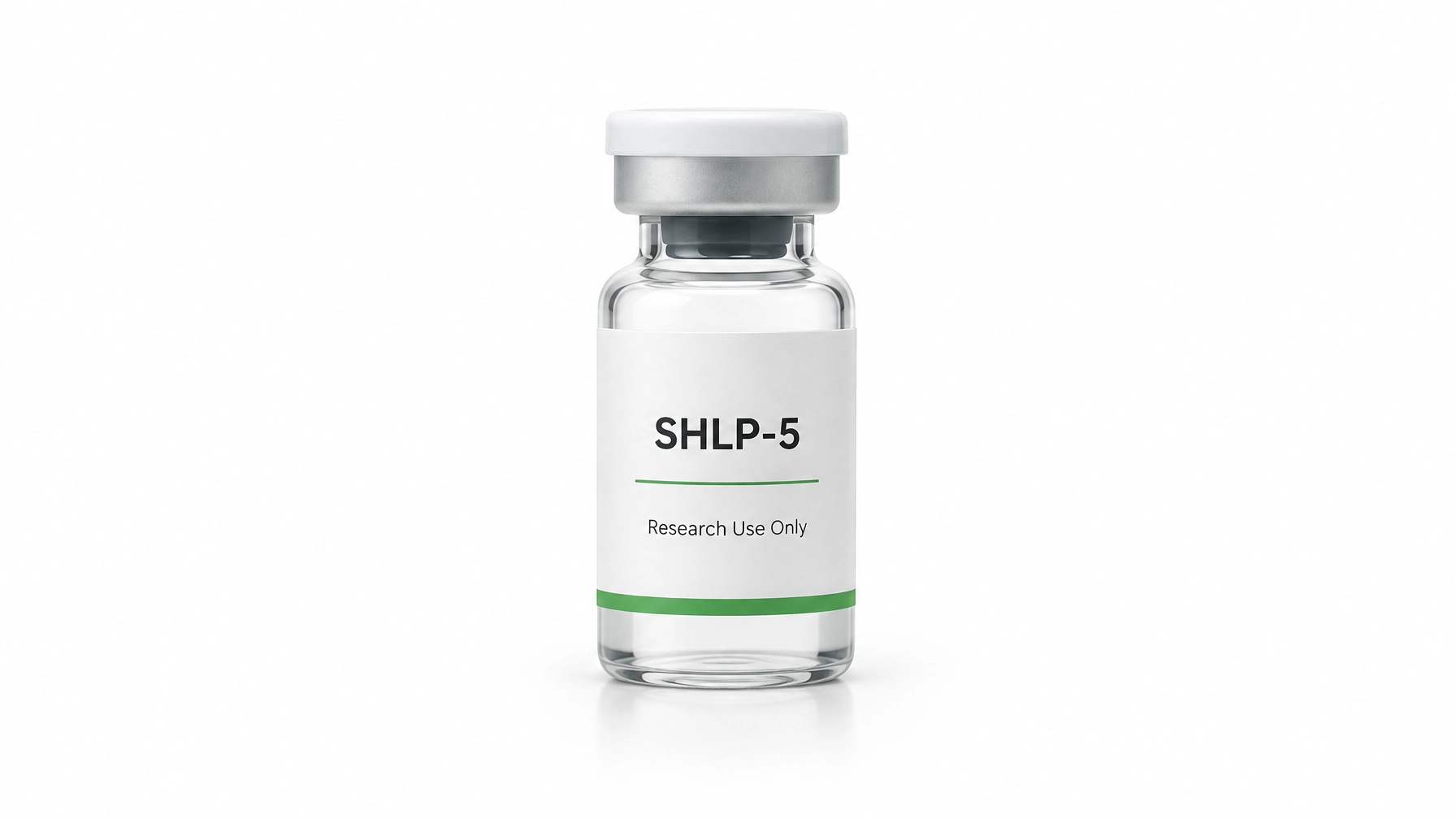
SHLP-5: The Mitochondrial-Derived Peptide for Cellular Protection and Aging Research

Mitochondria are often described as the “powerhouses” of the cell. That comparison is useful, but incomplete. Your mitochondria are not just battery packs. They are more like a combined power station, quality-control department and communication hub.
They produce adenosine triphosphate (ATP), the main energy currency used by cells. They help manage reactive oxygen species (ROS), which are chemically active molecules produced during normal metabolism. They also influence calcium balance, inflammation, stress responses and programmed cell death.
This is why mitochondrial function has become a central thread in longevity research.
SHLP-5, short for Small Humanin-Like Peptide 5, belongs to a newly identified family of short peptides produced from mitochondrial genetic material. It is attracting interest because researchers are investigating whether mitochondrial DNA produces more than traditional energy-related proteins.
However, you need to understand the evidence clearly: SHLP-5 research is still at an early stage. Its mitochondrial origin and peptide sequence have been described, but its specific biological function has not yet been established.
Video placeholder: Insert SHLP-5 introductory video here.
What is SHLP-5?
The problem: Mitochondrial biology is more complex than a simple energy model
For many years, mitochondria were mainly viewed as cellular furnaces. They convert nutrients into ATP, much like a power station converts fuel into electricity.
Researchers now understand that mitochondria also communicate with the rest of the cell. They can send signals to the nucleus, alter gene activity and respond to stress. This is sometimes called mitonuclear communication, meaning communication between mitochondrial DNA and the cell nucleus.
The research solution: Study mitochondrial-derived peptides
Mitochondrial-derived peptides, or MDPs, are short peptides made from small open reading frames in mitochondrial DNA. A small open reading frame is a short DNA sequence that can be read to produce a peptide.
The SHLP family includes six named peptides:
- SHLP-1
- SHLP-2
- SHLP-3
- SHLP-4
- SHLP-5
- SHLP-6
The family shares an important origin. The SHLPs are associated with the MT-RNR2 region, which encodes part of mitochondrial 16S ribosomal RNA. In simple terms, they are like short messages hidden inside a larger mitochondrial instruction manual.
Research has confirmed that SHLP-5 is mitochondrial in origin. Its reported sequence is:
MYCSEVGFCSEVAPTEIFNAGLVV
That tells researchers what SHLP-5 is made of. It does not yet tell them exactly what SHLP-5 does.
Key point: SHLP-5 has a defined identity, but its function remains largely unexplored.

What roles are researchers investigating?
The problem: Cellular stress can damage the systems that keep cells functioning
Cells constantly manage challenges such as oxidative stress, nutrient changes, inflammation and damaged proteins. Think of a cell as a busy construction site. It needs energy, waste removal, repair crews and emergency signals.
When these systems become unbalanced, cells may produce excessive ROS, lose mitochondrial efficiency or activate apoptosis. Apoptosis is programmed cell death: a controlled process that removes damaged or unnecessary cells.
The research solution: Examine whether mitochondrial peptides act as stress signals
Researchers are investigating MDPs as possible signalling molecules. Some members of the broader mitochondrial peptide family have shown effects in laboratory and animal research involving:
- Cellular survival during stress
- Oxidative balance
- Mitochondrial energy production
- Insulin sensitivity
- Inflammatory signalling
- Apoptosis-related pathways
- Communication between mitochondria and the nucleus
For example, studies of SHLP-2 and SHLP-3 have reported cellular effects involving viability, ROS, mitochondrial respiration and apoptosis. Humanin and MOTS-c, which are also mitochondrial-derived peptides but are not SHLP-5, have been studied in relation to metabolism and cellular stress responses.
This family-level research creates a useful scientific map. It suggests that mitochondrial peptides may not all perform the same job.
One peptide may influence energy metabolism. Another may help coordinate stress signalling. Another may affect cell survival or inflammatory pathways.
But you must not transfer evidence from one peptide to another. Research on SHLP-2, SHLP-3, Humanin or MOTS-c does not prove that SHLP-5 has the same effects.
At present, there is no strong published evidence establishing SHLP-5 as a cellular protector, anti-aging agent or treatment for any health condition.
The responsible interpretation is simple: SHLP-5 is a promising research question, not a proven therapy.
How do researchers study SHLP-5 alongside the other SHLPs?
The problem: A family name does not mean identical biological behaviour
The SHLPs share a mitochondrial origin, but their sequences differ. Think of them as members of the same sports team. They wear the same uniform, but each player may have a different position.
Researchers therefore compare the peptides rather than assuming they are interchangeable.
The research solution: Build a function-by-function comparison
A structured research program may compare SHLP-5 with the other SHLPs across several stages.
| Research question | What scientists may measure | Why it matters |
|---|---|---|
| Does the peptide affect cell survival? | Cell viability and apoptosis markers | Shows whether cells tolerate a defined stressor |
| Does it change oxidative balance? | ROS and antioxidant markers | Helps map possible stress-response activity |
| Does it influence mitochondrial performance? | ATP, oxygen consumption and membrane potential | Indicates whether energy systems are affected |
| Does it alter signalling? | Pathways such as ERK, AKT or STAT3 | Identifies possible communication routes |
| Does it interact with proteins? | Binding and receptor-screening studies | Helps identify potential mechanisms |
| Does it behave differently by tissue? | Liver, muscle, neuronal or other cell models | Shows whether effects are cell-specific |
| Does it change with age? | Tissue or circulating measurements | Tests whether it has an age-related pattern |
This process resembles testing parts in a car engine. You do not assume every component controls the same function. You test the battery, fuel system, cooling system and control unit separately before describing the whole engine.
For SHLP-5, the first priority is basic characterisation:
- Confirm the peptide’s identity and purity.
- Determine whether it is detectable in relevant cells or tissues.
- Test whether it enters cells or remains outside them.
- Screen for protein or receptor interactions.
- Measure its response under controlled cellular stress.
- Compare the results with SHLP-1 through SHLP-6.
This approach protects research quality. It prevents an attractive theory from being mistaken for a proven mechanism.
Video placeholder: Insert a laboratory methods or SHLP family comparison video here.

Why mitochondria are central to aging research
The problem: Aging affects several connected cellular systems at once
Aging is not controlled by one switch. It is more like an old building where several systems gradually require more maintenance: electrical wiring, plumbing, structural supports and ventilation.
Mitochondria are connected to many of these systems. With age, researchers study changes in:
- ATP production and energy availability
- Oxidative stress management
- Mitochondrial quality control
- Removal of damaged mitochondria, called mitophagy
- Inflammatory signalling
- Cellular senescence, where cells stop dividing but remain metabolically active
- Communication between mitochondrial DNA and nuclear DNA
The research solution: Treat mitochondrial signalling as part of the wider aging network
This does not mean that improving one mitochondrial marker will automatically extend lifespan. Aging biology is highly interconnected.
Instead, researchers ask whether mitochondrial signals can help explain why some cells adapt to stress better than others. MDPs are interesting because they may function as internal messages from the mitochondria to the rest of the cell.
SHLP-5 could eventually prove to have a distinct role in this network. It may influence a pathway that has not yet been mapped. It may work only in certain tissues. It may require another cellular signal to become active. Or it may have a limited role that is useful for understanding mitochondrial biology but not for treatment development.
All of these outcomes would be scientifically valuable.
The goal is not hype. The goal is accurate mapping.
SHLP-5 research product information
You can review the current WL Australia bioregulators catalogue for available research products and product information. You can also explore the site’s broader longevity research category for related topics.
At the time of writing, a dedicated SHLP-5 product page was not available in the indexed catalogue. Check the bioregulators category or contact WL Australia for current availability, specifications and documentation before placing an order.

Safety, compliance and responsible research
SHLP-5 should be treated as an experimental research peptide. Early-stage laboratory evidence must not be interpreted as proof of safety or effectiveness in people.
WL Australia’s research peptide products are intended for laboratory research and are not presented as approved medicines or treatments. They should not be self-administered, injected or used to diagnose, prevent or treat a medical condition.
Before considering any peptide-related decision:
- Do not self-treat with SHLP-5 or other research peptides.
- Obtain review from a qualified Australian health professional for personal health concerns.
- Do not replace prescribed treatment with an experimental compound.
- Review storage, handling, purity and laboratory documentation carefully.
- Keep research products away from children and unauthorised users.
- Confirm applicable Australian requirements, including Therapeutic Goods Administration (TGA) and Australian Register of Therapeutic Goods (ARTG) considerations, before any clinical or commercial use.
- Treat marketing claims cautiously when dedicated human research is unavailable.
Final perspective
SHLP-5 represents an open question in mitochondrial biology. Its shared origin with the SHLP family gives researchers a clear starting point, while its limited functional evidence leaves substantial work to complete.
You can think of the SHLP family as a set of unopened communication channels inside the cell. Researchers are still determining which channel carries which message.
The strongest conclusion today is measured but optimistic: SHLP-5 is a defined mitochondrial-derived peptide with potential value for cellular protection and aging research, but its specific biological role remains unknown.
Progress will come through careful comparison, validated laboratory methods, transparent reporting and appropriate medical oversight.
Research first. Evidence always.
 Immune Support, ant bacterial, anti viral, auto immune.
 Bioregulators
 Brain
 Skin & Hair Products