

SHLP-6: The Mitochondrial-Derived Peptide for Insulin Sensitivity and Neuroprotection Research

SHLP-6, or Small Humanin-Like Peptide 6, is part of a developing group of mitochondrial-derived peptides (MDPs). These short biological signals are attracting research interest because mitochondria do more than produce energy. They also communicate with the rest of the cell, helping coordinate metabolism, stress responses and cellular survival.
The important point is simple: SHLP-6 is a research compound, not an established treatment. Current findings are mainly based on cell studies, animal models and family-level research. Human clinical evidence is not available to confirm that SHLP-6 improves insulin sensitivity, glucose control, neuroprotection or longevity.
You can view the SHLP-6 10mg product page for product information. The material below is educational and research-oriented only.
Research status: SHLP-6 is labelled by WL Australia as a research chemical and not for human use. It is not presented as a medicine, treatment or substitute for medical care.
What makes SHLP-6 different?
The problem: mitochondrial research is often reduced to “energy production”
Mitochondria are commonly described as the cell’s batteries. That analogy is useful, but incomplete. A better comparison is a power station with its own instruction manual and emergency alarm system.
Mitochondria contain their own genetic material, called mitochondrial DNA (mtDNA). Unlike nuclear DNA, which is stored in the cell’s central nucleus, mtDNA sits inside the mitochondria. It contains instructions for several mitochondrial components and can also encode very small proteins and peptides.
These small proteins are sometimes called microproteins. The mitochondrial-derived peptides include:
- Humanin
- MOTS-c
- SHLP-1
- SHLP-2
- SHLP-3
- SHLP-4
- SHLP-5
- SHLP-6
Research reviews report that SHLP-1 through SHLP-6 are associated with the MT-RNR2 region, which encodes the mitochondrial 16S ribosomal RNA. In simple terms, researchers have found that an area once viewed mainly as part of the mitochondrial “protein-making machinery” may also contain small biological messages.
That changes the research question. Instead of viewing mitochondria as passive batteries, scientists are studying them as communications hubs.

SHLP-6 and the wider metabolic question
The problem: insulin resistance involves several systems at once
Insulin sensitivity describes how effectively cells respond to insulin. When sensitivity is reduced, the body may need to produce more insulin to move glucose from the blood into tissues.
Think of insulin as a keycard and the cell as a building. In insulin-sensitive tissue, the card opens the door efficiently and glucose enters the cell. In insulin resistance, the reader becomes less responsive. The key may still be present, but the door does not open as easily.
Mitochondria are involved because glucose and fatty acids must be processed through complex energy pathways. If those pathways become strained, the cell’s fuel-handling system may become less flexible.
Research on mitochondrial-derived peptides has therefore examined:
- Glucose uptake and utilisation
- Insulin signalling
- Fat metabolism
- Oxidative stress
- Mitochondrial biogenesis, meaning the creation of new mitochondria
- Inflammation and cellular stress responses
However, you should separate family-level research from SHLP-6-specific evidence.
The best-known metabolic evidence in the SHLP group relates to SHLP-2, not SHLP-6. Studies of SHLP-2 have reported insulin-sensitising and glucose-regulating effects in preclinical models. That does not mean the same findings can automatically be transferred to SHLP-6.
Short summary: SHLP-6 belongs to a metabolically interesting family, but it is not currently established as an insulin-sensitising peptide.
What does SHLP-6 research actually examine?
The problem: broad product claims can sound more certain than the science
The SHLP-6 product page describes research directions involving apoptosis, oxidative stress and inflammatory signalling. These areas are scientifically relevant, but they should be treated as hypotheses for investigation, not confirmed outcomes.
Researchers may examine SHLP-6 in several layers.
1. Cell survival and apoptosis
Apoptosis is programmed cell death. It is not the same as accidental cell damage. You can think of apoptosis as a building’s controlled demolition process: the structure is dismantled in an organised way rather than collapsing randomly.
A major review of mitochondrial-derived peptides reports that SHLP-6 was associated with apoptosis in multiple cell lines. This is important because it distinguishes SHLP-6 from SHLP-2, which has more often been discussed for cytoprotective and metabolic effects.
But the details matter:
- A cell-line result does not prove an effect in a human body.
- “Apoptosis in multiple cell lines” does not prove selective activity against diseased cells.
- It does not establish SHLP-6 as a cancer treatment.
- The relevant dose, exposure time, tissue distribution and mechanism require further research.
2. Oxidative stress
Cells naturally generate reactive oxygen species (ROS) during energy production. In controlled amounts, these molecules can act as signals. In excess, they may damage proteins, membranes and DNA.
The usual analogy is rust on machinery. A small amount of oxidation may be manageable; uncontrolled oxidation can gradually reduce performance.
Research may measure antioxidant enzymes such as:
- Superoxide dismutase (SOD)
- Catalase (CAT)
- Glutathione (GSH)
Changes in these markers can help researchers understand whether a peptide influences the cell’s defensive systems. They do not, by themselves, prove that a compound prevents disease or improves health in people.
3. Inflammatory signalling
Researchers may also measure cytokines, which are small proteins used by cells to communicate during immune and inflammatory responses. Interleukin-10 (IL-10) is one anti-inflammatory cytokine often examined in cellular research.
The goal is to understand whether SHLP-6 changes the balance between inflammatory and protective signals. This is similar to studying a sports team’s communication system: one message may encourage attack, while another tells the team to slow down and protect its position.
Again, a change in IL-10 in a laboratory model is not evidence that SHLP-6 treats inflammation in humans.
SHLP-6 compared with SHLP-2
The problem: the most visible peptide is not always the most relevant comparison
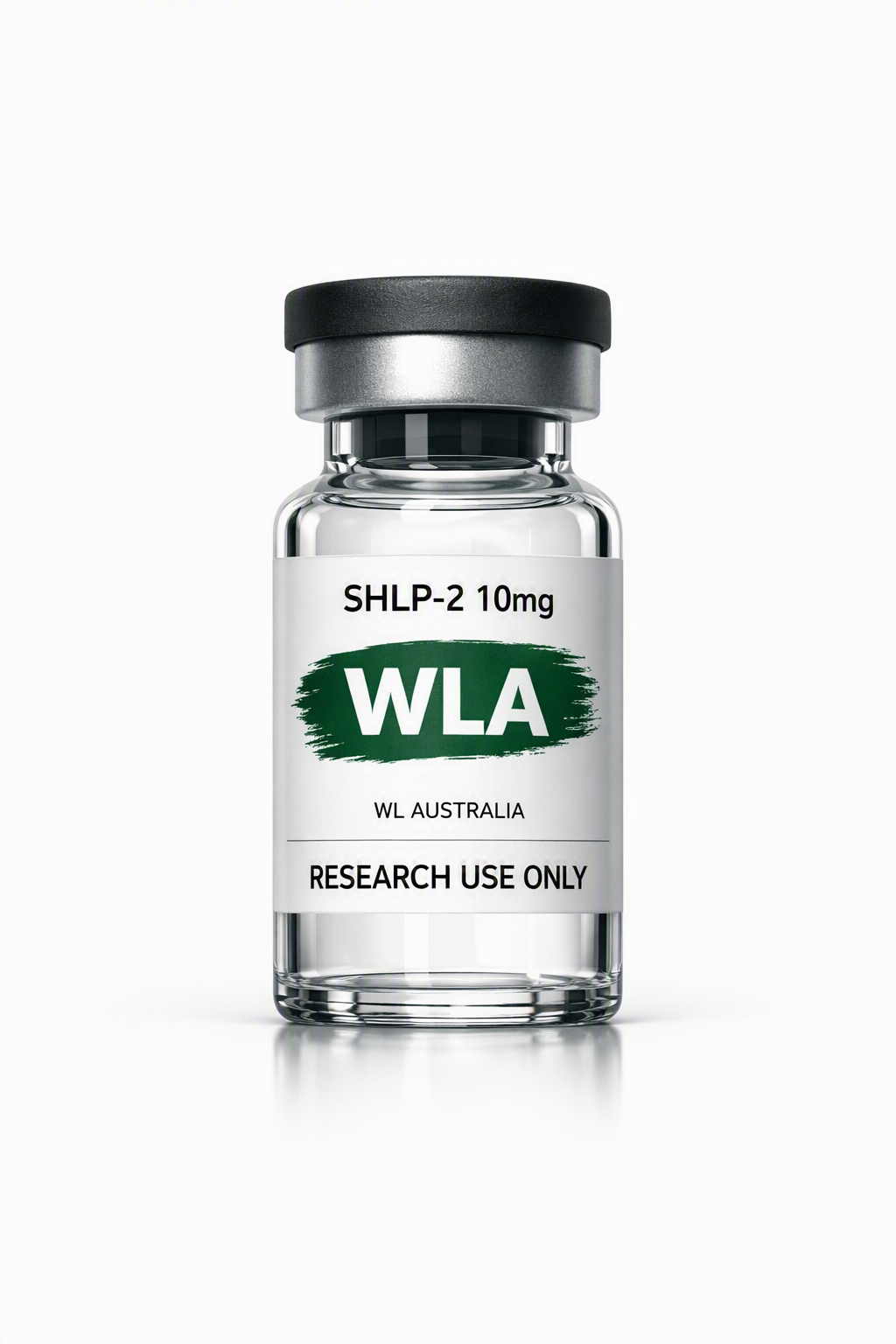
SHLP-2 receives much of the attention because its research profile is more developed. You can compare the two products through the SHLP-2 10mg product page.
| Research feature | SHLP-2 | SHLP-6 |
|---|---|---|
| Mitochondrial origin | Reported within the MT-RNR2/16S rRNA region | Reported within the MT-RNR2/16S rRNA region |
| Metabolic research | More direct preclinical research involving insulin sensitivity and glucose metabolism | Direct SHLP-6 metabolic evidence remains limited |
| Neuroprotection | Studied in models involving amyloid-beta toxicity and retinal degeneration | Neuroprotective relevance remains a research question rather than an established effect |
| Cell-survival profile | Often studied for cytoprotective effects | Reported in reviews as inducing apoptosis in several cell lines |
| Evidence level | Multiple cell and animal studies | More limited and less clearly defined |
| Human clinical evidence | Not established as a human therapy | Not established as a human therapy |
The key lesson is that these peptides should not be treated as interchangeable parts in a biological “stack”. They may share an origin, but their sequences, receptor interactions and cellular effects can differ.
Same family does not mean same function.
Why researchers study the SHLP family as a group
The problem: focusing on one peptide can hide the biological system
A single peptide may produce an interesting result, but researchers often learn more by studying the family together. This is similar to examining a car engine by looking at the fuel injector, timing system, cooling system and exhaust together, rather than testing one component in isolation.
Family-level research may compare:
- Amino-acid sequences
- Cellular location
- Secretion into circulation
- Receptor interactions
- Effects on mitochondria
- Oxidative stress markers
- Apoptosis and cell survival
- Glucose uptake and insulin signalling
- Changes across age, disease or metabolic stress
- Differences between tissues such as muscle, liver, brain and fat
This approach helps answer an important question: are SHLPs separate signals with distinct jobs, or are they overlapping parts of a larger mitochondrial stress-response network?
Researchers also need to confirm whether a detected peptide is genuinely produced by mtDNA, how stable it is in blood, how quickly it is broken down and whether laboratory measurements accurately distinguish it from similar sequences.
These are foundational issues. Before a peptide can be considered for clinical development, researchers need reliable identity, purity, pharmacology, toxicology and reproducible biological effects.
The research priority is verification before optimisation.
Two video placeholders
Video placeholder 1: Mitochondrial-derived peptides explained
[Insert approved educational video explaining mtDNA, microproteins and mitochondrial signalling]
Video placeholder 2: SHLP-2 and SHLP-6 research comparison
[Insert approved video comparing the current preclinical evidence for SHLP-2 and SHLP-6]
Australian safety and regulatory context
The problem: “research use only” does not make an unapproved peptide a medicine
In Australia, therapeutic goods are regulated by the Therapeutic Goods Administration (TGA). Products included on the Australian Register of Therapeutic Goods (ARTG) have been assessed under the relevant regulatory pathway.
SHLP-6 is not presented here as an ARTG-listed medicine. The product page identifies it as a research chemical only and states that it is not for human use.
You should not:
- Use SHLP-6 to self-treat diabetes, insulin resistance, neurological symptoms or cancer.
- Replace prescribed treatment with a research peptide.
- Interpret preclinical findings as proof of benefit.
- Assume that a product label establishes safety, efficacy or legality for personal use.
- Make decisions about an unapproved peptide without qualified medical and regulatory advice.
If you have concerns about blood glucose, memory, nerve symptoms, inflammation or fatigue, speak with a registered Australian health professional. A clinician can review your symptoms, medications, medical history and appropriate testing.
For broader background, see our article Mitochondrial Mojo: Powering Your Cellular Batteries with SS-31 and Humanin, browse the mitochondrial peptides collection, or explore the metabolism collection.
Final takeaway
SHLP-6 is an emerging mitochondrial-derived peptide with research interest in apoptosis, oxidative stress, inflammation and possible neuroprotective biology. Its mitochondrial DNA origin places it within a wider signalling family that includes SHLP-2, humanin and MOTS-c.
SHLP-2 currently has the stronger preclinical profile for insulin sensitivity and glucose metabolism. SHLP-6 should not be described as a proven metabolic or neuroprotective therapy. Instead, it represents a less-defined research subject that may help scientists understand how mitochondria communicate during metabolic and cellular stress.
Research first. Verify the mechanism. Respect the evidence.
 Immune Support, ant bacterial, anti viral, auto immune.
 Bioregulators
 Brain
 Skin & Hair Products