
IGF-DES Explained: How the 1-3 Truncation Changes IGF-1’s Behaviour in Tissue Research

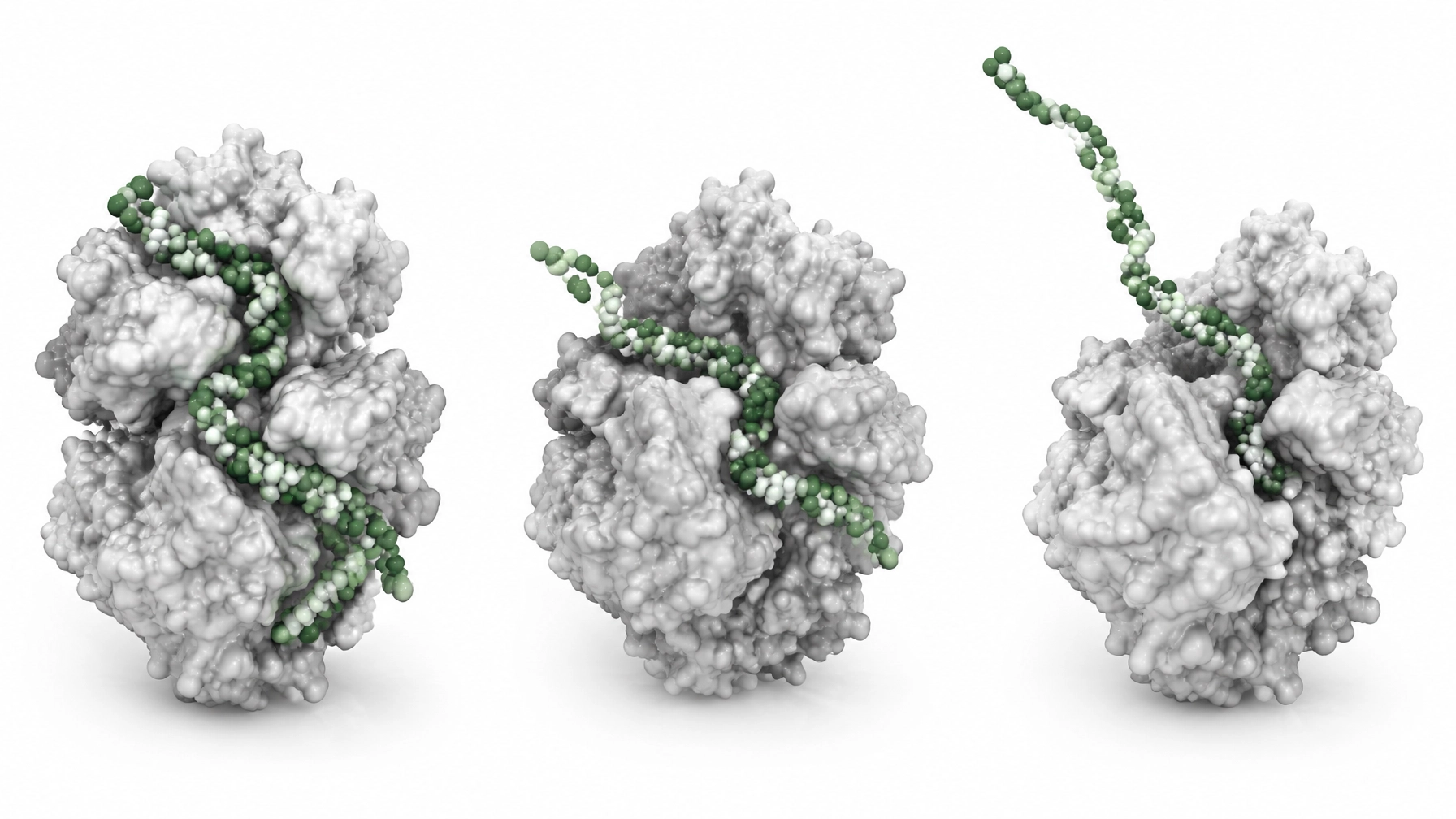
Conceptual illustration only; it is not a verified molecular structure of IGF-DES.
IGF-DES is often described by what it may do. But to understand the research rationale, start with what it is: an insulin-like growth factor 1 (IGF-1) analogue with three amino acids removed from one end of the molecule.
That small edit can change how the peptide interacts with its biological “carriers.” It may leave more of the molecule available to interact with cells in some experimental systems, while also reducing the time it remains in circulation. Think of it like removing a shipping label: a parcel may be easier to access, but it may also lose the packaging that helps protect it during transit.
This article focuses on that molecular trade-off, not on a human-use protocol. IGF-DES is a research compound, and preclinical findings do not establish a safe or effective treatment for people.
What does “DES 1-3” mean?
IGF-1 is a protein made from a chain of amino acids. Its first three amino acids sit at the N-terminus. The starting end of that chain. “Des(1-3)IGF-1,” commonly shortened to IGF-DES, means those first three residues have been deleted.
Picture a beaded necklace with 70 beads. IGF-DES is like the same necklace with its first three beads removed. The rest of the chain retains the broad IGF-1 structure, but that small change can affect how the molecule is handled by other proteins.

Conceptual representation only; molecular models are illustrative, not structural data.
Why does removing three residues matter?
In blood and tissues, IGF-1 interacts with a family of proteins called IGF-binding proteins (IGFBPs). These proteins can bind IGF-1, affecting how much is free to interact with its receptor and how long it persists in circulation. One useful analogy is a transport team: IGFBPs can carry and buffer IGF-1, but a bound molecule may not be immediately available to engage a cell.
Research indicates the N-terminal region contributes to IGFBP binding. Removing residues 1–3 reduces that interaction. This does not mean IGFBPs are simply “bad” blockers: binding proteins also help regulate transport and availability. Their role is more like a combination of carrier, storage system and traffic controller.
In cell experiments, IGFBPs inhibited the activity of intact IGF-1 more strongly than that of des(1-3)IGF-1. The truncated form retained activity at the type 1 IGF receptor (IGF-1R), the cell-surface receptor through which many IGF-1 signals are transmitted. A key point: increased activity in some assays appears to reflect reduced binding-protein sequestration, not necessarily a dramatic increase in receptor affinity. Results vary by cell type and experimental conditions. See the primary study on IGFBP inhibition of IGF-1 and des(1-3)IGF-1.

Conceptual illustration of molecular interactions; it does not depict a measured biological process or actual peptide structure.
The trade-off: more accessible does not mean longer-lasting
A carrier can limit immediate access while helping protect its cargo. That is the central trade-off in understanding IGF-DES.
With less binding to IGFBPs, a greater fraction of the peptide may remain free in certain research settings. But binding proteins also help extend the circulation time of intact IGF-1. When the protective association is reduced, the free peptide may distribute or be cleared more quickly.
A rat study using radiolabelled peptides reported a serum disappearance half-life of 20.5 ± 4.0 minutes for des(1-3)IGF-1, compared with 228.3 ± 22.0 minutes for intact IGF-1. These are animal findings, not a validated human half-life. They also do not establish how a particular research product behaves in people. The study is available through Endocrine Journal.
The implications for research design are straightforward:
- Potential advantage: reduced IGFBP binding can increase the free fraction available to interact with cells in some models.
- Potential limitation: less carrier protection can mean faster disappearance from circulation.
- Important caveat: effects depend on the model, tissue, dose, route and measurement method. A result in a cell dish or rodent cannot be directly translated into a human outcome.
A short half-life may lead researchers to examine different exposure schedules in preclinical work. That is not a dosing recommendation: experimental schedules are study-specific and should not be repurposed as instructions for human use.
IGF-DES and IGF-1 LR3: different modifications, similar binding-protein question
IGF-1 LR3 is another modified IGF-1 analogue. It includes an N-terminal extension and a substitution at position 3. It is commonly described in commercial material as “long-acting,” while IGF-DES is often associated with shorter persistence.
The structural distinction is real, but “longer-lasting” needs careful interpretation. Both analogues have reduced interactions with IGFBPs compared with intact IGF-1. Since IGFBP binding can prolong IGF-1’s circulation time, reduced binding alone does not guarantee a longer plasma half-life. Animal studies of LR3 have also reported rapid plasma clearance under certain conditions. In other words, “long-acting” may describe a product’s marketing or a particular experimental outcome; it should not be treated as a universal pharmacokinetic fact.
| Feature | Intact IGF-1 | IGF-DES | IGF-1 LR3 |
|---|---|---|---|
| Structural change | No truncation | First three N-terminal residues deleted | N-terminal extension and residue substitution |
| IGFBP interaction | Stronger binding in many settings | Markedly reduced binding in studied models | Reduced binding in studied models |
| Research question | Carrier-bound transport and receptor signalling | Whether reduced binding changes free availability and clearance | How a different structural modification affects binding and activity |
| Key caution | Binding can buffer activity and extend circulation | Higher activity in some assays does not prove human benefit | “Longer-acting” claims depend on the context and evidence |

Illustrative comparison only; this is not a verified structure or binding experiment.
For related background, see the IGF-1 LR3 and MGF-containing blend listing and WL Australia’s body-recomposition research article. These pages describe research products and topics; they are not evidence that a combination is clinically effective or safe.
What this means, and what it does not
The truncation helps explain why IGF-DES can appear more potent than intact IGF-1 in some laboratory assays: less binding to IGFBPs may leave more peptide available to interact with cells. But the same change may reduce carrier-mediated protection and shorten circulation time.
That is a useful research question, not a promise of targeted tissue effects. Reduced binding does not guarantee that activity stays local, nor does a stronger signal in one model establish a predictable effect in a person.
Video placeholder 1: A short animation showing the three-residue N-terminal deletion and how it may alter IGFBP interaction.
Video placeholder 2: A comparison of intact IGF-1, IGF-DES and IGF-1 LR3, highlighting structural differences and why circulation time depends on more than one feature.
Safety, regulation and research-only context
IGF signalling can affect multiple biological systems. The safety profile of IGF-DES in humans has not been established, and it should not be used to self-treat an injury, alter body composition or pursue muscle growth. Anyone with a health concern should speak with a registered clinician rather than attempting self-treatment with research compounds.
In Australia, the Therapeutic Goods Administration (TGA) explains that a “research use only” label does not automatically exempt a product from therapeutic-goods requirements. Its status depends on the product and how it is presented, supplied or used. See the TGA’s guidance on regulating therapeutic peptide products. IGF-1 and its analogues are also prohibited at all times under the 2026 World Anti-Doping Agency Prohibited List.
For research context only, visit the IGF-DES product listing. Product information is not medical advice and does not establish human safety or efficacy.
Bottom line: IGF-DES removes three amino acids from IGF-1’s N-terminus. That change reduces binding to IGFBPs in studied models, which can increase free-peptide availability while also removing some carrier-mediated protection. Its apparent potency and short persistence are two sides of the same molecular trade-off, and neither finding should be mistaken for a proven human benefit.
 Immune Support, ant bacterial, anti viral, auto immune.
 Bioregulators
 Brain
 Skin & Hair Products