
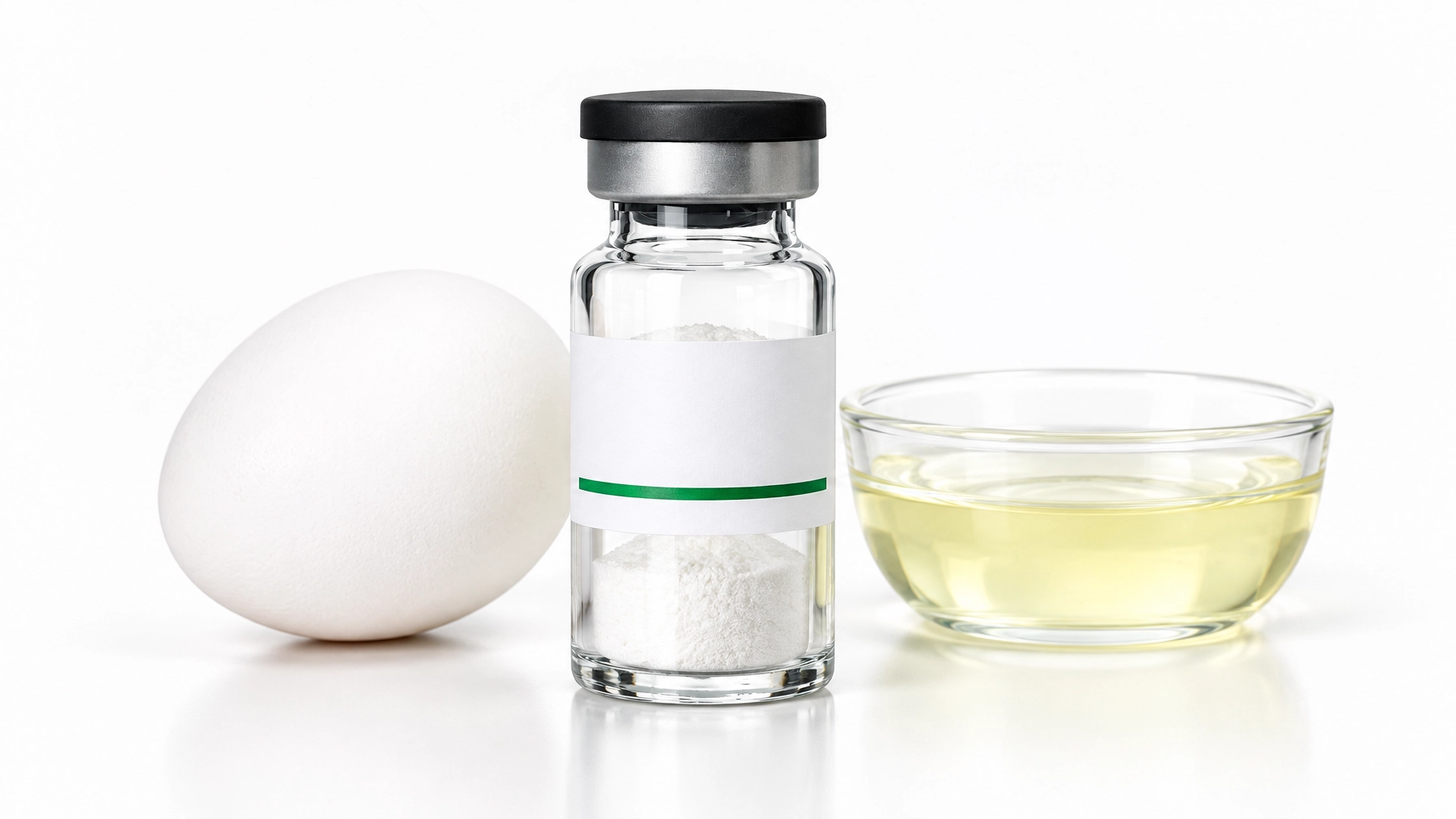
Ovotransferrin: The Egg-White Iron-Binding Protein for Immune and Antimicrobial Research

Ovotransferrin is an iron-binding glycoprotein found mainly in chicken egg white. It belongs to the transferrin family, a group of proteins that manage iron and help limit microbial growth.
It is sometimes described as an “egg-white peptide,” but that is not technically accurate. Ovotransferrin is a large protein, approximately 686 amino acids long. Understanding that distinction matters because proteins and short peptides behave differently in the body, in laboratory systems and in food formulations.
This article explains what ovotransferrin is, why researchers study it and how it may contribute to antimicrobial, immune, antioxidant, iron-metabolism and food-science research.
Video placeholder: Insert educational video: “Ovotransferrin explained, iron binding, nutritional immunity and antimicrobial research.”
What is ovotransferrin?
The problem is simple: many proteins in egg white are discussed as if they perform the same job. They do not.
Egg white, also called albumen, contains several proteins with different functions. Ovotransferrin, also known as conalbumin, acts like a highly specialised storage and security system. It can bind iron tightly, helping move or hold this mineral while making less of it available to unwanted microbes.
In the egg, this creates an important protective environment for the developing embryo.
Think of iron as a valuable building material at a construction site. Microbes need iron to build enzymes, replicate and maintain their cellular machinery. Ovotransferrin acts like a warehouse manager who locks much of that material away. The microbes may still be present, but access to a key resource becomes more difficult.
Key characteristics include:
- A transferrin-family glycoprotein
- Found predominantly in avian egg white
- Capable of binding up to two ferric iron ions, written as Fe³⁺
- Involved in iron transport and sequestration research
- Studied for antibacterial, antiviral and antifungal activity
- Investigated for antioxidant, anti-inflammatory and immunomodulatory effects
The research solution is to study ovotransferrin according to its real biology, not as a generic immune booster, and not as a short peptide.
Ovotransferrin, lactoferrin and serum transferrin: related but different
Ovotransferrin shares a common structural design with lactoferrin and serum transferrin. Each has two major lobes, and each lobe contains an iron-binding site. This is similar to a two-compartment transport vehicle: each compartment can carry one item of cargo.
However, their roles and locations differ.
| Protein | Main location | Primary biological emphasis | Research focus |
|---|---|---|---|
| Ovotransferrin | Chicken and other avian egg white | Egg defence and iron handling | Antimicrobial activity, food science and iron delivery |
| Lactoferrin | Milk, tears, saliva and other secretions | Mucosal defence and iron regulation | Immune modulation, microbial control and nutraceuticals |
| Serum transferrin | Blood circulation | Systemic iron transport | Iron delivery to tissues and iron-status regulation |
Transferrin can refer broadly to this protein family. Serum transferrin usually refers specifically to the circulating mammalian protein produced mainly by the liver.
Ovotransferrin and lactoferrin are structurally related, sharing roughly half of their amino-acid sequence identity. Yet they are not interchangeable. Different glycosylation patterns, surface charges and tissue environments influence how each protein behaves.
That distinction is essential when comparing laboratory results.

Iron sequestration and nutritional immunity
The central research problem is microbial access to iron.
Many bacteria, fungi and other microbes require iron for growth. Your body uses a defence strategy known as nutritional immunity, which means limiting access to essential nutrients during an immune challenge. Ovotransferrin contributes to this concept by binding iron so tightly that microbes have less available iron to use.
This does not mean ovotransferrin “kills every pathogen” or acts like an antibiotic medicine. In many experimental systems, the effect is better described as bacteriostatic, slowing or limiting microbial growth, rather than automatically destroying every organism.
The process works like this:
- Ovotransferrin encounters available iron.
- It binds ferric iron with high affinity.
- Free iron levels fall in the surrounding environment.
- Microbes face a more difficult growth environment.
- Researchers measure changes in microbial growth, viability or iron use.
Some microbes attempt to solve this problem by producing siderophores, which are molecules that capture iron for the microbe. Studying the interaction between ovotransferrin, iron and siderophores helps researchers understand how nutritional immunity works, and how microbes adapt.
Short summary: ovotransferrin does not simply “attack” microbes. It can change the resource environment around them.
Antimicrobial, antiviral and antifungal research
Ovotransferrin is studied across several areas of host-defence research.
Antibacterial research
Researchers investigate ovotransferrin against both Gram-positive and Gram-negative bacteria. These terms describe broad differences in bacterial cell-envelope structure.
Research models explore whether ovotransferrin:
- Reduces bacterial growth through iron deprivation
- Interacts with microbial surfaces
- Changes membrane permeability
- Works differently in iron-rich and iron-poor environments
- Produces different results when intact or enzymatically fragmented
The N-terminal lobe, or N-lobe, has received particular attention because it contains regions associated with antimicrobial activity. Smaller ovotransferrin-derived fragments are also studied separately. These fragments should not automatically be treated as equivalent to the complete protein.
Antifungal research
Fungal cells also depend on iron and other nutrients. Ovotransferrin is therefore investigated in models involving yeasts and fungi, with researchers examining both iron sequestration and direct surface interactions.
The outcome can depend on:
- The fungal species
- Iron concentration
- pH and temperature
- Protein concentration
- Whether the protein is intact or fragmented
- The surrounding food or biological matrix
Antiviral research
Antiviral research is more complex because viruses do not grow like bacteria. A virus enters host cells and uses the host’s machinery to replicate.
Studies examine whether ovotransferrin or its fragments can:
- Interfere with viral attachment
- Affect host-cell entry pathways
- Alter cellular antiviral signalling
- Influence nitric oxide or other immune-related responses
- Reduce viral activity in cell-culture models
These are laboratory findings, not proof that ovotransferrin prevents or treats viral infection in people. A cell-culture result is like testing a component on a workbench; it does not prove the entire vehicle is safe or effective on the road.
Antioxidant, anti-inflammatory and immune-cell research
Another frustration in biological research is separating direct antimicrobial effects from broader immune effects. Ovotransferrin is being studied in both areas.
Antioxidant research
Iron can participate in chemical reactions that generate reactive oxygen species, or ROS. ROS are highly reactive molecules that can damage lipids, proteins and DNA when they accumulate.
By binding iron, ovotransferrin may reduce the availability of iron that contributes to certain oxidative reactions. Researchers also study whether ovotransferrin can directly influence antioxidant systems in cells and food products.
This is one reason the protein is of interest in both biological and food-science research.
Anti-inflammatory research
Inflammation is not automatically harmful. It is more like a fire alarm: useful when controlled, damaging when it continues after the threat has passed.
Research investigates whether ovotransferrin can influence:
- Pro-inflammatory signalling
- Cytokine production
- Oxidative stress
- Barrier-cell responses
- The balance between immune activation and resolution
A cytokine is a signalling protein that helps immune cells communicate. Ovotransferrin may affect immune-cell activity indirectly through iron availability, oxidative balance and interactions with cell surfaces.
Immunomodulatory research
Immunomodulation means changing immune activity rather than simply switching it “on.” Research models explore whether ovotransferrin can influence macrophages, lymphocytes and other immune cells.
The scientific question is not simply, “Does it boost immunity?” A better question is:
Which cells respond, through which pathways, at what concentration and under what conditions?
This more precise approach is important because excessive immune stimulation can be as problematic as insufficient activity.

Iron metabolism and bioavailability studies
Iron is essential, but more is not always better. Your body must absorb, transport, use, store and recycle iron in a controlled system.
Ovotransferrin is studied as an iron carrier because its structure allows reversible iron binding. Researchers examine whether this protein can:
- Improve iron stability in a food matrix
- Influence iron absorption in simulated digestion systems
- Deliver iron across model intestinal barriers
- Reduce unwanted iron reactions
- Support the development of new iron-fortification formats
Bioavailability means the portion of a nutrient that becomes available for absorption and use. A food may contain iron, but that does not guarantee the body can access it efficiently.
Ovotransferrin may act like a protective delivery vehicle: it carries iron while reducing some of the uncontrolled reactions associated with free iron. However, results from simulated digestion or cell-barrier models do not establish a clinical treatment for iron deficiency.
If you suspect iron deficiency, use blood testing and clinician guidance, not an experimental protein.
Food science and nutraceutical relevance
Ovotransferrin has practical relevance beyond biomedical research.
Food scientists study it for:
- Natural antimicrobial preservation
- Functional food formulation
- Egg-white protein recovery
- Food packaging and surface coatings
- Iron-fortified products
- Protein purification and processing
- Nutraceutical ingredient development
A nutraceutical is a food-derived product studied or marketed for potential health-related value. Ovotransferrin is attractive in this field because it combines nutritional protein characteristics with iron-binding and antimicrobial research interest.
Researchers must still consider several practical issues:
- Egg allergy and allergen labelling
- Heat stability during processing
- Changes caused by pH
- Digestion and proteolysis
- Protein purity and batch consistency
- Iron saturation state
- Compatibility with other ingredients
- Australian food and therapeutic-product regulations
The food-science question is therefore not just, “Does ovotransferrin work?” It is, “Does it remain stable, safe and functional in the intended product?”
Ovotransferrin for laboratory research
You can view the Ovotransferrin 10mg product page for current product information. The listing identifies it as a research chemical only, not for human use.
For related background, explore our complete guide to immunity-building peptides and our article on AKG and mitochondrial metabolic research.
Ovotransferrin should be considered a protein research material. It is not a substitute for prescribed antibiotics, antifungals, antivirals, iron therapy or medical care.
Video placeholder: Insert laboratory handling video: “Ovotransferrin research workflow, sample preparation, iron-binding assays and responsible documentation.”
Safety, legal and handling notes
Ovotransferrin is not approved by this article as a treatment or supplement. Do not ingest, inject or self-administer a research-use product.
Before any human use of a protein ingredient, a qualified clinician and relevant regulatory professional should review:
- Intended route of administration
- Allergy history, especially egg allergy
- Product identity and purity
- Contamination and endotoxin testing
- Interactions with medicines
- Australian regulatory requirements
- Appropriate clinical evidence
In Australia, a product’s label, claims and intended use can affect how it is regulated. A substance sold for laboratory research is not automatically legal or appropriate for use in people.
Handle laboratory materials according to the supplier’s documentation, institutional procedures and applicable safety standards. Keep products away from children, pets and food-preparation areas.
Final takeaway
Ovotransferrin is not a short peptide and not a generic immune booster. It is a transferrin-family iron-binding glycoprotein from egg white with a distinctive role in nutritional immunity.
Its research value comes from several connected functions:
- Binding and sequestering iron
- Limiting microbial access to a key nutrient
- Supporting antibacterial, antiviral and antifungal investigation
- Influencing oxidative and inflammatory pathways
- Modulating immune-cell activity in experimental models
- Exploring new approaches to iron delivery and bioavailability
- Supporting innovation in food science and nutraceutical formulation
Think of ovotransferrin as both a courier and a security guard: it helps manage iron while making the environment less welcoming to microbes.
The strongest research path is disciplined and evidence-led: accurate classification, controlled experiments, proper testing and clinician oversight wherever human health is involved.
 Immune Support, ant bacterial, anti viral, auto immune.
 Bioregulators
 Brain
 Skin & Hair Products