
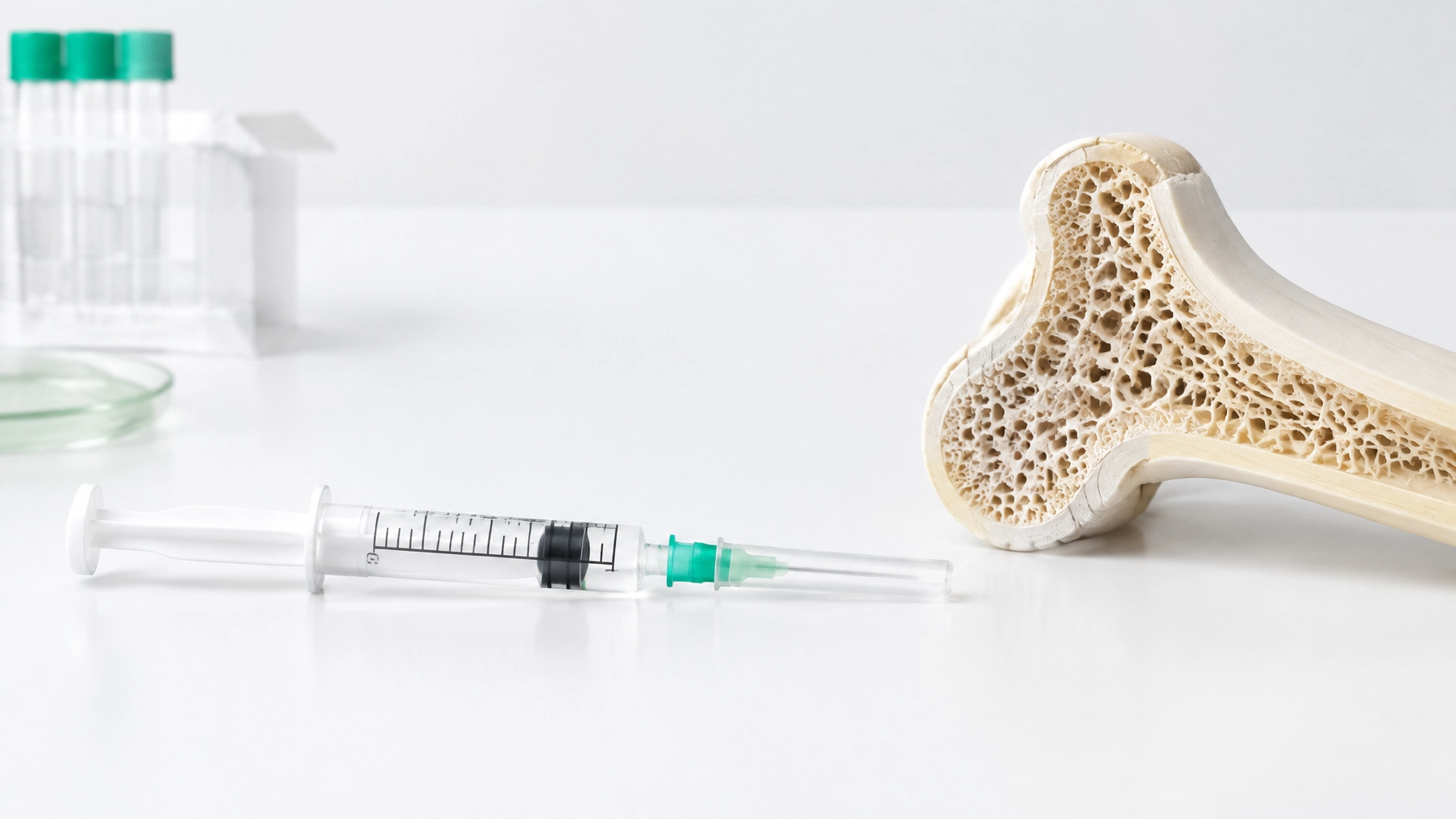
Romosozumab: The Sclerostin Inhibitor Rewriting Bone Formation Research

Important classification: Romosozumab is a humanised monoclonal antibody, not a peptide or supplement. In Australia, it is a registered Schedule 4 prescription medicine known as Evenity. It must be prescribed and monitored by a qualified clinician.
Bone is not an inert scaffold. It is a living tissue that constantly removes old material and builds new structure. Think of your skeleton as a construction site with two crews:
- Osteoblasts are the builders, producing new bone.
- Osteoclasts are the demolition team, removing older bone.
- Osteocytes are the site managers, sensing mechanical stress and coordinating the work.
When demolition consistently outpaces construction, bone mineral density falls and fracture risk rises. This is the central problem in osteoporosis.
Romosozumab is important because it targets a biological “brake” called sclerostin. By inhibiting that brake, it can increase bone formation while also reducing bone resorption. That dual effect makes it different from most osteoporosis medicines.
What is sclerostin?
The problem: bone formation needs a braking system
Your skeleton must not build bone without limits. Excessive or poorly controlled bone formation could disrupt normal structure. To regulate this process, mature osteocytes release sclerostin, a protein that helps reduce osteoblast activity.
Sclerostin acts like a site supervisor telling the builders to slow down. It reduces signals that encourage osteoblasts to produce new bone.
This is useful in normal bone maintenance. However, in osteoporosis, the balance may already be tilted toward bone loss. A strong formation brake can then contribute to declining structural strength.
The solution: temporarily release the brake
Romosozumab binds to sclerostin and prevents it from exerting its usual inhibitory effect. This allows bone-forming signals to become more active.
The result is not simply “more calcium in the bones”. It is a coordinated change in bone remodelling, including:
- Increased activity from bone-forming osteoblasts.
- Increased bone mineral density (BMD).
- Improved trabecular and cortical bone structure.
- Reduced osteoclast-associated bone resorption.
Short summary: Romosozumab does not replace bone biology. It changes the instructions being received by the bone-remodelling system.

How the Wnt pathway enters the picture
The problem: osteoblasts need a clear growth signal
One of the most important signalling systems in bone is the Wnt pathway. Wnt proteins act like messages passed between cells. When canonical Wnt signalling is active, it can promote the development and function of osteoblasts.
A simplified version looks like this:
- Wnt binds to receptors on an osteoblast-lineage cell.
- The signal involves the co-receptors LRP5 and LRP6, meaning low-density lipoprotein receptor-related proteins 5 and 6.
- The intracellular messenger β-catenin becomes more stable.
- Gene activity changes in a way that supports osteoblast differentiation and bone formation.
Sclerostin interferes with this process by interacting with the LRP5/6 receptor system. In practical terms, it partially closes the communication channel between the Wnt message and the bone-forming cell.
The solution: restore the signal
Romosozumab neutralises sclerostin, allowing Wnt signalling to proceed more effectively. The analogy is a zipper:
- Wnt signalling helps close the zipper between the biological instruction and the osteoblast response.
- Sclerostin pulls the zipper open.
- Romosozumab blocks sclerostin, helping the zipper stay closed.
This pathway is one reason romosozumab has attracted interest in bone biology research. It demonstrates how a targeted antibody can influence a complex tissue-level process through a specific extracellular regulator.
Why romosozumab has a dual effect
The problem: most osteoporosis therapies emphasise one side of remodelling
Many established osteoporosis medicines primarily reduce bone resorption. That can be highly valuable, but it is similar to slowing the demolition team without directly increasing the construction crew’s output.
Romosozumab is unusual because it has two effects:
| Bone process | Effect observed with romosozumab | Practical meaning |
|---|---|---|
| Bone formation | Increases, particularly early in treatment | More activity from the “building” side |
| Bone resorption | Decreases | Less bone removed during the treatment period |
| Bone mineral density | Increases at the spine and hip | Greater measured bone mass |
| Bone strength | Improves through changes in structure and density | Potentially lower fracture risk |
In the Australian product information, the bone-formation marker P1NP, procollagen type 1 N-terminal propeptide, rose rapidly after treatment began. The bone-resorption marker CTX, or type 1 collagen C-terminal telopeptide, fell.
This pattern is important. It resembles a construction project where new materials arrive quickly while demolition is also reduced.
The solution: use the anabolic window responsibly
The formation response is strongest early and is not intended to continue indefinitely. Australian prescribing information limits treatment to 12 monthly doses. After that, a clinician must plan transition to an antiresorptive therapy to help preserve the gains.
This is not a casual “cycle”. It is a time-limited prescription treatment strategy requiring diagnosis, monitoring and follow-through.
Core principle: Build, then maintain. The follow-on therapy is part of the treatment plan, not an optional extra.
VIDEO PLACEHOLDER 1, Mechanism explainer: Animated explanation of osteocytes, sclerostin inhibition, Wnt/β-catenin signalling, osteoblast activity and osteoclast regulation.
What did the clinical trials show?
FRAME: romosozumab followed by denosumab
The FRAME trial studied 7,180 postmenopausal women with osteoporosis. Participants received either romosozumab or placebo for 12 months, followed by denosumab. A separate antiresorptive monoclonal antibody commonly known by the brand name Prolia.
At 12 months:
- New vertebral fractures occurred in 0.5% of the romosozumab group compared with 1.8% of the placebo group.
- This represented a 73% relative reduction in new vertebral fracture risk.
- Clinical fractures were reduced by 36% during the first year.
By 24 months, after both groups transitioned to denosumab:
- New vertebral fracture risk remained 75% lower in the romosozumab-to-denosumab group than in the placebo-to-denosumab group.
The important lesson is sequencing. Romosozumab provided the initial bone-building phase; denosumab helped maintain suppression of bone resorption afterwards.
ARCH: romosozumab followed by alendronate
The ARCH trial involved postmenopausal women at particularly high fracture risk. Participants received romosozumab for 12 months followed by alendronate, or alendronate throughout.
Compared with alendronate alone, the romosozumab-to-alendronate sequence produced:
- 48% lower risk of new vertebral fracture at 24 months.
- 27% lower risk of clinical fracture.
- 19% lower risk of non-vertebral fracture.
- 38% lower risk of hip fracture.
This trial showed the potential advantage of beginning with a bone-forming treatment in selected, very-high-risk patients.
BRIDGE: evidence in men
The BRIDGE trial evaluated romosozumab in men with osteoporosis. Romosozumab increased BMD at the lumbar spine, total hip and femoral neck compared with placebo.
However, the trial was smaller than FRAME and ARCH. Cardiovascular events occurred more often in the romosozumab group, adding to the safety signal that clinicians must consider.
Research takeaway: The evidence supports substantial BMD gains and fracture reduction in selected populations, but treatment decisions must weigh cardiovascular risk individually.

Cardiovascular and calcium safety come first
The problem: effective biology can still carry risk
Romosozumab is not appropriate for everyone. In ARCH, myocardial infarction and stroke occurred numerically more often with romosozumab than with alendronate. FRAME did not show the same imbalance against placebo, so the exact cause remains uncertain.
Australian regulatory information includes strong cardiovascular warnings. Clinicians must assess cardiovascular history and risk before treatment. Romosozumab should not be initiated in patients who have had a myocardial infarction or stroke within the preceding year, and current Australian safety information should be checked for the most up-to-date contraindications.
Treatment should be stopped and urgent medical attention sought if symptoms of a heart attack or stroke occur.
Hypocalcaemia
Romosozumab can cause a temporary fall in blood calcium, particularly when calcium or vitamin D status is already inadequate.
Before treatment, a clinician should assess and correct:
- Hypocalcaemia, meaning low blood calcium.
- Vitamin D deficiency.
- Conditions affecting mineralisation, such as osteomalacia.
- Factors that increase risk, including severe kidney impairment or dialysis.
Patients may need clinician-directed calcium and vitamin D intake. Symptoms such as tingling around the mouth, muscle cramps or spasms require prompt medical advice.
Other risks listed in prescribing information include hypersensitivity reactions, injection-site reactions, rare osteonecrosis of the jaw and rare atypical femoral fractures. Dental health and unusual thigh, hip or groin pain should not be ignored.
VIDEO PLACEHOLDER 2, Clinical safety overview: Clinician-led discussion of cardiovascular screening, calcium and vitamin D assessment, dental considerations, monitoring and the 12-month treatment limit.
Australian regulatory and practical context
Romosozumab is not a research peptide and is not an over-the-counter supplement. In Australia, Evenity is a prescription-only medicine registered for osteoporosis in postmenopausal women at high fracture risk and for increasing bone mass in men with osteoporosis at high risk of fracture.
The Australian product information describes:
- 210 mg subcutaneously once monthly.
- Two 105 mg injections given at the same visit.
- A maximum course of 12 monthly doses.
- Required transition to an antiresorptive osteoporosis medicine afterwards.
Because Australia can experience significant heat, cold-chain handling matters. The medicine should be stored and transported according to the current product information and pharmacy instructions. Do not leave it in a hot vehicle, direct sunlight or an unattended mailbox. Do not freeze, shake or use a product with abnormal appearance.
A current Australian Product Information document should always take priority over older summaries. See the TGA Product Information database and the Australian Rheumatology Association romosozumab information.
Romosozumab in bone biology research
Romosozumab has helped researchers study several important questions:
- How osteocytes sense mechanical loading.
- How sclerostin regulates bone formation.
- How Wnt signalling influences osteoblast development.
- Why bone formation and resorption can change in opposite directions.
- How BMD relates to actual fracture protection.
- How an anabolic treatment should be followed by maintenance therapy.
It also reinforces a wider principle: bone health is a systems problem. Nutrition, resistance exercise, falls prevention, hormonal status, kidney function, vitamin D, medications and cardiovascular health all matter.
You can explore related WLA research articles such as Foundation of Strength: Sigumir and Bone Health Research and Ostarine and bone health research. These articles discuss broader musculoskeletal research, but they are not substitutes for approved osteoporosis treatment.
Product availability note
No dedicated romosozumab product page was identified in the current wlaustralia.com.au catalogue during research. Given that romosozumab is a registered prescription medicine, not a peptide or supplement, do not assume that a general catalogue listing represents supply, approval or suitability. Visit the wlaustralia.com.au website for current catalogue information and contact a qualified Australian clinician or pharmacist regarding approved treatment.
Final perspective
Romosozumab has changed the conversation around osteoporosis by showing that one targeted medicine can increase bone formation while reducing bone resorption. Its action is best understood as releasing a biological brake, restoring Wnt signalling and shifting the construction site toward stronger structural renewal.
But control requires discipline. Screen first. Monitor closely. Treat for the approved duration. Maintain the gains afterwards.
Romosozumab must be prescribed and administered under medical supervision. It is not for self-administration, self-treatment or experimentation. This article is educational only and does not replace a diagnosis, prescription or personalised advice from an Australian healthcare professional.
 Immune Support, ant bacterial, anti viral, auto immune.
 Bioregulators
 Brain
 Skin & Hair Products